FANUC Robots: 17-Model Lineup From 6kg Cobots to 1,700kg Arms
FANUC's 17-robot range spans a 283x payload gap, from 6kg delta pickers to a 1,700kg arm. The yellow giant has shipped over 1 million robots worldwide.
A single FANUC catalog stretches from a 6 kg delta picker to a 1,700 kg arm that lifts a small car - a 283x payload spread no other brand in our database matches. Seventeen models, six robot types, reaches from 650 mm to 3,734 mm, repeatability numbers as tight as 0.01 mm at the SCARA end, and speeds reaching 10,000 mm/s in the delta segment. If you are specifying a robot for any high-volume manufacturing application and FANUC is not on your shortlist, you are probably leaving performance, ecosystem depth, or long-term serviceability on the table. This guide works through all 17 models in our database, breaks down the spec picture by robot type, and maps each segment of the lineup to the applications where the yellow arms actually earn their place.
Who makes FANUC?
FANUC stands for Fuji Automatic Numerical Control. The company was founded in 1955 as a division of Fujitsu, entering the numerical-control business under the leadership of engineer Seiuemon Inaba. Inaba’s focus was machining control electronics, not robots - but the two disciplines were always converging. FANUC became an independent company in 1972, separating from Fujitsu with its own balance sheet and engineering roadmap. Two years later, in 1974, FANUC installed its first robots inside its own Japanese factories. The choice to deploy its own automation in its own production lines was not accidental. It was a commitment to proving the technology in the hardest possible environment: 24-hour volume manufacturing where uptime is revenue.
Today FANUC’s headquarters occupies a campus in Oshino-mura, a small village at the foot of Mount Fuji in Yamanashi Prefecture. The location is remote by design. The campus is largely self-contained, with housing, research labs, and production floors co-located. The factories there run what FANUC calls “lights-out” production: robots assembling robots, largely unattended through the night, requiring only occasional human intervention for maintenance and replenishment. The marketing significance of this is straightforward - when a customer asks whether FANUC’s robots are reliable enough for continuous-duty production, FANUC can answer with footage from its own factory. That answer is not available to every robot maker.
The business scale is significant across two product lines. First, CNC controllers: FANUC holds an estimated 65% share of the global CNC controller market. Machine tools in automotive, aerospace, and precision manufacturing around the world run FANUC control systems. Second, industrial robots: FANUC has shipped over one million robots worldwide, a number no other manufacturer has reached. The full catalog spans 21 series and over 100 models, with payloads reaching approximately 2,300 kg and arm reaches up to roughly 4.7 m. Primary markets are automotive body manufacturing, electronics assembly, general fabrication, machine tending, arc and spot welding, palletizing, and CNC machine tending. In all of those sectors, FANUC competes near the top of the install-base rankings in every major industrial region.
The CNC heritage matters more than it might appear at first. FANUC’s R-30iB controller - the brain of most current FANUC robots - draws from decades of CNC control architecture. Motion planning, interpolation accuracy, and deterministic cycle timing are core competencies baked into the hardware. That background shows up in the repeatability numbers: the median across our 17-robot sample is 0.04 mm, and several models reach 0.01-0.02 mm. Those numbers are competitive with any robot maker on the market. See the full FANUC series overview for the complete picture beyond the 17-robot subset we cover here.
What types of robots does FANUC make?
Our 17-robot sample spans six distinct robot types. Articulated robots are the plurality at 41%, but the collaborative robot segment - the CRX series - is the fastest-growing part of the catalog and accounts for nearly 30% of the sample. The remaining 29% covers palletizers, a welding specialist, a delta picker, and a SCARA.
Articulated arms (7 models, 41%). The articulated robot segment is FANUC’s broadest, covering the M-10iD/12, M-20iD/25, M-710iC/50, R-2000iC/165F, M-900iB/400L, LR Mate 200iD/7L, and M-2000iA/1700L. Payloads in this group run from 7 kg to 1,700 kg. These are 6-axis general-purpose arms, suited to machine tending, pick-and-place, spot welding, assembly, and material handling. The defining characteristic is flexibility: a 6-axis articulated arm can reach into a CNC machine, rotate a part, present it to a vision system, and place it on an outfeed conveyor - all in one robot cell. The trade-off is cost and cell complexity relative to purpose-built geometries like delta or SCARA.
Cobots (5 models, 29%). The CRX series - CRX-10iA, CRX-10iA/L, CRX-20iA/L, CRX-25iA - and the older CR-35iB form FANUC’s collaborative lineup. These are force-limited arms designed for fenceless deployment under ISO/TS 15066. The CRX generation uses a drag-and-drop tablet interface called CRX Teach App, which is significantly more accessible than FANUC’s traditional TP pendant for non-specialist operators. Payloads range from 10 kg to 50 kg. The CR-35iB at 50 kg is one of the heaviest collaborative arms on the market from any manufacturer. Repeatability across the cobot segment clusters at 0.04-0.08 mm, which covers most assembly, tending, and inspection tasks.
Palletizers (2 models, 12%). The M-410iB/700 and M-410iC/185 are purpose-built end-of-line stacking arms. The geometry is different from a standard 6-axis: these are 4-axis designs optimized for the repetitive vertical-reach cycle of picking cases from a conveyor and placing them on a pallet. Four-axis design reduces inertia and cycle time for this specific motion profile. The 3,143 mm reach on both models covers a Euro pallet with standard layer-building clearance. Repeatability at 0.50 mm is deliberately relaxed relative to precision assembly - a case does not need to land within 0.05 mm to be stacked correctly.
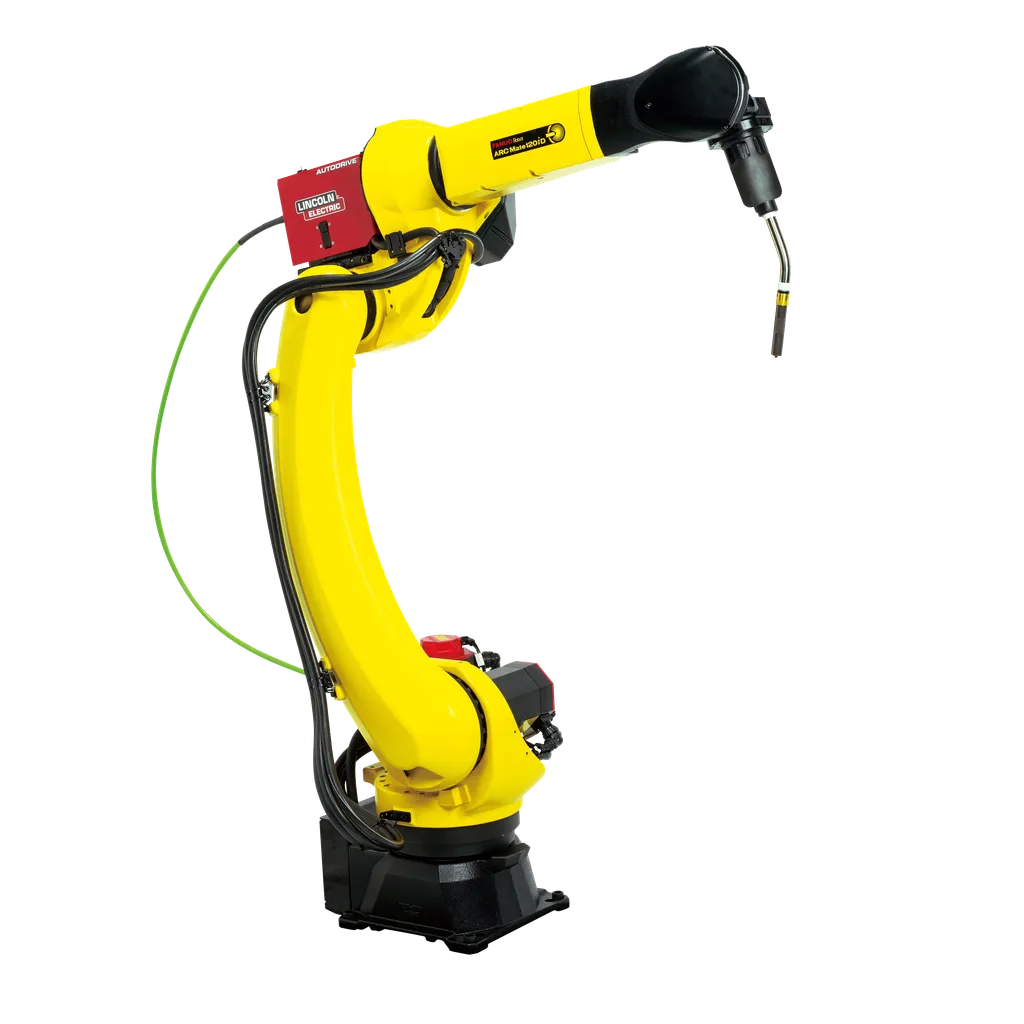
Welding (1 model, 6%). The ARC Mate 120iD is a dedicated arc welding arm, not a general-purpose arm with a torch attached. The 20 kg payload accommodates a welding torch plus optional seam-tracking sensor. The 1,831 mm reach covers most medium-size weld fixtures. Repeatability at 0.03 mm supports consistent bead placement where weld quality is dimensionally inspected. FANUC integrates its arc welding process software - arc start/end conditions, weave patterns, seam tracking - at the controller level, not as a third-party add-on. The ARC Mate series extends beyond this single model to cover spot welding and heavier arc applications.
Delta (1 model, 6%). The M-3iA/6S is a delta robot, an overhead-mount parallel-link arm designed for high-speed pick-and-place on conveyors. At 10,000 mm/s maximum speed, it operates in a completely different performance band from every other robot in the sample. The 6 kg payload and 1,350 mm working diameter suit food sorting, pharmaceutical blister-pack loading, and small electronics kitting. Delta geometry means compact vertical stroke and very high acceleration - the delta’s strength is not reach or payload but cycle rate.
SCARA (1 model, 6%). The SR-6iA is FANUC’s SCARA robot in this sample: a 6 kg, 650 mm reach arm with 0.01 mm repeatability and 4,000 mm/s speed. SCARA geometry - horizontal-plane articulation with a vertical Z axis - is best suited to bench-scale tasks where the work volume is compact, vertical motion is limited, and precision is the primary requirement. Electronics assembly, small-part insertion, precision dispensing, and laboratory automation are the core SCARA applications. The 0.01 mm repeatability here is the tightest number in the entire 17-robot FANUC sample.
One gap worth flagging: our 17-robot database sample carries no IP rating data. Zero models publish IP67 or IP69K ratings. This does not mean FANUC offers no sealed variants - it means our current data set does not include them. Buyers in food, beverage, pharmaceutical, or any washdown-intensive environment must verify ingress protection directly with FANUC or a certified integrator before specifying. Do not assume sealing capability from the standard catalog sheet.
Payload range: 6 kg to 1,700 kg - which FANUC arm carries the most?
The M-2000iA/1700L stands alone at 1,700 kg payload and 3,734 mm reach. Nothing else in our 17-robot sample comes within a factor of two. The second-heaviest robot, the M-410iB/700, is a palletizer at 700 kg - 41% of the M-2000iA’s capacity. The M-900iB/400L sits at 400 kg with the second-longest reach in the sample at 3,704 mm. These three heavy-end machines represent a capability tier - automotive stamping plant, casting foundry, structural steel - that most robot makers do not address at all. FANUC addresses it with multiple models.
The bar chart below shows all 17 robots sorted lightest to heaviest. The scale is 0-1,700 kg, which means most of the sample’s bars are narrow. That is the point: the visual makes clear how extreme the M-2000iA outlier is relative to the rest of the lineup.
Source: Industrial Robotics Hub database, 17 FANUC robots.
The payload distribution is distinctly bimodal. Eleven of the 17 robots sit below 50 kg - the light-end cluster covering all five cobots, the four small articulated arms, the delta picker, and the SCARA. The remaining six span 50 kg to 1,700 kg. The median payload across the full 17-robot sample is 25 kg, which corresponds to the M-20iD/25. That number is a useful anchor for spec comparisons: half the lineup handles tasks a mid-weight cobot could theoretically attempt, and half handles tasks that require an industrial-class machine with a safety fence.
Reach follows a similar distribution. The SR-6iA SCARA bottoms out at 650 mm - a bench-mount precision arm with a tight working radius. The M-2000iA/1700L tops out at 3,734 mm, nearly 12 feet of reach, which is necessary when handling complete automotive body panels or large structural frames where the robot must reach across the full part without repositioning. Seventeen robots, 650 mm to 3,734 mm, one controller family. That architectural consistency is one of FANUC’s competitive advantages: a maintenance engineer familiar with the R-30iB controller can work on the LR Mate and the M-2000iA without retraining on a different platform.
Speed tells a more nuanced story. The 10,000 mm/s delta is in its own category. Among the articulated and cobot arms, speeds run from 1,000 to 4,000 mm/s. The SCARA and LR Mate hit 4,000 mm/s, making them the fastest non-delta arms in the sample. The heavy articulated arms - M-2000iA/1700L at 1,300 mm/s, M-900iB/400L at 1,500 mm/s - are slower, as expected for machines moving hundreds or thousands of kilograms. The palletizers run at 3,000 mm/s despite their large payload capacity, a consequence of their purpose-built 4-axis geometry: less mass in motion than a full 6-axis arm at the same payload.
FANUC performance specs at a glance
The table below summarizes the six robot types in our sample by key performance metrics. All figures are computed from the 17-robot database slice, not from FANUC’s full catalog.
| Type | Robots | Payload median (kg) | Repeat median (mm) | Speed range (mm/s) | IP67+ |
|---|---|---|---|---|---|
| Articulated | 7 | 50 | 0.05 | 1,300-4,000 | 0% |
| Cobot | 5 | 20 | 0.04 | 1,000-2,000 | 0% |
| Palletizer | 2 | 443 | 0.50 | 3,000 | 0% |
| Welding | 1 | 20 | 0.03 | 2,000 | 0% |
| Delta | 1 | 6 | 0.10 | 10,000 | 0% |
| SCARA | 1 | 6 | 0.01 | 4,000 | 0% |
The repeatability gradient across types is worth examining closely. The SCARA at 0.01 mm sits at the precision end. The welding arm at 0.03 mm and the M-series articulated arms at 0.02-0.05 mm form the mid-precision cluster. The cobots at 0.04 mm are marginally less precise than the equivalent M-series arms, which is consistent with the different mechanical designs - force-sensing cobots have compliant joints that trade some stiffness for safety. The palletizers at 0.50 mm are deliberately de-tuned: pallet layer tolerance is typically 5-10 mm, so 0.5 mm is more than adequate, and the relaxed spec allows the controller to prioritize speed over settling time. The delta at 0.10 mm is between the cobot and palletizer tiers - fast pick-and-place applications need good repeatability but not SCARA-level precision.
The speed column shows the inverse correlation with payload that engineers would expect: heavier arms move slower. The delta breaks this pattern by being both light and extreme-speed, which is the entire point of delta geometry. The 4,000 mm/s SCARA is similarly decoupled from the payload-speed trade-off because SCARA joints operate in the horizontal plane under lower gravitational loading than a 6-axis arm reaching overhead.
The IP67+ column is a flat zero across every type. This represents a data gap in our current database, not a definitive product gap. FANUC offers specialist washdown-rated variants in some series. Buyers with ingress-protection requirements should treat this column as “unverified” rather than “absent” and confirm directly with FANUC’s application engineering team.
Complete FANUC robot lineup
All 17 robots in the Industrial Robotics Hub database, sorted by payload descending. Models link to their individual spec pages.
| Model | Type | Payload (kg) | Reach (mm) | Repeat (mm) | Max Speed (mm/s) | IP |
|---|---|---|---|---|---|---|
| M-2000iA/1700L | articulated | 1,700 | 3,734 | 0.27 | 1,300 | - |
| M-410iB/700 | palletizer | 700 | 3,143 | 0.50 | 3,000 | - |
| M-900iB/400L | articulated | 400 | 3,704 | 0.15 | 1,500 | - |
| M-410iC/185 | palletizer | 185 | 3,143 | 0.50 | 3,000 | - |
| R-2000iC/165F | articulated | 165 | 2,655 | 0.05 | 2,000 | - |
| CR-35iB | cobot | 50 | 1,813 | 0.08 | 1,500 | - |
| M-710iC/50 | articulated | 50 | 2,050 | 0.07 | 2,000 | - |
| CRX-25iA | cobot | 30 | 1,889 | 0.04 | 1,500 | - |
| M-20iD/25 | articulated | 25 | 1,831 | 0.03 | 2,000 | - |
| ARC Mate 120iD | welding | 20 | 1,831 | 0.03 | 2,000 | - |
| CRX-20iA/L | cobot | 20 | 1,418 | 0.04 | 1,500 | - |
| M-10iD/12 | articulated | 12 | 1,441 | 0.02 | 2,000 | - |
| CRX-10iA | cobot | 10 | 1,249 | 0.04 | 1,000 | - |
| CRX-10iA/L | cobot | 10 | 1,418 | 0.04 | 2,000 | - |
| LR Mate 200iD/7L | articulated | 7 | 911 | 0.02 | 4,000 | - |
| M-3iA/6S | delta | 6 | 1,350 | 0.10 | 10,000 | - |
| SR-6iA (SCARA) | scara | 6 | 650 | 0.01 | 4,000 | - |
A few spec notes on models that raise questions during specifying. The CRX-10iA and CRX-10iA/L are the same payload (10 kg) on two reach variants: 1,249 mm for the compact version and 1,418 mm for the long variant. Speed differs too - 1,000 mm/s on the standard, 2,000 mm/s on the /L. Choose based on cell geometry first, then verify whether the speed difference matters for your cycle time budget. The M-410iB/700 and M-410iC/185 share identical reach and speed but differ enormously in payload - the iB is for full-pallet manipulation, the iC for individual case layers. The M-20iD/25 and ARC Mate 120iD share identical reach (1,831 mm) and speed (2,000 mm/s) but differ in purpose: one is a general-purpose arm, the other is a welding specialist with process integration built in.
The ARC Mate series page covers the welding arm family in detail beyond this sample. The full FANUC robot catalog lists all series and models, including variants outside our 17-robot database slice.
Which FANUC robot fits your application?
You need to lift automotive bodies or castings over one tonne.
The M-2000iA/1700L at 1,700 kg payload and 3,734 mm reach. This arm belongs in a class of machines that most robot buyers never consider because most parts do not weigh a metric ton. In automotive body shops, stamping plants, and large casting foundries, moving whole assemblies between stations is a real problem. Gantry cranes are slow and require human operators. The M-2000iA replaces that workflow with a programmable arm that repeats at 0.27 mm - fine for structural transfers, not appropriate for precision fixturing, but that is not the application. The 3,734 mm reach puts the gripper roughly 12 feet from the robot base, which clears most automotive body dimensions with room for tooling.
Nothing else in our 17-robot database approaches this capability. The M-900iB/400L at 400 kg and 3,704 mm reach is the nearest analog, useful for large but not extreme-weight handling tasks. Both of these machines require substantial foundation work, safety infrastructure, and integrator expertise. They are not weekend deployments. But for plants that need this capability, FANUC is one of a small number of manufacturers who can supply it.
You are building a high-throughput palletizing line for a distribution center or warehouse.
The M-410iB/700 for full-pallet manipulation, or the M-410iC/185 for case-level layer building. Both run at 3,000 mm/s and reach to 3,143 mm, which covers a Euro pallet plus approach clearance. The 4-axis palletizer geometry produces faster cycle times than a 6-axis arm doing the same job, because fewer joints means less inertia to accelerate and decelerate on each cycle. In a plant running 24-hour shifts with continuous case flow from production, those fractional seconds per cycle compound into significant daily output differences.
The 0.50 mm repeatability on both models is a feature, not a flaw. Relaxed repeatability tolerances allow the controller to optimize for speed rather than precision settling time. A pallet layer that lands within 10 mm of target is stacked correctly; there is no value in spending cycle time achieving 0.05 mm on a cardboard case. The 700 kg capacity on the iB model is primarily relevant for pallet transfers rather than single-case picking - no individual case weighs 700 kg. The 185 kg iC model is the workhorse for most FMCG and food distribution applications.
You run arc welding production and need a robot that understands the process, not just the motion.
The ARC Mate 120iD at 20 kg payload and 1,831 mm reach. The 0.03 mm repeatability supports bead-to-bead consistency that holds up under downstream dimensional inspection. FANUC’s welding software integrates arc start/end parameters, weave patterns, and touch sensing directly at the controller level, not as a separately-licensed module that communicates over a serial link to the robot controller. That integration reduces the latency and communication failure modes that add complexity to third-party welding packages on general-purpose arms.
The 20 kg payload accommodates a MIG or TIG torch plus a seam-tracking laser sensor with margin. The 1,831 mm reach covers most medium-size weld fixtures - truck frame sections, structural steel joints, exhaust manifolds. For larger structures or spot welding, the broader ARC Mate series includes heavier and longer-reach variants not in our current sample.
You need a collaborative robot for assembly or machine tending without a fixed safety fence.
The choice within FANUC’s cobot lineup depends primarily on payload and reach requirements. For most bench-scale assembly and machine-tending tasks in the 10-30 kg range, the CRX-25iA at 30 kg payload and 1,889 mm reach is the strongest performer in the sample. It hits 0.04 mm repeatability, which covers most precision assembly tasks. The 1,889 mm reach is enough to service most CNC machine envelopes without repositioning the robot base.
For lighter tasks or tighter spaces, the CRX-10iA/L at 10 kg and 1,418 mm reach offers more workspace than the standard CRX-10iA (1,249 mm) while sharing the same 0.04 mm repeatability. The extra reach matters in cells where the robot must reach across a fixture or machine opening. The CRX-10iA/L also runs at 2,000 mm/s versus the standard CRX-10iA at 1,000 mm/s - that speed difference is meaningful for applications where the cobot is running rapid transfer cycles between positions.
The CR-35iB at 50 kg is the heaviest collaborative arm in the sample - heavier than Universal Robots’ UR20 at 20 kg, and heavier than most competitor cobots. At 0.08 mm repeatability, it trades some precision for payload capacity. The CR-35iB is best suited to heavy-part machine tending, large-component assembly, and material handling tasks where the collaborative deployment mode (no fixed guarding) is required but where parts exceed what a standard cobot can handle.
One consideration specific to FANUC cobots: the CRX series uses FANUC’s tablet-based CRX Teach App for programming, which is significantly more accessible than the traditional TP pendant for line technicians who are not FANUC-trained programmers. The CR-35iB predates the CRX platform and uses the standard pendant. If operator accessibility matters - particularly for frequent changeover or non-specialist programming - factor that interface difference into your platform selection.
You need maximum pick rate for food sorting, pharma blister packing, or small electronics kitting.
The M-3iA/6S delta at 6 kg payload and 10,000 mm/s. Delta geometry - an overhead parallel-link mechanism - produces cycle rates that 6-axis articulated arms cannot match on short-stroke pick-and-place. The M-3iA/6S is capable of over 100 picks per minute in optimized conditions, depending on part presentation, vision cycle time, and gripper design. The 1,350 mm working diameter covers most single-lane conveyor applications.
Important caveat: our database carries no IP rating data for this model. Food applications frequently require periodic washdown of the robot and surrounding equipment. Before specifying the M-3iA/6S for any food or pharmaceutical application with cleaning cycles, confirm the sealing rating with FANUC’s application engineering team. Do not assume IP67 from the standard spec sheet.
Your application requires the tightest positional accuracy available in the FANUC lineup.
The SR-6iA SCARA robot at 0.01 mm repeatability, 6 kg payload, 650 mm reach, and 4,000 mm/s. The 0.01 mm figure is the best repeatability in our entire 17-robot sample - tighter than any articulated arm, any cobot, and the welding specialist. SCARA geometry - horizontal-plane rotation with a vertical Z stroke - benefits from lower gravitational loading on the joints, which contributes to tighter positioning. The 650 mm reach limits the working envelope to a compact zone suitable for bench-top electronics assembly, precision dispensing, small-part insertion, and laboratory automation. If your process tolerance demands sub-0.02 mm repeatability and your parts fit within a 650 mm radius, the SR-6iA is the arm to specify.
You run traditional machine tending with caged cells and need proven M-series performance.
The M-20iD/25 at 25 kg and 1,831 mm reach, or the M-10iD/12 at 12 kg and 1,441 mm for smaller parts. Both hit 0.02-0.03 mm repeatability at 2,000 mm/s. These are not collaborative machines - they run behind safety fencing at full industrial speed. The M-series arms are the workhorses of FANUC’s lineup, the robots that populate dense machine-tending cells at automotive tier-one suppliers and electronics factories worldwide. Their advantage is not novelty - it is proven uptime, broad integrator familiarity, and deep spare-parts availability in every major industrial region.
The R-2000iC/165F at 165 kg and 2,655 mm reach occupies the mid-heavy tier: too large for small-part assembly, but well-suited to automotive body panel tending, large casting handling, or spot welding applications where 165 kg of wrist payload is needed to carry a heavy gun plus fixtures.
The bottom line
FANUC is the right brand when you need scale, ecosystem depth, and a service network that does not require you to bet on a smaller player’s support infrastructure. More than one million robots shipped is not a marketing number - it means spare parts are stocked in-country, trained service engineers exist in every major industrial region, and integrators in virtually every market know the platform cold. The FANUC robot lineup is the broadest on the market, which matters during long-term specifying: if you need a 6 kg picker this year and a 165 kg machine tender next year, both run on the same R-30iB controller architecture, the same KAREL and TP programming environment, and the same service contract structure. Standardizing on one controller family across a mixed robot fleet reduces training burden and spare-parts inventory.
The data from our 17-robot sample reinforces what the full catalog reflects: FANUC engineers for range. The 0.01 mm SCARA and the 1,700 kg heavy lifter are not different companies’ products stitched together through an acquisition - they run the same controller, share the same teach methodology, and are supported through the same global service organization. That platform consistency is a real operational advantage for a plant running six robot types across multiple production lines. An operator comfortable on one FANUC arm has a head start on every other FANUC arm in the facility.
The case against FANUC breaks down into three categories. First, price. FANUC is not a budget brand. The CRX cobots are competitive on capability but sit at or above midrange pricing compared with equivalent-payload Chinese collaborative arms. Buyers who need 10 kg payload for straightforward tasks and are working within tight capital budgets will find better economics from several Chinese and Korean alternatives. Second, programming accessibility on the traditional M-series. The TP pendant and KAREL programming language have a steeper learning curve than the drag-and-drop interfaces of newer cobot platforms. For plants that need frequent product changeover programmed by line technicians, the CRX series with its tablet interface is a better match; the traditional M-series requires trained FANUC programmers, which has a staffing cost. Third, washdown environments. The IP rating gap in our 17-robot sample is a genuine specification concern for food, beverage, pharma, and chemical applications. FANUC does not market the standard catalog as washdown-ready, and our data confirms zero IP67+ entries in this sample. That does not make FANUC wrong for washdown environments - it means buyers need to explicitly specify IP protection requirements and confirm compliance with FANUC’s engineering team before purchasing.
For automotive body manufacturing, heavy general fabrication, electronics volume production, high-throughput palletizing, and precision machine tending - FANUC’s core market segments - the combination of ecosystem depth, install base scale, service infrastructure, and the breadth of the lineup makes it the default serious consideration. Every other brand in our database competes against parts of the FANUC catalog. No other brand competes against all of it simultaneously.
The spec table in this guide is your starting filter. Match your payload requirement to the appropriate model tier. Check the reach against your cell geometry. Verify repeatability against your process tolerance. Confirm speed against your target cycle time. And for any washdown, food-grade, or IP-sensitive application, treat the IP column as an open action item rather than a confirmed spec. Once those four checks pass, request a cycle-time simulation and cost model from a FANUC-certified integrator. The numbers in our database give you the entry point for that conversation.
Browse the complete FANUC robot series directory for additional models beyond our 17-robot sample, including heavier ARC Mate variants, additional SCARA configurations, and the full M-2000 heavy-payload series. The FANUC Wikipedia entry covers the company’s corporate history and CNC market context in depth for buyers who want to understand the business before signing a multi-year supply agreement.
Compare these robots