The Fastest Robot We Track Isn't a SCARA Anymore
A 110 kg Staubli arm now hits 14,000 mm/s tip speed in our robot database, 22% faster than the SCARA that held our speed record two months ago.
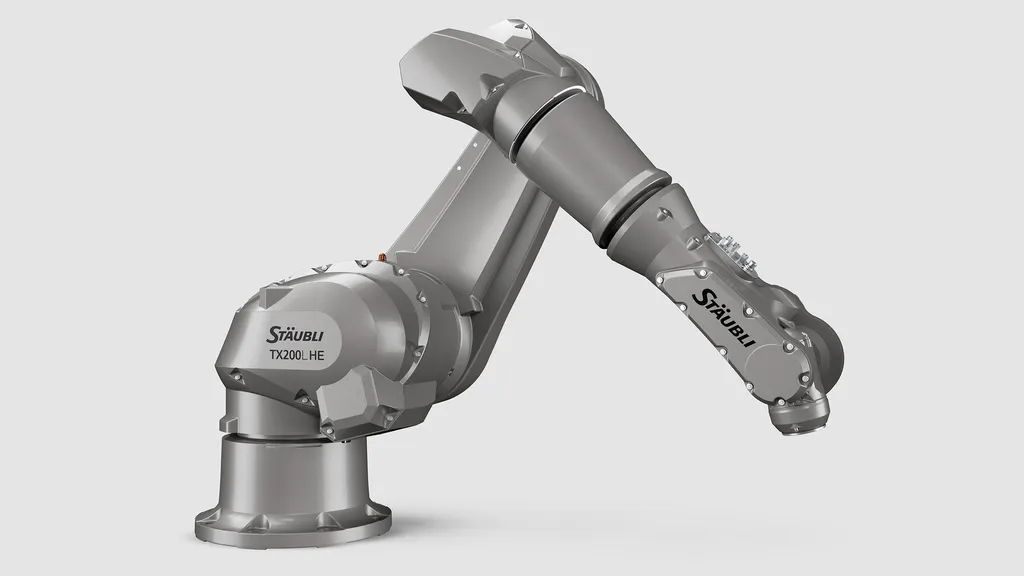
Our fastest-tracked robot changed, and the new record holder breaks the pattern we published two months ago. In June, the fastest published tool-tip speed in the Industrial Robotics Hub database belonged to a 20 kg SCARA, the Epson G20, at 11,000 mm/s. The database has grown since then, and a new robot now tops that table: the Stäubli TX2-200L, a 110 kg-payload six-axis arm, at 14,000 mm/s. That is 22% faster than Epson’s own current published figure for the G20 (11,500 mm/s). A robot built to move pallets is now the fastest thing in our catalog, not a lightweight pick-and-place machine.
Which robot is the fastest we track now?
The Stäubli TX2-200L, at 14,000 mm/s (14 m/s). Its shorter-reach sibling, the Stäubli TX2-200, carries 170 kg and hits 12,000 mm/s. Both figures come straight from Stäubli’s own TX2-200 / TX2-200L product data sheet (PDF), which lists “maximum speed at load gravity center” as 14 m/s for the -200L and 12 m/s for the -200 - we pulled the PDF directly rather than trust the stored database value.
Neither robot is small. The TX2-200L has a 2,609 mm reach and is built for long-reach palletizing and large-part handling, the same job category as the “palletizer” class we found stuck at a comparatively pedestrian 3,000 mm/s median in our original speed post. The TX2-200 carries 170 kg, the heaviest payload of any robot in our top-10 speed ranking by a wide margin.
| Robot | Type | Max TCP speed | Payload |
|---|---|---|---|
| Stäubli TX2-200L | Articulated | 14,000 mm/s | 110 kg |
| Stäubli TX2-200 | Articulated | 12,000 mm/s | 170 kg |
| Epson G20 | SCARA | 11,000-11,500 mm/s | 20 kg |
| Stäubli TX2-90 | Articulated | 10,900 mm/s | 7 kg |
| Inovance IR-S20-100Z42S5 | SCARA | 10,800 mm/s | 20 kg |
| Siasun SA20A | SCARA | 10,800 mm/s | 20 kg |
| FANUC M-3iA/6S | Delta | 10,000 mm/s | 6 kg |
| KUKA KR DELTA | Delta | 10,000 mm/s | 3 kg |
| Mitsubishi MELFA RV-13FR | Articulated | 10,000 mm/s | 13 kg |
| Mitsubishi MELFA RV-20FR | Articulated | 10,000 mm/s | 20 kg |
Source: our analysis of 425 robots in the Industrial Robotics Hub database, cross-checked against Stäubli’s and Epson’s own published specifications for the top two entries. Four of the top ten are now Stäubli or Mitsubishi articulated arms, not SCARA or delta machines.
How can a 110 kg arm outrun a 20 kg SCARA?
Tool-tip speed is a function of reach and joint angular velocity together, not payload class. The TX2-200L’s outer wrist joints move at up to 450 deg/s (axis 6) and 360 deg/s (axis 5), and those joints are swinging a 2,609 mm arm. Angular velocity times radius gives linear tip speed, so a long arm moving at a moderate angular rate can out-pace a short arm moving at a much higher angular rate. A SCARA’s speed comes from low inertia and a short, simple two-link path. A long six-axis arm’s speed comes from reach and strong actuators pushing that reach through the air. Both routes get you a big mm/s number on a spec sheet; they are not the same kind of fast, and they are not interchangeable for a buyer’s actual application.
That distinction matters for anyone reading “max speed” as a single ranking. The TX2-200L’s 14,000 mm/s is a straight-line sweep across a 2.6-meter work envelope, useful for moving a heavy pallet load a long distance fast. A SCARA’s 11,000 mm/s is a tight, repeated pick-and-place cycle over a much smaller footprint. If your application is high-frequency small-parts picking, the SCARA number is the one that predicts your cycle time. If it is long-reach palletizing, the Stäubli number is.
Has the rest of the speed picture moved too?
Yes, and unevenly. SCARA coverage nearly tripled since June, from 10 robots publishing a max TCP speed to 27, and the class median climbed 44%, from 5,000 mm/s to 7,200 mm/s. That is a real shift, not sampling noise: the new entries span Inovance, Estun, Mitsubishi and Epson models across the 4,000-11,000 mm/s range, not one outlier dragging the number up.
Cobots and AMRs have not moved at all: 1,500 mm/s medians, unchanged from June, still capped by ISO/TS 15066 power-and-force limiting and warehouse-floor safety logic respectively. Articulated arms as a whole median also held flat at 2,000 mm/s even as the sample grew from 28 to 37 robots and gained the database’s new speed record. That tells you the TX2-200L and TX2-200 are outliers inside their own class, not evidence that articulated arms broadly got faster.
Is the database more useful for this question than it was in June?
Less than the growth suggests. The catalog grew 62% since our original speed post, from 263 robots to 425. The number publishing a max TCP speed grew only 33%, from 105 to 140. Coverage fell from roughly 40% to 32.9%. The overall spread also widened: 1,000 mm/s (still the floor, still five Doosan cobots: A0509, A0509F, A0509S, A0912F and H2017) to 14,000 mm/s is a 14x range, up from 11x in June. More of the catalog is now silent on speed, even though the top of the range moved further away from the bottom.
What this means for your RFQ
The lesson from June still holds: ask for max TCP speed at your payload, in mm/s, on your actual path distance, before you commit to a vendor. What changes today is which class you should expect that number from. A fast SCARA or delta buys you tight-radius pick-and-place cycles. A fast heavy-payload articulated arm, like the TX2-200 family, buys you long-reach material movement at a scale no SCARA is built to attempt. Neither one is “the fastest robot” in a way that transfers to your floor. The 14,000 mm/s number on Stäubli’s data sheet is real and independently verified, and it is also the wrong number to quote if your job is a 300 mm SCARA pick, not a 2.6-meter pallet sweep. Match the class to the path, then check whether the vendor actually publishes the speed at all - on the evidence here, there’s a one-in-three chance they don’t.
Compare these robots