KUKA Robots: All 19 Models From 3kg Cobots to the 1-Ton TITAN
A 1968 Augsburg gas-lamp maker now owned by China's Midea spans a 333x payload gap: KUKA's 19 models run from a 3kg cobot to the 1,000kg KR 1000 TITAN.
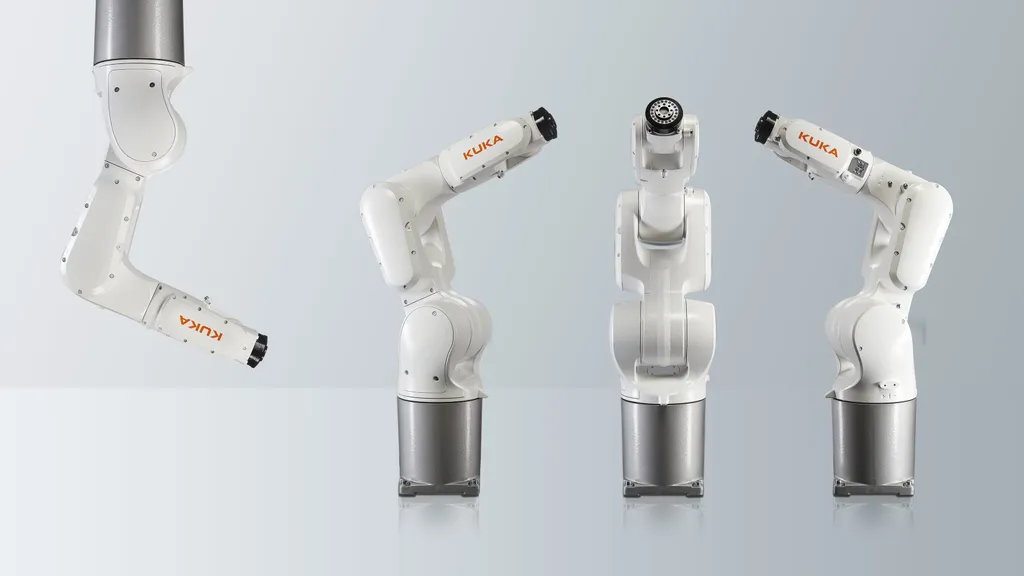
KUKA’s catalog stretches across a 333-to-1 payload range, from a 3 kg LBR iisy cobot to the 1,000 kg KR 1000 TITAN that reaches over 3.2 meters - and that single fact tells you most of what you need to know about this brand. No other catalog forces you to choose between a collaborative arm you can deploy next to a person without a cage and a robot that can lift a loaded pallet rack. If your application sits anywhere in that spectrum, KUKA has something. The question is which of the 19 models actually fits your cell, your budget, and your integration stack.
Most buyers encounter KUKA through one of three pathways. The first is an automotive integration project where the spec sheet already says “KUKA QUANTEC” because that’s what’s running on three other lines in the same plant. The second is a cobot evaluation where someone has read about the LBR iiwa’s force-torque sensing and wants to understand whether it justifies the premium. The third is a heavy-handling application with a payload above 500 kg where the buyer has already ruled out most of the market and KUKA’s TITAN is on a short list of two.
Each of those starting points leads you to a very different part of the catalog. This guide covers all 19 models, organized so you can navigate from your use case to a specific model - or rule out the whole brand quickly if the numbers don’t match your requirements.
Reach ranges from 541 mm (KR 3 AGILUS, smallest articulated) to 3,202 mm (KR 1000 TITAN). Repeatability ranges from 0.01 mm (KR SCARA R600) to 0.10 mm (KR DELTA, LBR iiwa 7, KR 1000 TITAN). Maximum published speed ranges from 1,000 mm/s (LBR iisy 3, LBR iiwa 7) to 10,000 mm/s (KR DELTA). If any of those ranges don’t overlap with your requirements, read no further - the brand isn’t a fit.
Who makes KUKA?
KUKA began in 1898 in Augsburg, Germany, when Johann Josef Keller and Jakob Knappich founded a company to manufacture acetylene lamps and hardware for horse-drawn vehicles. The name is an acronym: Keller und Knappich Augsburg. For the first seven decades, KUKA had nothing to do with robots.
That changed in 1973, when KUKA built FAMULUS - one of the world’s first six-axis electromechanically driven industrial robots. The move into robotics was well-timed. German automotive manufacturers were scaling body-in-white production and needed consistent, repeatable automation. KUKA’s orange-painted arms became fixtures on Volkswagen and BMW lines, and the automotive sector remained the brand’s anchor market for the next four decades. KUKA is now counted among the global “Big Four” industrial robot makers, alongside FANUC, ABB, and Yaskawa. Source: Wikipedia
The ownership picture changed sharply in 2016. China’s Midea Group offered approximately EUR 4.5 billion for KUKA, completing the acquisition in January 2017 with roughly 94.55% of voting shares - the largest Chinese takeover of a German industrial firm at the time, at a total transaction value near EUR 4.66 billion. The deal drew political scrutiny in Germany over strategic-technology transfer. Headquarters remain in Augsburg. The signature orange paint is still on every arm. But KUKA has been a Chinese-owned company for nearly a decade, and that context matters if you operate in sectors with supply-chain visibility requirements or government contracting constraints.
On the product side, KUKA has extended its cobot line in the years since the acquisition. The LBR iiwa (Intelligent Industrial Work Assistant) was an early pioneer of force-torque controlled collaborative robotics, with joint-level torque sensing that predates most competitors’ collision-detection cobots by several years. The newer LBR iisy line simplified deployment and brought that force-sensing capability to a wider range of payloads and price points. In January 2026, KUKA launched the KR AGILUS ultra with IP67 certification and payloads up to 16 kg - notable because none of the 19 models currently in the Industrial Robotics Hub database carry an IP67+ rating. If wash-down or coolant-splash resistance is a hard requirement today, verify the AGILUS ultra spec sheet directly before committing. KUKA product catalog
The three facts worth keeping in context when evaluating KUKA against alternatives: First, it is a Chinese-owned company (Midea, since 2017) headquartered in Germany, which affects supply-chain perception in certain regulated or government-adjacent sectors. Second, it remains one of the top four industrial robot makers globally by volume, meaning parts, trained integrators, and controller expertise are not scarce. Third, the KR CYBERTECH family - not covered in this database but in the KUKA catalog - fills some of the mid-payload gap between the AGILUS and QUANTEC families, so if a model here doesn’t match your spec, verify the full catalog at the KUKA product page before concluding the brand is out of range. The 19 models in this database are representative, not exhaustive.
What types of robots does KUKA make?
Twelve of the 19 models are articulated robots, covering payload from 3 kg (KR 3 AGILUS) to 1,000 kg (KR 1000 TITAN). Five are cobots in the LBR family, running from 3 kg to 15 kg. One is a SCARA (KR SCARA R600 at 8 kg), and one is a delta robot (KR DELTA at 3 kg with 10,000 mm/s peak speed).
The articulated majority is consistent with KUKA’s automotive heritage - most of those 12 arms exist to weld, handle, or machine parts at industrial scale. The cobot slice (26%) is larger than you’d see in a purely heavy-industry catalog, reflecting KUKA’s LBR investment over the past decade. The SCARA and delta entries are essentially point solutions: the SCARA targets high-speed assembly at moderate payload, and the delta is a pick-and-place specialist for food, pharma, and light electronics.
The geometry choice has downstream consequences that matter before you ever open a spec sheet. A delta robot moves its working head by varying the lengths of three parallel chains - fast on acceleration, constrained on orientation, mechanically simpler than a 6-axis arm, and limited to a dome-shaped workspace. A SCARA robot has two rotating horizontal arms and a vertical-travel axis, which makes it inherently fast on horizontal plane moves and rigid against vertical loads - well matched to board assembly and screw driving, poor for anything requiring complex 3D paths. A 6-axis articulated arm is the general-purpose answer: it can reach around obstacles, tilt tools at any angle, and serve nearly any orientation requirement, at the cost of higher inertia and more complex path planning. A cobot (as KUKA defines it with the LBR family) is a 6-axis arm with integrated torque sensing at each joint, enabling contact detection and compliant motion that standard industrial arms don’t offer - but with speed and repeatability trade-offs.
If your application doesn’t fit one of those four motion geometries, KUKA is not the answer. If it does, the question becomes payload and reach - covered next.
Payload range: 3 kg to 1000 kg
KUKA’s payload distribution is not a smooth curve. It clusters at two ends: a group of light arms under 20 kg (ten models), then a gap, then a mid-heavy tier from 70 kg to 210 kg (three models), then two outliers at 500 kg and 1,000 kg. The median across all 19 models is 14 kg - which tells you that numerically, KUKA’s catalog skews light, even though the headline robots are monsters.
| Model | kg | Payload |
|---|---|---|
| KR 3 AGILUS | 3 | |
| KR DELTA | 3 | |
| LBR iisy 3 R760 | 3 | |
| LBR iiwa 7 R800 | 7 | |
| KR SCARA R600 | 8 | |
| KR 6 R700 sixx | 6 | |
| KR 10 R900 sixx | 10 | |
| KR 10 R1100-2 (AGILUS) | 10 | |
| LBR iisy 11 R1300 | 11 | |
| LBR iiwa 14 R820 | 14 | |
| LBR iisy 15 R930 | 15 | |
| KR 20 R1810 | 20 | |
| KR 20 R3100 IONTEC | 20 | |
| KR 30 R2100 | 30 | |
| KR 70 R2100 | 70 | |
| KR 120 R2700-2 | 120 | |
| KR 210 R2700-2 (QUANTEC) | 210 | |
| KR 500 R2830 | 500 | |
| KR 1000 TITAN | 1000 |
Source: Industrial Robotics Hub database, 19 KUKA robots.
The bi-modal distribution has a practical implication: if your payload is between 30 kg and 70 kg, you’re in a gap. The KR 30 tops out at 30 kg and the KR 70 starts at 70 kg. You either overbuy reach-and-payload with the KR 70 (2.1 m reach you may not need) or constrain yourself to the KR 30. There’s no 40 kg or 50 kg mid-tier articulated arm in this catalog right now. If your end-of-arm tooling plus part weight lands in the 35-65 kg band, compare KUKA’s KR 70 against mid-tier arms from FANUC or ABB before committing - you may find a tighter-payload fit at lower cost from a competitor.
Below 20 kg, the selection pressure goes the other way - you have multiple options at similar payloads but very different motion geometries, reach envelopes, and collaboration modes. A 10 kg pick-and-place job could use the KR 10 R900 sixx (fastest small articulated in the AGILUS family, 0.02 mm repeatability), the KR DELTA (10,000 mm/s peak speed for high-cycle light work), or the KR SCARA R600 if the work is horizontal assembly. The specs diverge sharply even when the payload number looks the same.
Speed data deserves particular attention at the light end. The KR 3 AGILUS publishes 2,200 mm/s - the fastest articulated arm in the lineup - while the KR DELTA reaches 10,000 mm/s, which is not a comparable metric. The AGILUS 2,200 mm/s is a sustained TCP (tool center point) path speed along a programmed trajectory. The DELTA 10,000 mm/s reflects peak speed in short-stroke point-to-point moves with minimal payload. Neither number is the right benchmark unless you know your actual stroke length, cycle count per minute, and whether the process is path-controlled or point-to-point. Always request cycle time studies from the integrator for your specific geometry - published max speeds are marketing anchors, not throughput guarantees.
Reach numbers also require interpretation. Two models share the same 2,101 mm reach: KR 70 R2100 and KR 30 R2100. They are not the same arm in different payload variants. The KR 30’s rated payload is 30 kg; the KR 70 is 70 kg. The physical structure is different, the joint torques are different, and the mass of each arm affects its own dynamic behavior. Do not substitute one for the other based on reach matching alone.
KUKA performance specs at a glance
| Type | Robots | Payload median (kg) | Repeat median (mm) | Speed range (mm/s) | IP67+ |
|---|---|---|---|---|---|
| Articulated | 12 | 15 | 0.04 | 1600-2200 | 0 of 12 |
| Cobot | 5 | 11 | 0.05 | 1000-1500 | 0 of 5 |
| Delta | 1 | 3 | 0.10 | 10000 | 0 of 1 |
| SCARA | 1 | 8 | 0.01 | 6200 | 0 of 1 |
A few observations worth noting before reading the full table.
Repeatability across the articulated family is consistently tight - four models hit 0.02 mm (KR 10 R900 sixx, KR 6 R700 sixx, KR 3 AGILUS, KR 20 R1810), which is competitive with the best small-arm specs on the market. The SCARA edges them at 0.01 mm - expected for that motion geometry. The LBR cobots are looser at 0.05-0.10 mm, reflecting the trade-off that comes with integrated torque sensing and compliance. For precision assembly where you are letting the robot feel its way into a connector seat, the LBR iiwa’s force control compensates for what it gives up in raw repeatability. For pure positional accuracy without compliance, the AGILUS or sixx family is the better call.
One thing repeatability figures do not tell you: they are measured under specific laboratory conditions - typically ISO 9283, with a specific payload fraction, ambient temperature, and warm-up cycle. In a production environment with thermal cycling, worn joints, cable tension variation, and inconsistent tool weights, the real-world repeatability you see over eight-hour shifts is not the same number as the spec sheet. For applications where the process tolerance is within 2x of the published repeatability, request long-run positional accuracy data from the integrator or run a capability study in the first weeks of production before signing off the cell.
IP67 coverage is zero across the entire 19-model lineup. That is not a typo. Every robot in this database is rated below IP67. The 2026 KR AGILUS ultra announcement adds IP67 as a new feature - which implies KUKA itself recognized the gap. If coolant, washdown, or outdoor exposure is in your design envelope, confirm the specific variant’s IP rating with KUKA directly before writing it into your specification. Operating an arm outside its IP rating voids warranty and risks premature joint failure from coolant contamination of motors and encoders - a failure mode that typically appears after 6-18 months, not immediately, making it harder to attribute to the root cause.
Cobot speeds cap at 1,500 mm/s - roughly one-third of the top articulated speed. That ceiling exists partly because ISO/TS 15066 power-and-force limiting requires conservative speed profiles in collaborative mode, and partly because the LBR architecture optimizes for force fidelity over raw velocity. If throughput is the primary KPI, the cobots are not the right answer regardless of payload. A cell running two shifts with a 12-second cycle time target should be modeled with a standard articulated arm behind guarding, not a cobot in open access mode.
The speed data for the heavy arms is also worth reading carefully. Both the KR 1000 TITAN and the KR 500 R2830 publish 1,600 mm/s, which looks low compared to the 2,000 mm/s of QUANTEC arms. At 1,000 kg payload and 3.2 m reach, inertia becomes the limiting factor, not the servo drive. Running at 1,600 mm/s with a full payload at full extension puts enormous stress on the joint reduction gears and is not a continuous-duty operating point - it’s a maximum. For motion profiling in heavy-payload cells, assume 50-70% of rated max speed as a sustainable cycle parameter and have the mechanical engineer check gear fatigue life at your actual duty cycle.
Complete KUKA robot lineup
| Model | Type | Payload (kg) | Reach (mm) | Repeat (mm) | Max Speed (mm/s) | IP |
|---|---|---|---|---|---|---|
| KR 1000 TITAN | articulated | 1000 | 3202 | 0.10 | 1600 | - |
| KR 500 R2830 | articulated | 500 | 2826 | 0.08 | 1600 | - |
| KR 210 R2700-2 (QUANTEC) | articulated | 210 | 2700 | 0.06 | 2000 | - |
| KR 120 R2700-2 | articulated | 120 | 2701 | 0.06 | 2000 | - |
| KR 70 R2100 | articulated | 70 | 2101 | 0.04 | 2000 | - |
| KR 30 R2100 | articulated | 30 | 2101 | 0.04 | 2000 | - |
| KR 20 R3100 IONTEC | articulated | 20 | 3101 | 0.04 | 2000 | - |
| KR 20 R1810 | articulated | 20 | 1813 | 0.04 | 2000 | - |
| LBR iisy 15 R930 | cobot | 15 | 930 | 0.05 | 1500 | - |
| LBR iiwa 14 R820 | cobot | 14 | 820 | 0.10 | 1500 | - |
| LBR iisy 11 R1300 | cobot | 11 | 1300 | 0.05 | 1500 | - |
| KR 10 R1100-2 (AGILUS) | articulated | 10 | 1101 | 0.03 | 2000 | - |
| KR 10 R900 sixx | articulated | 10 | 901 | 0.02 | 2000 | - |
| KR SCARA R600 | scara | 8 | 600 | 0.01 | 6200 | - |
| LBR iiwa 7 R800 | cobot | 7 | 800 | 0.10 | 1000 | - |
| KR 6 R700 sixx | articulated | 6 | 706 | 0.02 | 2000 | - |
| KR 3 AGILUS | articulated | 3 | 541 | 0.02 | 2200 | - |
| KR DELTA | delta | 3 | 1200 | 0.10 | 10000 | - |
| LBR iisy 3 R760 | cobot | 3 | 760 | 0.05 | 1000 | - |
The reach column deserves a close read. The KR 20 R3100 IONTEC has 3,101 mm of reach at only 20 kg payload - meaning it can serve a wide workspace on a compact footprint without the cost and floor space of a 70 kg or 120 kg arm. That’s an underappreciated model for large-format but light-payload work like laser marking, dispensing, or vision-guided inspection over a wide conveyor. On the other end, the KR SCARA R600 is constrained to 600 mm reach - tight enough that cell layout becomes a genuine design constraint rather than an afterthought.
The cobot reach numbers follow their own logic. The LBR iisy 11 R1300 has the longest cobot reach at 1,300 mm - nearly 500 mm more than the LBR iiwa 14 R820, which carries more payload at 820 mm. If your collaborative station has a work surface that extends beyond arm’s length and you don’t need the full 15 kg of the iisy 15, the iisy 11 is the better geometry choice for keeping the robot base out of the operator’s way. Cobot reach is often underweighted in selection compared to payload, but on a workbench station where the operator and robot share a 1,500 mm span, 300-400 mm of extra reach can eliminate awkward repositions or shoulder travel that degrades ergonomics.
The KR 1000 TITAN’s reach of 3,202 mm is a separate category. At that reach-to-payload ratio, you are building an installation, not a work cell. The robot base alone weighs several tonnes, requires a reinforced floor, and the cell perimeter is set by a 3.2 m radius safety zone. The TITAN is a project, not a purchase, and the integration cost typically exceeds the hardware cost. That does not make it wrong - for foundry transfer, die casting extraction, or large-press tending at multi-tonne loads, no other solution is viable. But the total cost of ownership calculation looks nothing like a standard cell.
All speed figures in this table are published maximums (mm/s at TCP). For path applications - welding, sealing, dispensing - actual path speed is what matters, and that is set by the process, not the robot’s top speed. A welding arc at 600 mm/min does not care that the robot can move at 2,000 mm/s. In those applications, the relevant spec is path accuracy under load, which is not a published number but can be requested from the supplier as an application study.
Which KUKA robot fits your application?
Automotive body-in-white spot welding - high payload, long reach
This is the original KUKA use case, and the KR 210 R2700-2 (QUANTEC) or KR 120 R2700-2 are the standard answers. Both carry 0.06 mm repeatability at 2,000 mm/s and reach into the 2.7 m range - adequate for most body panel work. The QUANTEC series was also KUKA’s first line marketed with software “digital motion modes,” which means smoother trajectories on curved paths without manual tuning of velocity profiles. If the gun weight is over 120 kg and you need to reach across a full door opening, step up to the KR 500 R2830 at 500 kg payload and 2.8 m reach. KUKA QUANTEC product page
In a spot-welding cell, gun weight plus cable management typically adds 20-30 kg to the rated EOAT load, so a 120 kg arm may be running near its effective limit if the gun is heavy. The KR 210 gives you headroom. For high-density transfer press lines where you need a robot inside the press opening, the 2.7 m reach of the QUANTEC arms typically allows mounting on a shelf or floor pedestal outside the press footprint and reaching through the die clearance window. Verify that geometry with a simulation model before committing floor space - the reach envelope has a dead zone near the base that catches engineers who use 2D diagrams rather than 3D simulation for reach validation.
Human-robot collaboration - assembly station beside a person
The LBR iiwa 7 R800 is the textbook answer if you need the tightest force-torque feedback and you’ve built a process around KUKA’s force-control APIs. It reads collision torque at every joint and can operate in restricted-speed-and-separation mode without a full hard cage. The trade-off is 800 mm reach and 1,000 mm/s max speed - which keeps cycle times high. If you need more arm length, the LBR iisy 11 R1300 extends to 1,300 mm at 1,500 mm/s, with 0.05 mm repeatability. KUKA LBR iiwa product page
The critical planning question for collaborative deployment is not the robot spec - it’s risk assessment. ISO/TS 15066 and ISO 10218-2 require a site-specific risk assessment regardless of what the robot is rated. Buying a cobot doesn’t eliminate fencing requirements; it makes it possible to engineer them out through analysis. Budget that analysis time. In most assembly environments, the risk assessment also needs to account for the end-of-arm tooling, which is frequently the actual pinch or impact hazard - not the robot arm itself. A KUKA LBR iiwa fitted with a sharp-edged gripper or a rotating spindle tool does not automatically become safe just because the arm has force-limiting capability.
The practical case for the LBR iiwa over a lower-cost cobot competitor is narrow but real: if you are doing assembly where the robot must detect and recover from part-not-seated conditions, search for a hole in a compliant fixture, or insert into a connector that has ±1 mm positional variation, the iiwa’s force-control programming interface gives you a direct handle on that process. Competing cobots with simpler collision detection (current threshold vs. joint torque model) are less predictable in those scenarios. If your assembly is rigid fixturing with tight tolerance on part presentation, that advantage disappears and you should buy on reach, repeatability, and cycle time.
See all KUKA cobots on our cobot type page for side-by-side comparison.
High-cycle light pick-and-place - food or pharma
The KR DELTA at 10,000 mm/s peak speed is the correct answer for light-cycle applications where throughput is the primary metric and you’re moving product under 3 kg over a short workspace diameter. Delta kinematics give low moving mass and very high acceleration - the arm doesn’t fight inertia the way a full 6-axis arm does at high speeds. The 0.1 mm repeatability is adequate for most pick-and-place positioning onto a conveyor or tray.
If the product requires more manipulation than a simple pick-and-orient - say, fitting a cap or aligning a label - the delta’s limited orientation control becomes a liability. In that case, the KR 10 R900 sixx (0.02 mm repeat, 2,000 mm/s) gives full 6-axis freedom with competitive small-arm speed.
One underrated application for the KR DELTA is tray loading in pharmaceutical packaging, where the product is homogeneous, the cycle count per minute is high (60-120 picks per minute is typical for delta robots), and the workspace is shallow - product coming in on a flat conveyor and going into a flat tray. The 1,200 mm reach is the total diameter of the delta’s dome workspace, not a linear reach, so it comfortably covers most standard conveyor widths. In that geometry, the KR DELTA at 10,000 mm/s peak speed will substantially outperform any 6-axis arm on throughput at the same payload. The KR AGILUS product family gives you the alternative when you need 6-axis freedom at the same payload tier.
Precision horizontal assembly - connectors, screws, PCB placement
The KR SCARA R600 returns 0.01 mm repeatability at 6,200 mm/s - the tightest repeat and highest sustained speed in KUKA’s 19-model lineup. SCARA motion is inherently stiff in the Z axis and naturally fast on XY plane moves, which matches the geometry of connector insertion, screw driving, and surface-mount operations. The 600 mm reach is tight; you’ll need to think carefully about fixture layout. If the work surface exceeds 600 mm in any dimension, you’re looking at either multiple SCARAs or a full 6-axis arm with the associated speed penalty. See SCARA type comparison for context on how the KR SCARA positions against competitors.
At 8 kg payload, the KR SCARA R600 can handle a moderately heavy tool - a screwdriver spindle plus the head is typically 1-2 kg, leaving 6 kg for the part or fixture weight. That’s adequate for most light electronics and small component assemblies. What it cannot do is service a part that requires rotation beyond 360 degrees on the theta axis or significant Z-axis travel at speed - SCARA Z travel is typically limited to 100-200 mm, and fast Z moves at the bottom of the stroke can induce vibration in the arm structure. If the process requires more than about 150 mm of Z stroke or the part geometry requires the tool to tilt, the SCARA geometry is the wrong choice regardless of the speed advantage.
Extra-large handling - foundry, press, heavy transfer
The KR 1000 TITAN is the only choice in this category within KUKA’s catalog - and one of very few anywhere. At 1,000 kg payload and 3,202 mm reach, it is certified to lift a metric ton at over three meters of extension. KUKA’s marketing has noted that this robot held a Guinness record as the world’s strongest six-axis robot. The 0.1 mm repeatability is looser than the lighter QUANTEC arms, which is a physical consequence of the structural compliance inherent at this scale. If your tolerance budget requires tighter positioning at heavy load, you’ll need downstream fixturing to take up the residual error. KR 1000 TITAN product page
Applications that actually use the TITAN in practice include large casting extraction from die-casting cells (the robot must reach inside a hot die and pull a multi-hundred-kg casting without deforming it), automotive body-in-white transfer at full body weight, aircraft fuselage positioning, and shipbuilding component handling. None of those are standard cell builds. The TITAN is spec’d and built as a project delivery, with integration teams that specialize in heavy-payload cells. Budget 18-30 months for design, build, and commissioning in a first-of-type application.
Indicative 2026 pricing (via Standard Bots): KR AGILUS range runs approximately $25,000-$35,000; LBR iisy 11 around $50,000-$60,000; QUANTEC and FORTEC heavy arms from $90,000 to over $120,000. The TITAN is not in typical list-price catalogs - it’s spec-and-quote only. For any QUANTEC or heavier arm, the robot hardware typically represents 30-40% of total cell cost once you add the controller, EOAT, guarding, integration labor, and commissioning. If the hardware quote surprises you, the full project number will surprise you more.
The bottom line
KUKA is a strong buy for three specific situations and a harder sell for two others.
Buy KUKA if: Your primary market is automotive and you want deep supplier ecosystem support and proven body-in-white tooling. The QUANTEC and FORTEC heavy arms have decades of deployment data in welding cells, and KUKA’s KR C4/C5 controller ecosystem integrates with most automotive PLC environments without custom middleware. If that lineage matters to your procurement team or your line’s existing controller architecture, KUKA is the path of least resistance.
Buy KUKA if: You are building a collaborative cell and you need force-torque sensing that goes deeper than collision detection. The LBR iiwa’s joint-level torque sensing is genuinely differentiated - it enables process applications like part-in-fixture searching and compliant assembly that simple impedance-mode cobots can’t do cleanly. The iisy line brings a simplified deployment experience at lower entry cost. If force control is a design requirement rather than a nice-to-have, KUKA’s cobot family is worth the premium.
Buy KUKA if: You need very heavy payload - above 200 kg and up to 1,000 kg - from a supplier with global service coverage. The KR 500 and KR 1000 TITAN have no direct analog in most competitors’ standard catalogs. For foundry transfer, large press tending, or palletizing at full-pallet weight, KUKA’s heavy-tier articulated arms are among the shortest lists of viable options worldwide.
Be cautious with KUKA if: Your application requires IP67 or better ingress protection today, not in a future product generation. The current 19-model lineup has zero IP67+ entries. The AGILUS ultra with IP67 launched in January 2026, but that model is not yet in this database and the spec should be verified directly. Designing a wash-down cell around a KUKA arm means confirming very specific variant availability and stocking strategy with your distributor before committing to the cell layout.
Be cautious with KUKA if: Your payload is between 30 kg and 70 kg. That is a real gap in the articulated family right now. You’ll either overpay for the KR 70’s reach and capacity or accept the KR 30’s ceiling. A competitor with a 40 kg or 50 kg mid-tier arm may be a cleaner fit at lower cost.
The spec table above is not just a reference - it is a decision tree. Start with payload. Then reach. Then check repeatability against your process tolerance. Only then look at IP rating and speed. If the model that clears those gates is a KUKA, you are buying a well-supported arm from one of the four largest robot makers in the world, with over 50 years of industrial robotics deployment and - unusually - the track record of building the strongest six-axis arm on the planet. A company that started selling gas street lamps in 1898 and ended up holding a Guinness record for robotic lifting capacity has demonstrated a particular kind of industrial seriousness. Whether you care about that legacy or just the torque rating on the A1 axis, the specs hold up.
One more thing for buyers who get deep into a KUKA evaluation: the KR C5 controller is the current platform, and it runs KUKA’s WorkVisual software environment for programming and commissioning. If your integrators already know WorkVisual, that reduces risk. If they don’t, budget training time - the controller environment has a learning curve, and experienced KUKA integrators are not uniformly available in all regions. The automotive markets of Germany, the US Midwest, and parts of Asia have deep pools of KUKA-certified integrators. In less dense industrial regions, verify local integrator availability before committing to the platform. A robot without an integrator who can commission and support it is not a working solution.
Finally, a note on the Midea ownership context for those buying for regulated industries. KUKA is a German company with German engineering, manufacturing in Germany and elsewhere, and it remains on the global Big Four list - the ownership transfer did not change the technical character of the product line. That said, in defense-adjacent manufacturing, certain government contracts, and industries with specific country-of-origin requirements on automation capital equipment, the Chinese ownership stake is a factor that procurement teams in those sectors will need to address. It is not a disqualifier for most commercial manufacturing, but it is a question that comes up and should be answered before the purchase order is signed, not after.
Browse all KUKA robots in the database to compare individual model pages with full specification tables.
KUKA product specifications sourced from the Industrial Robotics Hub database. Brand and ownership information from Wikipedia and KUKA’s official product catalog. Indicative pricing is market research, not manufacturer list price; verify with your distributor.
Compare these robots