Omron Robots: 12 Models From a 1,500 kg AMR to 0.01 mm SCARA
Half of Omron's 12-robot catalog is mobile, not arms. The lineup spans a 1,500 kg AMR down to SCARAs hitting 0.01 mm repeatability and Vipers at 8,600 mm/s.
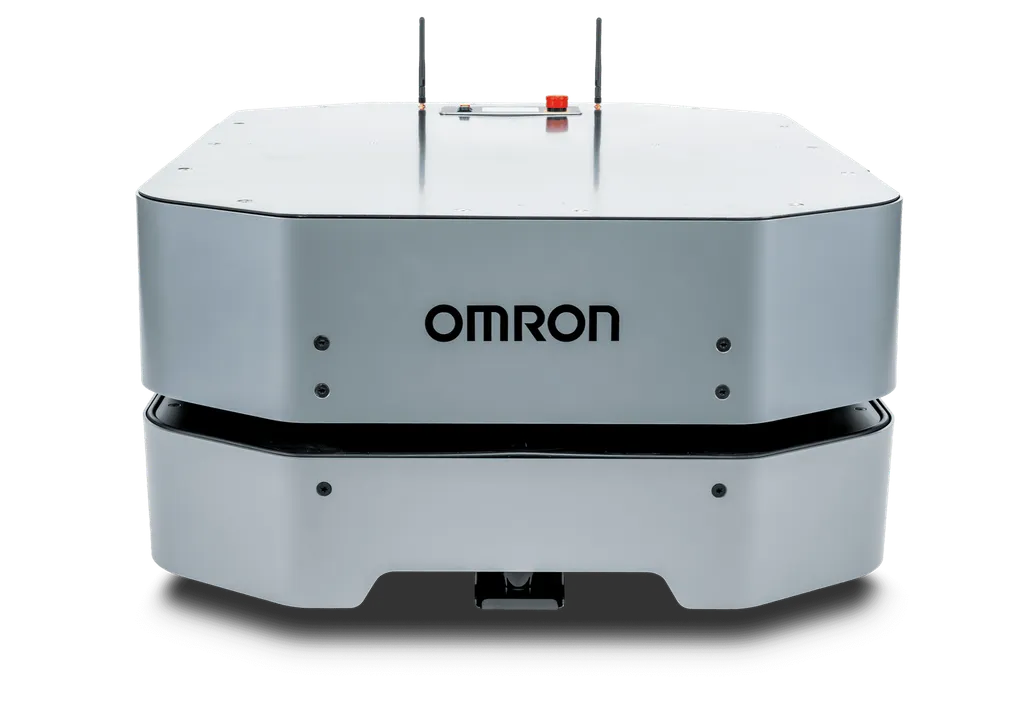
Most robot makers lead with arms, but half of Omron’s 12-model catalog rolls on the floor: six autonomous mobile robots, topped by an HD-1500 that hauls 1,500 kg. That split tells you something important about what Omron actually is - not primarily an arm builder, but an intralogistics and floor-automation company that also happens to make precise SCARA and articulated arms. If you are shopping for a picking arm, Omron has three SCARA families and two Viper 6-axis models. If you need to move pallets, totes, or carts autonomously, the AMR lineup runs from 60 kg all the way to a payload that outweighs a mid-size SUV.
Who makes Omron robots?
Omron Corporation was founded in Kyoto, Japan in 1933 and built its automation business across sensors, PLCs, and safety controllers. The robotics lineage, however, comes from a different place: Adept Technology, a Silicon Valley startup founded in 1983 by Bruce Shimano and Brian Carlisle out of Stanford’s AI lab. Adept built the world’s first direct-drive SCARA robot, the AdeptOne, in 1984 - a design that eliminated gearboxes and set the template for high-speed assembly automation. That heritage is why Omron’s SCARA arms still benchmark well on speed and repeatability today.
Omron acquired Adept Technology in October 2015 for roughly $200 million, folding the robotics operation into its wider industrial automation business and eventually rebranding it as Omron Robotics and Safety Technologies, headquartered in Pleasanton, California. The combined entity now claims 40-plus years of robotics expertise and more than 46,000 robots deployed across 130 countries. Primary markets are electronics assembly, automotive subassembly, appliances, semiconductor and ESD-sensitive environments, and intralogistics material handling.
The important strategic detail: Omron does not sell robots in isolation. The pitch is integration with its own controls, vision, and safety stack. If your line already runs Omron PLCs and vision systems, the robots slot in more cleanly than a competing arm would. If your line runs a different controls architecture, weigh that integration overhead before the spec sheet.
What types of robots does Omron make?
Six of the twelve robots in our database are autonomous mobile robots, four are SCARA arms, and two are 6-axis articulated arms. No cobots. No delta or parallel-link robots.
That 50/33/17 split is not typical for industrial robot suppliers. Most catalogues are arm-heavy, with mobile robots as an afterthought or a separate division. Omron treats AMRs as a first-class product line, with six distinct models spanning an 8:1 payload ratio (60 kg to 1,500 kg) and multiple navigation and fleet-management options. If your application is material transport - tote delivery, pallet movement, WIP staging - Omron has more SKUs aimed at that problem than most arm-first suppliers.
The SCARA and articulated segments are narrower. Four SCARA models cover two families (i4 and eCobra) in two reach sizes each. Two Viper models cover a single 6-axis family in two reach sizes. That is a deliberate catalog: depth in mobile, focused precision in fixed arms.
Payload range: 5 kg to 1500 kg
The payload chart above looks like two separate catalogs, because it essentially is. The arms split into two bands: 5-5.5 kg for the Viper and eCobra lines, and 15 kg for the i4 SCARA family - nearly 3x heavier. The AMRs start well above all of them: 60 kg at the low end, stepping through 90, 250, 650, 900, and 1,500 kg. There is no medium-payload arm in this lineup. If you need an arm that handles 20, 50, or 100 kg, Omron does not have one. You would need to look at ABB, FANUC, or KUKA for that range.
The payload median across all 12 robots is 37.5 kg, which is a somewhat misleading number - it sits exactly in the gap between the arms and the AMRs. Speed-wise, 8 robots publish a maximum speed figure ranging from 1,200 to 8,600 mm/s. Repeatability is published for 6 robots, with a median of 0.017 mm. None of the 12 carry an IP67 or higher rating, which matters if your environment involves washdowns or significant dust or moisture exposure.
Omron performance specs at a glance
| Type | Robots | Payload median | Repeat median | Speed range | IP67+ |
|---|---|---|---|---|---|
| AMR | 6 | 470 kg | - | 1,200-1,700 mm/s | 0 |
| SCARA | 4 | 10.25 kg | 0.016 mm | - | 0 |
| Articulated | 2 | 5 kg | 0.02 mm | 8,600 mm/s | 0 |
The SCARA arms lead on repeatability: the i4 family hits 0.015 mm, the eCobra family hits 0.017 mm. Those are competitive numbers for electronics assembly and semiconductor handling. The Viper articulated arms trade some repeatability (0.02 mm) for speed - 8,600 mm/s TCP is genuinely fast, driven by lightweight arm design and low-inertia Harmonic Drives. That speed matters in high-cycle pick-and-place where the robot is the cycle-time constraint.
The AMR column has no repeatability figure because AMRs do not have repeatability in the arm sense. Navigation accuracy is a different spec entirely, measured differently, and the table reflects what is published.
Complete Omron robot lineup
| Model | Type | Payload (kg) | Reach (mm) | Repeat (mm) | Max Speed (mm/s) | IP |
|---|---|---|---|---|---|---|
| HD-1500 | AMR | 1,500 | - | - | 1,200 | - |
| MD-900 | AMR | 900 | - | - | 1,500 | - |
| MD-650 | AMR | 650 | - | - | 1,500 | - |
| LD-250 | AMR | 250 | - | - | 1,350 | - |
| LD-90 | AMR | 90 | - | - | 1,700 | - |
| LD-60 | AMR | 60 | - | - | 1,700 | - |
| i4-850 | SCARA | 15 | 850 | 0.015 | - | - |
| i4-650 | SCARA | 15 | 650 | 0.015 | - | - |
| eCobra 800 | SCARA | 5.5 | 800 | 0.017 | - | - |
| eCobra 600 | SCARA | 5.5 | 600 | 0.017 | - | - |
| Viper 850 | Articulated | 5 | 855 | 0.02 | 8,600 | - |
| Viper 650 | Articulated | 5 | 653 | 0.02 | 8,600 | - |
A few things worth noting in the table. The LD-60 and LD-90 both hit 1,700 mm/s, faster than the MD series at 1,500 mm/s. Lighter AMRs move faster - not surprising, but worth checking when you assume larger means more capable in all dimensions. The Viper 650 and Viper 850 are mechanically identical on speed and repeatability; the only difference is reach (653 mm vs 855 mm). Same story with the i4-650 and i4-850 - same 15 kg payload, same 0.015 mm repeatability, different reach. You are really choosing the workspace, not the arm.
Which Omron robot fits your application?
Electronics assembly with sub-millimeter precision. The i4-650 or i4-850 are the right call here. At 0.015 mm repeatability with a 15 kg payload, these SCARAs are built for the component densities and cycle times that electronics assembly demands. The i4 family inherits directly from the Adept SCARA lineage that essentially defined the category. Choose 650 mm reach for tight cell layouts, 850 mm if your workspace requires more span. See all SCARA options in our type page if you want to compare against other brands before committing.
High-speed light assembly or packaging with a 6-axis arm. The Viper 650 and Viper 850 are worth serious consideration at 8,600 mm/s. That TCP speed is near the top of the field for articulated robots in this payload class. The tradeoff is payload: 5 kg at the flange. Add a gripper and your part weight needs to be modest. If your application is intricate and fast - connector insertion, small part transfer, syringe handling - the Viper is competitive. If you need 10+ kg of payload, look elsewhere; Omron does not have a mid-range arm.
Autonomous transport of totes, bins, or wheeled carts. The LD-90 covers most light conveying work at 90 kg and 1,700 mm/s. It is a self-navigating AIV designed for dynamic environments with people present - the LD series uses laser-based natural feature navigation without floor markers. Scale up to the LD-250 if you are moving heavier shelving or multi-tote loads. The fleet management software (Omron Fleet Operations Workspace) is designed to coordinate multiple units, which matters once you deploy more than three or four.
Heavy pallet or equipment transport. The HD-1500 is the clearest application fit in the entire catalog. At 1,500 kg rated payload, it targets applications where forklifts or tuggers currently handle movement - automotive subassembly, heavy appliance manufacturing, warehousing of heavy stock. Omron markets it as the strongest mobile robot for heavy-duty transport, and the specification supports that claim. The 1,200 mm/s top speed is lower than the lighter LD units, which makes sense at that mass. If your transport application sits in the 600-900 kg range, the MD-650 and MD-900 bridge the gap.
Mixed arm-plus-mobile operation on one controls platform. This is where Omron’s integration pitch has the most merit. If you are deploying both a SCARA picking cell and AMRs for inbound material delivery, running everything through Omron’s own automation stack - PLC, vision, safety, fleet management - reduces the integration surface area. Competing against a point-solution mix (one brand’s arm, another’s AMR, a third’s PLC) means fewer protocol bridges and a single vendor to call when something misbehaves. That is a real operational advantage, not a marketing claim, assuming the individual robot specs meet your requirements.
The bottom line
Omron is the right brand if your application is intralogistics transport, electronics assembly, or high-speed light manipulation - and especially if you want a single vendor across fixed and mobile automation. The eCobra line has a strong heritage from the Adept acquisition, and the Viper arms genuinely deliver on speed. The AMR depth is unusual in this industry and reflects a deliberate strategy, not catalog padding.
Where Omron falls short: there is no arm above 8 kg payload. No washdown-rated robot in the lineup. No cobot - if you need ISO/TS 15066 power-and-force-limiting collaborative operation, Omron is not currently competitive. The reach ceiling on the arm side is 855 mm, which closes out large-workspace assembly and welding applications entirely.
The spec table reframes into a buying decision this way. If your shortlist item is a 5-8 kg arm at 0.01-0.02 mm repeatability, Omron competes at the top of that segment. If your shortlist item is a 60-1,500 kg floor transport robot with self-navigation, Omron has six options no other single supplier matches at that breadth. If your shortlist item is anything in between - a 20 kg arm, a washdown-rated robot, a true cobot - look at a different catalog.
The 40-year lineage from Stanford to Adept to Omron produced some genuinely good SCARA and arm engineering. The question before you sign a purchase order is whether what Omron is good at aligns with what your line actually needs. For half the applications that land on an engineer’s desk, it does not. For the other half - electronics, semiconductors, AMR-based intralogistics - it is a serious contender.
Compare these robots