Payload-to-Weight Ratio by Robot Type: SCARA Wins at 30%
We ran payload-to-weight ratio across all 400 robots in our database. SCARA carries 30% of its own mass; big articulated arms carry only 14%.
SCARA arms carry 30.2% of their own weight as payload, the median across 54 models in our database. Cobots are close behind at 26.8%. Big articulated arms, the class most buyers picture when they hear “industrial robot,” carry just 14.0%. That’s the full-catalog answer to a question we first asked narrowly two months ago, when the database had only 18 cobots to check.
This is the full-catalog successor to our earlier cobot-only payload-to-weight post, which anchored on a single robot: a 50 kg FANUC CR-35iB that weighs 990 kg. That number is still real and still in our database, unchanged. What’s new here is the scale: 382 of 400 robots (95.5%) in the Industrial Robotics Hub database publish both performance.payloadKg and physical.weightKg, the highest-coverage field pairing we’ve run this ratio against, spanning seven arm-type categories instead of one.
Which robot type carries the most payload relative to its own weight?
We computed payload-to-weight (payloadKg / weightKg, expressed as a percentage) for every robot with both fields, then grouped by robotType. SCARA leads, articulated arms trail every arm type except welding and delta:
| Type | n | Median | Min | Max |
|---|---|---|---|---|
| SCARA | 54 | 30.2% | 12.0% | 54.1% |
| Cobot | 117 | 26.8% | 1.3% | 60.1% |
| Palletizer | 11 | 14.2% | 11.3% | 30.3% |
| Articulated | 171 | 14.0% | 2.2% | 29.4% |
| Welding | 9 | 4.7% | 3.1% | 20.6% |
| Delta | 10 | 2.6% | 1.4% | 6.7% |
| Painting | 3 | 2.5% | 1.9% | 4.6% |
Median payload-to-weight ratio by robot type. Source: Industrial Robotics Hub database, 382 robots publishing both payload and weight, live query 2026-08-20.
Painting sits at the bottom of that table with only 3 robots in the whole database, too small a sample to rank seriously against types with 100+ entries; treat its number as a data point, not a finding. The real story is the top four: SCARA and cobots, the two arm types built for light-duty precision and flexible cell work, carry roughly twice the payload share of palletizers and general-purpose articulated arms, which are built for reach and structural load, not minimum mass.
Which single robot has the best payload-to-weight ratio in our database?
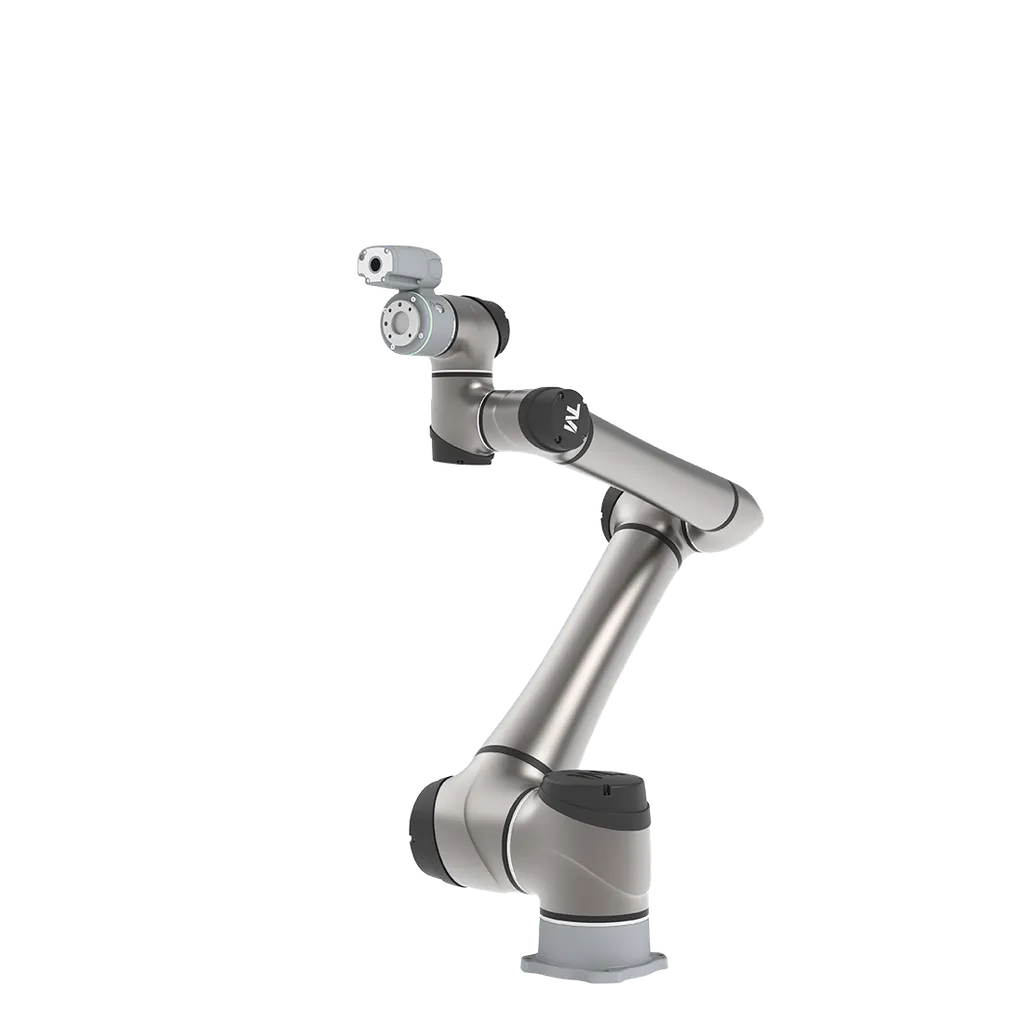
The Techman TM20S leads every robot we track, cobot or otherwise: 20 kg payload on a 33.3 kg frame, 60.1% of its own weight. The next four cobots aren’t far behind:
| Rank | Robot | Payload | Weight | Ratio |
|---|---|---|---|---|
| 1 | Techman TM20S | 20 kg | 33.3 kg | 60.1% |
| 2 | Universal Robots UR30 | 35 kg | 63.5 kg | 55.1% |
| 3 | JAKA Zu 18 | 18 kg | 35 kg | 51.4% |
| 4 | Universal Robots UR16e | 16 kg | 33.1 kg | 48.3% |
| 5 | Rokae xMate CR18 | 18 kg | 38 kg | 47.4% |
At the other end of the cobot list, the bottom five sit below 10%, anchored by the FANUC CR-35iB, the same 50 kg-payload, 990 kg robot that anchored our original narrower post:
| Rank | Robot | Payload | Weight | Ratio |
|---|---|---|---|---|
| 113 | FANUC CR-4iA | 4 kg | 48 kg | 8.3% |
| 114 | FANUC CR-15iA | 15 kg | 255 kg | 5.9% |
| 115 | ABB YuMi IRB 14050 (single-arm) | 0.5 kg | 9.5 kg | 5.3% |
| 116 | FANUC CR-35iB | 50 kg | 990 kg | 5.1% |
| 117 | ABB YuMi IRB 14000 (dual-arm) | 0.5 kg | 38 kg | 1.3% |
That’s a 45.6x spread from best to worst inside a single category all labeled “collaborative robot.” The TM20S and the YuMi IRB 14000 both wear the cobot badge. One of them is a light frame you can bolt to a cart. The other is closer to a dual-arm precision instrument that happens to carry almost nothing relative to its own mass, by design; the YuMi’s payload is intentionally tiny (0.5 kg, aimed at small-parts assembly), not a weight-efficiency failure. The CR-35iB’s 990 kg mass, by contrast, is the same story we told two months ago: heavy structure required to hit collaborative safety limits at industrial payload.
Why do cobots and SCARA arms beat heavy industrial arms?
SCARA and cobot designs start from a payload ceiling and build the lightest structure that can hit it safely. A SCARA’s two horizontal rotary joints and single vertical stroke carry load in compression along a fixed plane, so the arm doesn’t need the counterweighted, heavily geared structure a 6-axis arm needs to hold a load rigid at every possible orientation in a spherical work envelope. A cobot under 20 kg payload follows the same logic, plus a mandate to keep mass and inertia low enough to meet ISO/TS 15066 contact-force limits without slowing to a crawl.
Large articulated arms are solving a different problem. Reach, rigidity at full extension, and repeatability under load all demand structural mass: bigger gearboxes to hold position against gravity and inertial loads at 2-4 meters of reach, cast housings sized for stiffness rather than minimum weight, and counterweights to balance the arm through its full range of motion. None of that mass lifts payload. It holds the arm rigid so the payload it does lift lands within a fraction of a millimeter of where it’s supposed to. That tradeoff is exactly what pushes the median ratio down as arms scale up for heavy-industrial duty, and it’s why welding and delta robots, which optimize for motion speed and multi-axis reach rather than raw carrying capacity, land even lower than general-purpose articulated arms.
Which brands lead within cobots? Within articulated arms?
Within cobots (brands with n≥5), KUKA leads on median ratio, more than double the category’s worst-performing brand:
| Brand | n | Median ratio |
|---|---|---|
| KUKA | 5 | 42.3% |
| Universal Robots | 9 | 37.3% |
| Techman | 15 | 32.9% |
| JAKA | 13 | 29.3% |
| AUBO | 12 | 29.0% |
| Rokae | 11 | 28.0% |
| Doosan | 11 | 27.4% |
| Dobot | 11 | 27.4% |
| FANUC | 10 | 22.5% |
| Han’s Robot | 8 | 18.9% |
| ABB | 6 | 18.4% |
ABB’s cobot median (18.4%) sits well below its rivals, dragged down by the YuMi dual-arm pair; strip those two out and ABB’s remaining cobots would likely rank closer to the middle of the field, a caveat worth checking before using ABB as a general “worst cobot brand” example.
Within articulated arms (brands with n≥5), the spread is wider and JAKA’s small but new articulated lineup tops the list:
| Brand | n | Median ratio |
|---|---|---|
| JAKA | 5 | 29.3% |
| Mitsubishi | 6 | 18.6% |
| Inovance | 11 | 16.7% |
| ABB | 26 | 15.5% |
| FANUC | 10 | 15.2% |
| Siasun | 11 | 15.0% |
| Epson | 6 | 14.9% |
| KUKA | 19 | 14.8% |
| Estun | 23 | 13.9% |
| Rokae | 10 | 12.5% |
| Kawasaki | 15 | 12.5% |
| Yaskawa | 21 | 10.0% |
| Staubli | 6 | 8.4% |
JAKA’s 29.3% articulated median comes from a small, recently added lineup (JAKA A12, A12L, A20), not yet a proven catalog-wide pattern the way its 13-model cobot line is. Staubli’s 8.4% is the weakest median among high-volume articulated brands, worth flagging for anyone comparing Staubli against ABB or FANUC on a heavy-duty payload target where installed weight matters.
For SCARA, the three leaders are Inovance IR-S10-60Z20S-INT (54.1%, 10 kg/18.5 kg), Inovance IR-S35-80Z42S-INT (49.6%, 35 kg/70.5 kg), and Epson LS10-B (45.5%, 10 kg/22 kg), all clear of the SCARA category median by a wide margin.
Two things this ratio doesn’t capture cleanly
First, a data-quality flag we’re not burying in a footnote. One record in our database, the JAKA Mini2 (a 580mm-reach articulated arm), lists a 2 kg payload against a 1.1 kg total robot weight, which would make it the highest ratio in the entire database, 182%, by a wide margin over even the Techman TM20S. We’re excluding it, not crowning it. A 1.1 kg total mass is physically implausible for a 580mm-reach 6-axis arm; JAKA’s own comparable Minicobo cobot weighs roughly 9.6 kg per our prior enrichment notes, and a 580mm articulated arm carries more structure than a compact cobot, not less. We attempted to verify the real number against JAKA’s own product page but it’s a JS-rendered page that doesn’t return usable spec content to a plain fetch. Until that’s confirmed, the JAKA Mini2 is excluded from the articulated leaderboard and the articulated max above (29.4%, JAKA A20).
Second, the ratio breaks down entirely for mobile robots. Seven Omron AMRs in our database show a median payload-to-weight ratio of 239%, up to 409% for the Omron MD-900 (900 kg payload on a 220 kg chassis). We’re not including AMRs anywhere in the ranking above, and that’s deliberate: an AMR carries its payload as a rolling deck load on wheels, a structural and traction question, not a load held against gravity through a torque-generating joint the way every other robot type in this piece works. Comparing a wheeled platform’s ratio against an arm’s is comparing two different physics problems that happen to use the same formula.
What this means for a buyer
Payload-to-weight ratio isn’t a spec-sheet curiosity, it’s a proxy for what kind of installation you’re actually committing to. A robot that carries 30% of its own weight is a candidate for a light frame, a repositionable cart, or a ceiling mount where structural loading is tightly budgeted. A robot that carries 5% of its own weight needs a poured footer and a plan for how it gets moved if the line ever changes.
That distinction matters most when two robots can do the same job on paper. A buyer choosing between the FANUC CR-35iB and a purpose-built SCARA for a 50 kg-class task isn’t choosing between two similar machines with different price tags, they’re choosing between a 990 kg installation and something an order of magnitude lighter, with very different mounting, floor-loading, and facility requirements attached. Check the ratio before you check the quote.
For deeper cuts on related axes, see our companion pieces on payload vs. reach across the full catalog and power efficiency in watts per kilogram by type, neither of which restates this ratio.
Compare these robots