ROKAE Robots: 14 Models, 79% Cobots, 45 kg Top Payload
ROKAE launched in 2015 and now runs 14 robots in our database, 79% of them torque-sensing cobots reaching 45 kg payload and a 2,246 mm arm.
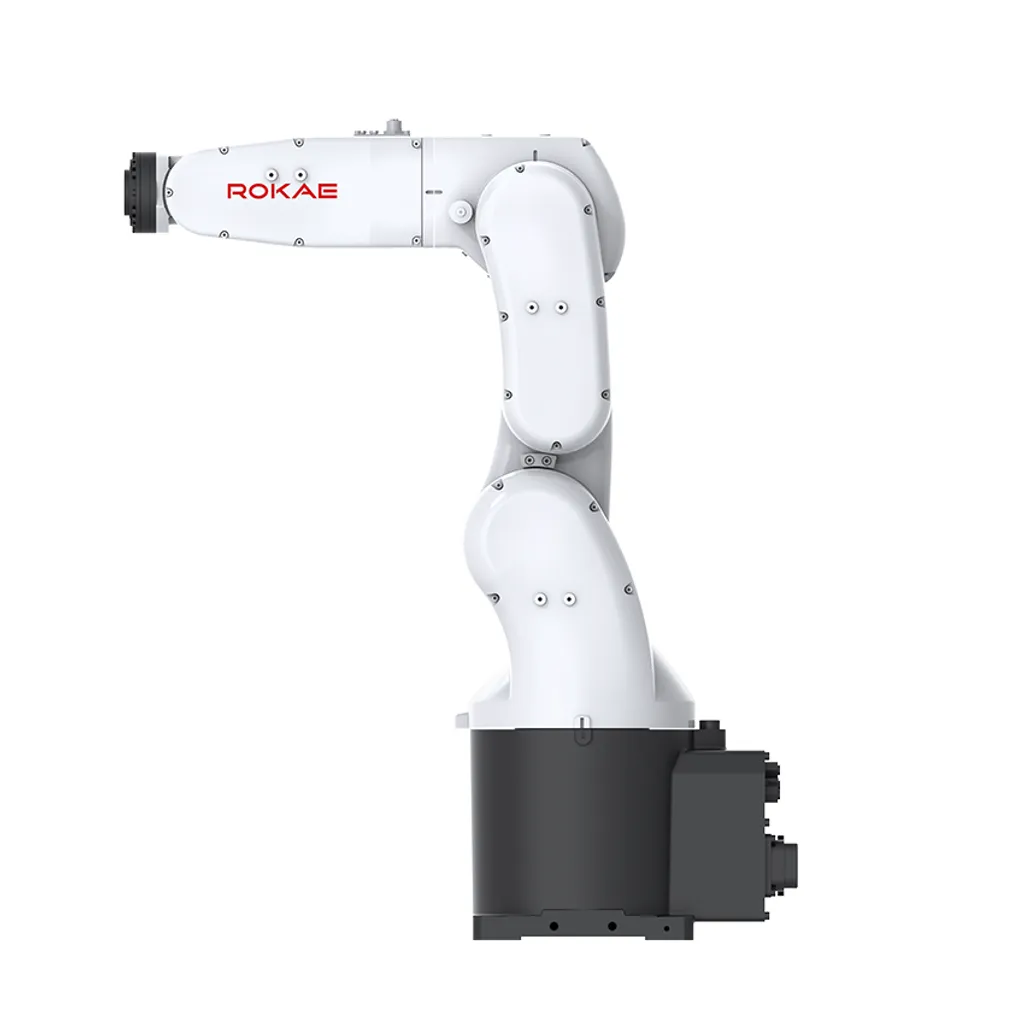
Founded in 2015, ROKAE skipped the heavy-iron arms race entirely: 11 of its 14 models in our database are torque-sensing cobots, topping out at a remarkable 45 kg payload. That single strategic bet - cabinet-free, joint-torque-sensing cobots as the primary product rather than a niche add-on - defines almost every purchase decision this brand forces you to make. Payload runs 3 kg to 45 kg, reach spans 596 mm to 2,246 mm, and repeatability clusters tightly at 0.02 to 0.05 mm across the full lineup. If your application needs heavy caged iron above 45 kg, ROKAE is not your brand. If it needs a force-sensing cobot with serious reach, ROKAE belongs on any shortlist.
This guide covers the complete 14-robot lineup: brand origin, fleet composition, payload landscape, spec table by robot type, full model reference, application scenarios, and a buying decision reframe at the close. Data comes from the Industrial Robotics Hub database - all 14 ROKAE robots, no estimates, no manufacturer marketing copy.
Who makes ROKAE?
ROKAE - formally ROKAE (Shandong) Robot Group Co., Ltd. - was founded in 2015 and headquartered in Beijing, China (Haidian district). The company emerged during a period when Chinese government industrial policy was aggressively promoting domestic robotics to reduce dependence on the four established foreign majors: FANUC, ABB, KUKA, and Yaskawa. Most Chinese entrants during that window started by copying the familiar 6-axis articulated format. ROKAE did not. From the beginning, the company targeted collaborative robots as its primary architecture, with built-in joint torque sensors on every cobot in the xMate line - a design choice that requires significantly more hardware engineering than simple speed/force limiting but produces a machine capable of genuine force control, drag-teaching, and compliant contact tasks.
By 2020, that bet had accumulated enough credibility to earn ROKAE designation as an “Industrial Robot Demonstration Unit” by the Chinese Association of Automation. The company holds more than 300 patents and sells into 20-plus countries, with its primary markets in light-industrial and commercial automation. The ROKAE product catalog today divides into two clear families: the xMate series (cobots, covering CR, ER, and SR sub-lines) and the XB series (compact articulated arms). The XB line is the smallest part of the portfolio - three models - which tells you clearly where the company’s engineering investment has gone.
The cabinet-free design on the xMate line deserves a specific note because it affects installation footprint in a way that payload and reach specs do not capture. Eliminating the external controller cabinet means the arm’s controller is integrated into the base. For constrained cells, collaborative islands, or mobile platforms where floor space is counted carefully, that is a concrete operational benefit rather than a marketing feature. ROKAE’s product overview positions this as the key differentiator against both legacy industrial arms and competing cobot brands that still require a separate controller box.
What types of robots does ROKAE make?
Fourteen robots, two types. That is the entire ROKAE catalog in our database. Eleven cobots account for 78.6% of the lineup. Three articulated robots cover the remaining 21.4%. There are no delta pickers, no SCARA arms, no painting specialists, no linear tracks. The focus is not subtle.
The cobot dominance is more pronounced than almost any other brand of comparable size. Among the major players - ABB, KUKA, FANUC, Yaskawa - cobots typically represent 20% to 35% of the lineup, with articulated arms carrying the rest. At ROKAE, the ratio is inverted. The three XB articulated arms (XB4, XB7, XB7L) fill a specific niche - compact, high-accuracy light arms in the 4-7 kg range that are tighter than most articulated robots of their size class, with repeatability at 0.02 mm. These are SCARA-replacement candidates in flat-plane precision assembly where a 6-axis arm gives more flexibility than a dedicated SCARA but the task does not need cobot-grade force sensing.
The cobot lineup is where the engineering depth lives. Three sub-lines: CR (Collaborative Robot, higher payload, full joint-torque sensing), ER (Embedded Robot, compact footprint, lower reach, still torque-sensing), and SR (Sensitive Robot, shorter reach, optimized for sensing tasks). The CR line runs from 7 kg to 45 kg, which is the part of the portfolio that has no close parallel in most cobot catalogs.
Payload range: 3 kg to 45 kg
The 3-to-45 kg payload spread across 14 robots is notable in two directions. The floor at 3 kg is higher than many cobot brands that start at 1-3 kg, which reflects ROKAE’s positioning away from tabletop assembly and toward light industrial tasks. The ceiling at 45 kg is genuinely unusual for a cobot - most torque-sensing collaborative arms top out at 10-20 kg. The xMate CR45 reaching 45 kg with a 1,947 mm arm is the kind of spec that opens applications like engine block handling, battery module transfer, or heavy fixture positioning - tasks that have historically required caged articulated arms.
The median payload across all 14 robots is 7 kg, which puts most of the fleet in the desktop-to-light-station range. Five models sit at 7 kg (XB7, XB7L, xMate CR7, xMate ER7, xMate ER7 Pro), which signals that ROKAE has deliberately triangulated around that payload class - it is the intersection of small-part assembly, CNC tending, and light material transfer that makes up the majority of cobot deployments worldwide.
| xMate ER3 | 3 kg | |
| xMate SR3 | 3 kg | |
| XB4 | 4 kg | |
| xMate SR5 | 5 kg | |
| XB7 | 7 kg | |
| XB7L | 7 kg | |
| xMate CR7 | 7 kg | |
| xMate ER7 | 7 kg | |
| xMate ER7 Pro | 7 kg | |
| xMate CR12 | 12 kg | |
| xMate CR18 | 18 kg | |
| xMate CR20 | 20 kg | |
| xMate CR35 | 35 kg | |
| xMate CR45 | 45 kg |
The bar chart above makes the payload clustering visible. Twelve of 14 robots fall at or below 20 kg. The CR35 and CR45 sit well above that band and represent a genuinely different application category. If your use case is in that 20-45 kg range and you want a cobot rather than a caged arm, those two models are worth evaluating closely. Nothing else in the lineup competes with them on payload-plus-collaborative spec.
ROKAE performance specs at a glance
| Type | Robots | Payload median | Repeat median | Speed range | IP67+ |
|---|---|---|---|---|---|
| Cobot | 11 | 7 kg | 0.03 mm | - | 0 of 11 |
| Articulated | 3 | 7 kg | 0.02 mm | - | 0 of 3 |
| All ROKAE | 14 | 7 kg | 0.03 mm | - | 0 of 14 |
Two things stand out immediately. First, repeatability is tight and consistent. The articulated XB series hits 0.02 mm, the cobots cluster at 0.03 mm (with CR20/CR35/CR45 at 0.05 mm at the heavy end). For a brand this young, that repeatability profile is competitive. The 0.05 mm figure on the large CR cobots is expected - at 35-45 kg payload with a 2,000+ mm arm, maintaining 0.03 mm repeatability is an extreme engineering challenge, and most competitors at comparable payload land in the same 0.03-0.08 mm range.
Second, IP ratings are absent across the board. Not a single model in our database carries IP67 or better. This is not unusual for a cobot-focused brand - torque-sensing cobots with exposed joint structures are architecturally difficult to seal to high ingress-protection standards - but it is a concrete limitation for washdown environments, food processing, outdoor use, or anywhere that fluids or particulates are in the air. If IP67 is a requirement, ROKAE’s current lineup does not meet it. Speed data for ROKAE robots is not populated in our database; the manufacturer cites approximately 1.5 m/s TCP on some SR models per third-party spec pages, but this is not verified in our database and is excluded from this table.
Complete ROKAE robot lineup
All 14 robots, sorted by payload ascending. Internal links go to each robot’s detail page. Use ”—” where a value is not in our database.
| Model | Type | Payload (kg) | Reach (mm) | Repeat (mm) | Max Speed (mm/s) | IP |
|---|---|---|---|---|---|---|
| xMate ER3 | Cobot | 3 | 760 | 0.03 | — | — |
| xMate SR3 | Cobot | 3 | 705 | 0.03 | — | — |
| XB4 | Articulated | 4 | 596 | 0.02 | — | — |
| xMate SR5 | Cobot | 5 | 919 | 0.03 | — | — |
| XB7 | Articulated | 7 | 707 | 0.02 | — | — |
| XB7L | Articulated | 7 | 906 | 0.03 | — | — |
| xMate CR7 | Cobot | 7 | 988 | 0.02 | — | — |
| xMate ER7 | Cobot | 7 | 850 | 0.03 | — | — |
| xMate ER7 Pro | Cobot | 7 | 850 | 0.03 | — | — |
| xMate CR12 | Cobot | 12 | 1,434 | 0.03 | — | — |
| xMate CR18 | Cobot | 18 | 1,062 | 0.03 | — | — |
| xMate CR20 | Cobot | 20 | 1,798 | 0.05 | — | — |
| xMate CR35 | Cobot | 35 | 2,246 | 0.05 | — | — |
| xMate CR45 | Cobot | 45 | 1,947 | 0.05 | — | — |
Notes on the table. The XB4 is the shortest-reach robot in the lineup at 596 mm - it is explicitly a compact-cell machine. The xMate CR35 has the longest reach at 2,246 mm, which is significant for a cobot - most collaborative arms stay under 1,300 mm. At 2,246 mm the CR35 can cover a work envelope comparable to a mid-size articulated arm while still operating under collaborative safety standards. The xMate ER7 and ER7 Pro share identical payload and reach; the Pro variant differs in joint design and force-sensing resolution per third-party documentation, though both carry the same database spec.
Which ROKAE robot fits your application?
Precision small-part assembly, benchtop or compact cell. If you are placing PCB components, assembling small connectors, or doing any task that requires 0.02 mm repeatability in a tight footprint, start with the XB4. At 4 kg payload and 596 mm reach it is not going to move heavy fixtures, but for genuine precision work in a constrained space it is the tightest spec in the ROKAE lineup. If you need cobot-grade force sensing at the same payload class, the xMate CR7 at 7 kg / 988 mm / 0.02 mm is the better choice - you gain force control and drag-teaching at the cost of a slightly larger footprint.
CNC machine tending, light machined parts. The xMate CR12 at 12 kg payload and 1,434 mm reach is the natural fit for single-spindle CNC tending of aluminum or small steel parts. The 1,434 mm reach covers a standard lathe door without the arm sitting directly in the splash zone. Force sensing helps with part insertion and fixture engagement. The cabinet-free design simplifies mounting to a mobile cart if you are running a shared-tending workflow across multiple machines.
Collaborative quality inspection, measurement, or scanning. Force-sensing cobots are increasingly used to guide measurement probes or scanning heads along part surfaces under controlled contact force. For this application the xMate SR5 (5 kg, 919 mm) or xMate ER7 Pro (7 kg, 850 mm) are worth evaluating. The SR sub-line is specifically tuned for sensing tasks per ROKAE’s own positioning. Neither carries the longest reach in the catalog, so these are best for parts that fit within roughly 800-900 mm of the base.
Heavy collaborative handling - battery modules, engine components, large fixtures. This is where the CR line is genuinely differentiated from the rest of the market. If you need to move parts in the 20-45 kg range without a safety cage, and the part geometry or cell layout makes a caged articulated arm impractical, the xMate CR20, xMate CR35, or xMate CR45 are rare options. The CR35 at 2,246 mm reach is particularly unusual - that combination of 35 kg payload and over 2 m reach in a collaborative architecture does not have many equivalents. At 0.05 mm repeatability it is not a precision machine, but for pick-and-place of heavy parts between conveyors or between machines, repeatability at that level is usually adequate.
Long-reach light collaborative tasks - conveyor transfers, palletizing light cartons. The xMate CR20 at 20 kg / 1,798 mm is the reach-to-payload balance point in this lineup. For moving light cartons or packages over a conveyor gap, the 1.8 m reach covers a lot of ground. At 20 kg the arm can handle a loaded carton plus end-of-arm tooling without issue. This is a reasonable candidate for mixed-product palletizing cells where frequent changeover makes a collaborative setup more practical than a caged arm with a complex safety interlock system.
The bottom line
ROKAE built a coherent product strategy around a single bet: that the cobot market would grow faster than the traditional articulated market, and that joint torque sensing - real force control, not just speed limiting - would become the expected baseline rather than a premium feature. Eleven years in, that bet looks correct. The xMate lineup’s across-the-board torque sensing, cabinet-free design, and unusually wide payload range (3 kg to 45 kg within the collaborative class) gives ROKAE a differentiated position against both the Chinese domestic competitors and the established Western brands.
The gaps are real and matter for specific applications. No IP67 coverage means ROKAE does not belong in washdown environments, food processing lines, or outdoor use. No robots above 45 kg means you will need a different brand for heavy press tending, spot welding, or large-part material handling. Speed data is not publicly documented in a consistent way, which is a due-diligence problem if cycle time is a primary driver of your ROI model. And as a brand founded in 2015, the global service and spare-parts network is thinner than ABB, FANUC, or Yaskawa - this is a real operational risk for facilities outside China or major European and North American automation hubs.
Buy ROKAE if: your application is collaborative (either genuinely fence-free or in a restricted-access cell), your payload sits between 3 kg and 45 kg, force control or drag-teaching is an operational requirement, and you are procuring in a market where ROKAE service coverage is adequate. The CR35 and CR45 in particular are worth a close look for heavy collaborative tasks where no obvious alternative exists. The XB series is competitive for compact precision articulated work if you do not need force sensing.
Look elsewhere if: you need IP67 or higher ingress protection, payloads above 45 kg, a single supplier for a mixed fleet including SCARA or delta pickers, or you require service infrastructure comparable to the established Big Four. The brand is still building that network. If your plant is in a location where ROKAE’s service coverage is thin, the spec advantages of the xMate line may be offset by downtime risk.
The spec table in section 6 is the buying tool. Sort by the three columns that actually constrain your application - payload, reach, repeatability - and the shortlist writes itself. If the resulting model name is a CR or ER or SR variant, you are in ROKAE territory. If the payload ceiling or IP requirement eliminates every row, that is the answer too.
All specs sourced from the Industrial Robotics Hub database. For complete ROKAE product documentation, see rokae.com/en and the collaborative robots section. XB4 detailed spec page: rokae.com/en/product/show/240/XB4.html. SR cobot line: rokae.com/en/product/show/349/SR-Cobots.html. ER cobot line: rokae.com/en/product/show/245/ER-Cobots.html. Brand background: rokae.com/en/about.html.
Compare these robots