SIASUN Robots: 11 Models From 3kg Cobots to 210kg Arms
SIASUN, China's largest robot maker and a Chinese Academy of Sciences spinout, spans 11 models from 3kg cobots to a 210kg, 3,053mm articulated giant.
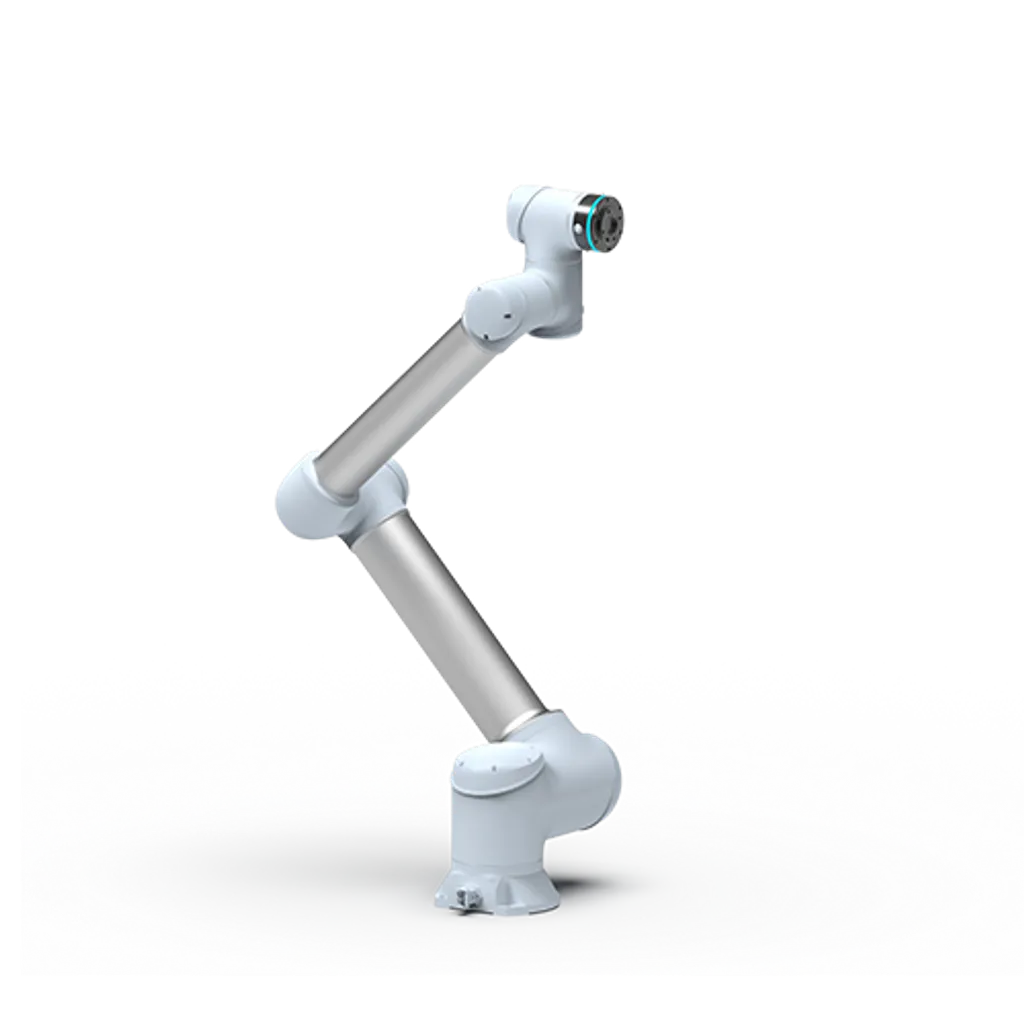
SIASUN is the only robot brand whose own factory was China’s first certified Industry 4.0 plant, and its 11-model lineup stretches from a 3 kg desktop cobot to a 210 kg arm reaching over 3 meters. That spread is not marketing - it reflects a genuine vertical range that few brands can match at any price tier. If you are sourcing for a cell that needs both a precision pick-and-place SCARA and a heavy-payload articulated arm, this is one of the few catalogs worth reading end to end before you call a distributor.
Who makes SIASUN?
SIASUN Robot & Automation Co., Ltd. (Shenzhen Stock Exchange: 300024) was founded in 2000 in Shenyang, Liaoning Province, China. The company name is a direct abbreviation of its parent institution: SIA stands for the Shenyang Institute of Automation, a division of the Chinese Academy of Sciences. CEO Qu Daokui led the spinout, and that state-research lineage shapes the company’s posture today - heavy on engineering depth, less aggressive on international sales infrastructure than its European or Japanese counterparts. Headquarters remain in Shenyang, with major industrial parks in Shanghai, Qingdao, Tianjin, and Wuxi. Sources: SIASUN About Us, Wikipedia.
The Shenyang campus is notable in its own right. It is the largest robotic industrial base in China and became the country’s first certified Industry 4.0 demonstration factory when it reached full operation in 2017 - a facility where robots manufacture robots, with annual capacity exceeding 10,000 robot sets. FY2024 revenue came in at roughly CNY 4.14 billion (approximately $547 M USD), with a net loss of around CNY 194 M, consistent with the heavy R&D spend the company has maintained throughout its scale-up phase. Products have shipped to 32 countries and are installed at over 3,000 enterprises. Primary verticals: automotive, electronics assembly, logistics and intralogistics, healthcare service robots, and welding automation.
Since 2024, SIASUN has been marketing what it calls a “Robot + AI” strategy. The practical implication is that its newer controllers embed large language model integration and real-time vision AI for natural-language instruction and unstructured-environment handling. Whether that translates to measurable productivity gains on your line is a commissioning question, not a spec-sheet question - but it does mean the software stack is evolving faster than the hardware catalog. Plan your integration timeline accordingly.
What types of robots does SIASUN make?
The 11-model catalog breaks down into three families: collaborative robots (cobots), SCARA robots, and traditional articulated arms. All 11 catalogued models are dry industrial arms. No cleanroom or IP-rated washdown variants appear in the current database - a real constraint if your environment runs coolant, wash cycles, or food-grade cleaning agents.
Cobots and articulated arms split the catalog evenly at four models each, with SCARAs rounding out the remaining three. That even split between cobots and articulated robots reflects deliberate catalog design - SIASUN is not a cobot-first brand or a heavy-payload specialist. It is positioning itself as a full-spectrum supplier that can cover most standard industrial motion tasks from a single vendor. SCARA robots get three slots, which is enough for a competitive payload-reach matrix (4 kg, 7 kg, 10 kg) without fragmentation.
The absence of delta/parallel robots, palletizing robots, or specialized welding variants in this database is worth noting. SIASUN almost certainly sells those form factors - its catalog on the main site is extensive - but the 11 models here represent the general-purpose articulated and precision assembly segment of the lineup.
Payload range: 3 kg to 210 kg
The 207 kg spread from lightest to heaviest is one of the widest in any single-brand database at this site. The median payload across the 11 models is 10 kg, which skews low because the cobot and SCARA families cluster between 3 and 25 kg. The articulated segment is where the payload story gets interesting: the SR210A-DW sits at 210 kg with a 3,053 mm reach, which puts it in the same tier as ABB’s IRB 6700 or Fanuc’s R-2000iC - arms that move engine blocks, press dies, and structural castings.
Source: Industrial Robotics Hub database, 11 SIASUN robots.
Below 25 kg, the catalog is dense and well-differentiated. Three cobots (GCR3, GCR7, GCR10) and three SCARAs (SA4A, SA7A, SA10A) cover the 3-10 kg precision assembly sweet spot, with the GCR25 cobot extending that range to 25 kg for heavier part handling that still needs human-safe force limits. Above 25 kg, coverage thins out: SR12A at 12 kg articulated, SR25A-35 at 35 kg, SR50A at 50 kg, then a large gap to the SR210A-DW at 210 kg. If your application sits in the 60-200 kg range, the catalog does not give you intermediate options - that gap is a real constraint for some machine-tending and palletizing scenarios.
Repeatability across the full 11-model range runs from 0.01 mm (SA4A SCARA) to 0.06 mm (SR210A-DW). For a 210 kg arm operating at 3 meters of reach, 0.06 mm is a solid number. The SCARA at 0.01 mm is exceptional and competitive with any SCARA on the market at that payload class.
SIASUN performance specs at a glance
TCP maximum speed is not published in the current database for any SIASUN model. The table below reflects what is verified. Do not use speed as a differentiator when evaluating this brand without pulling the current datasheet directly from en.siasun.com.
| Type | Robots | Payload median (kg) | Repeat median (mm) | Speed range (mm/s) | IP67+ |
|---|---|---|---|---|---|
| Cobot | 4 | 8.5 | 0.025 | - | 0% |
| SCARA | 3 | 7 | 0.02 | - | 0% |
| Articulated | 4 | 42.5 | 0.04 | - | 0% |
| All SIASUN | 11 | 10 | 0.03 | - | 0% |
The 0% IP67+ figure is the single largest gap in this catalog for applications in food and beverage, pharma, metalworking with coolant, or outdoor/harsh environments. SIASUN does not have a washdown-ready variant in this database. If IP protection matters to your application, this brand is not the right starting point - look at Staubli, Fanuc’s M-series, or Yaskawa’s food-grade lineup instead.
Complete SIASUN robot lineup
All 11 models. Max speed is not published in the database and is shown as - to avoid fabrication. IP rating is not listed for any model in the current catalog.
| Model | Type | Payload (kg) | Reach (mm) | Repeat (mm) | Max Speed (mm/s) | IP |
|---|---|---|---|---|---|---|
| GCR3 | Cobot | 3 | 618 | 0.02 | - | - |
| GCR7 | Cobot | 7 | 917 | 0.02 | - | - |
| GCR10 | Cobot | 10 | 1,300 | 0.03 | - | - |
| GCR25 | Cobot | 25 | 1,800 | 0.05 | - | - |
| SA4A | SCARA | 4 | 400 | 0.01 | - | - |
| SA7A | SCARA | 7 | 700 | 0.02 | - | - |
| SA10A | SCARA | 10 | 800 | 0.02 | - | - |
| SR12A | Articulated | 12 | 1,465 | 0.03 | - | - |
| SR25A-35 | Articulated | 35 | 1,803 | 0.05 | - | - |
| SR50A | Articulated | 50 | 2,158 | 0.05 | - | - |
| SR210A-DW | Articulated | 210 | 3,053 | 0.06 | - | - |
Sources: GCR10 product page, SR210A-DW product page, SR50A product page, SIASUN home.
Which SIASUN robot fits your application?
Electronics assembly, sub-5 kg parts, tight tolerances. The SA4A is the answer. At 0.01 mm repeatability and a compact 400 mm reach, it outperforms most SCARAs in its class on precision. If your part is small, the cycle envelope is tight, and you need the tightest repeat number in the SIASUN catalog, this is it. Its 400 mm reach is limiting - any cell layout that needs more than arm’s length from the center axis moves you to the SA7A or SA10A, which step up to 700 mm and 800 mm reach at 0.02 mm.
Human-collaborative light assembly, 5-15 kg payloads. The GCR10 hits the cobot sweet spot at 10 kg payload and 1,300 mm reach. It is the most commonly referenced SIASUN cobot for general-purpose assembly, kitting, and quality inspection tasks. The 0.03 mm repeat is adequate for most collaborative assembly scenarios. If your operator interaction footprint is large and you need the arm to reach across a shared workspace, the GCR25 at 1,800 mm reach with 25 kg payload covers that envelope - though at 0.05 mm repeat, it gives up some precision for reach.
Medium-payload machine tending, 30-60 kg parts. This is where the SIASUN catalog has its thinnest coverage. The SR25A-35 at 35 kg and 1,803 mm handles parts up to that weight at a reach suitable for standard CNC machine doors. The SR50A at 50 kg and 2,158 mm is the next step up. Both carry 0.05 mm repeat, which is acceptable for machine tending but not for precision fixtures. If your payload sits between 50 and 200 kg, SIASUN does not have a catalog answer in this database - you are looking at the 210 kg arm or a different brand for that range.
Heavy payload handling, automotive body-in-white, press tending. The SR210A-DW at 210 kg payload and 3,053 mm reach is a serious industrial arm. The “DW” designation typically indicates a dual-wrist or floor-mounted heavy configuration. At 0.06 mm repeatability for a 210 kg arm operating at over 3 meters, the performance is competitive with equivalent-tier Japanese and European arms. Commissioning a 210 kg arm from a Chinese manufacturer requires checking local support coverage carefully - SIASUN has 32-country distribution but that does not guarantee same-day field service everywhere.
Multi-robot cell needing both precision and heavy capacity. This is the scenario where SIASUN’s broad catalog is most valuable. A cell combining a SA4A for precision kitting, a GCR10 for human-collaborative inspection, and an SR50A for part transfer can theoretically run on a common SIASUN controller ecosystem - reducing integration complexity compared to mixing brands. The Robot + AI platform the company launched in 2024 may extend that advantage if natural-language cell programming actually ships in production-ready form, though verification of that claim belongs in your FAT, not your spec review.
The bottom line
SIASUN earns serious consideration in three specific situations. First, if you are buying in China or for a facility that heavily uses Chinese domestic supply chains, SIASUN’s scale, CAS research backing, and local support infrastructure are genuine advantages. Second, if you need to spec an entire cell from a single vendor spanning sub-10 kg precision assembly up to 50 kg or 210 kg heavy payload, no other Chinese brand has this range in a single catalog with this repeatability profile. Third, if the Robot + AI strategy delivers on natural-language controller integration in production, early adopters may gain a real programming-speed advantage - worth tracking on a 12-18 month horizon.
Where SIASUN falls short for some buyers: international after-sales support varies sharply by region, and you should verify parts lead times and field service SLAs before signing an order for the heavier arms. The complete absence of IP-rated variants in this database is a hard stop for food, pharma, and coolant environments. And the 60-200 kg payload gap - where most European and Japanese brands have two or three model options - leaves mid-range heavy users with no good catalog fit other than jumping all the way to the 210 kg arm.
The spec table above collapses to a straightforward decision tree. Under 25 kg with precision requirements: GCR or SA series. Collaborative cells: GCR series by reach. Articulated machine tending under 50 kg: SR12A or SR50A depending on part weight. Heavy payload automotive: SR210A-DW, with full scrutiny of your regional support contract. Anything requiring IP67 or above: go elsewhere. That is the honest read of what the catalog delivers.
For a brand whose flagship factory is the proof-of-concept for Chinese Industry 4.0 manufacturing, SIASUN ships robots that perform at spec. The question for most buyers outside China is not whether the hardware is credible - it is - but whether the local service infrastructure matches the ambition of the product lineup. Get that answer from an existing customer in your region before committing to the heavier arms. On the cobot and SCARA side, the risk calculus is more forgiving.
Compare these robots