Yaskawa Robots: 21 Motoman Models from 0.5 to 320 kg
Yaskawa built Japan's first all-electric robot in 1977 and has shipped 600,000+ since. Our 21-model Motoman tour spans 0.5 to 320 kg payloads.
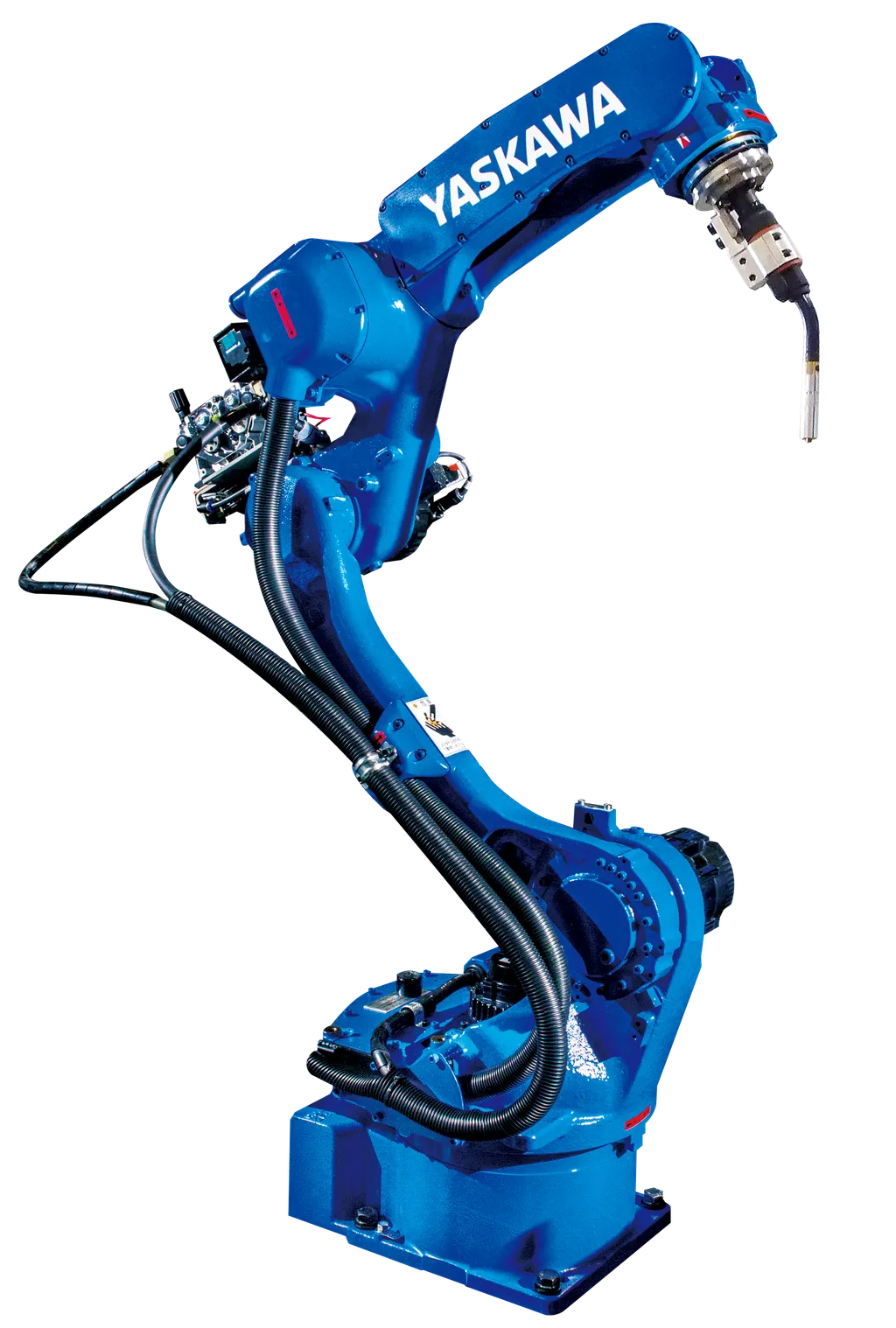
Yaskawa’s 21 Motoman models in our database stretch from a 0.5 kg tabletop MotoMINI to a 320 kg PL320 palletizer - a 640x payload spread from a single brand. That is not marketing copy. It reflects a company that has been building electric motors since 1915, completed Japan’s first all-electric industrial robot in 1977, and has spent nearly five decades methodically filling every segment of the industrial floor from precision electronics assembly to bagged-cement palletizing. If you are trying to place one of these 21 arms into a real application, this guide works through the full lineup by payload class, flags where the data has gaps, names the specific robot for five common scenarios, and closes with a buying-decision framework that reframes the spec table into four plain questions.
Who makes Yaskawa, and why does the history matter?
Yaskawa Electric Corporation was founded in 1915 in Kitakyushu, Fukuoka Prefecture, Japan - a full six decades before the industrial robot market existed as a defined category. The company’s original business was electric motors and mechanical gears. That origin is not trivia. Yaskawa still designs and manufactures its own servo motors, servo drives, and motion controllers, not just the six-axis arms that mount on them. When a Motoman robot moves, nearly every component in the drivetrain came from the same engineering organization. That vertical integration is a genuine competitive differentiator in a market where most OEMs assemble arms from third-party servo suppliers and pass the integration tolerances on to the end customer.
The robot division’s defining moment is 1977. Yaskawa completed the MOTOMAN-L10, Japan’s first fully electric industrial robot - a prototype had been exhibited in 1974, and the production version entered the field in 1977. This matters technically and historically. In 1977 most industrial robots were still hydraulic, inheriting their actuation technology from press-line transfer equipment. Hydraulic robots leak, require dedicated power units, are sensitive to fluid viscosity changes with temperature, and present serious contamination risks in food and electronics environments. An all-electric servo robot eliminates all of those problems. Yaskawa committed to the all-electric architecture when competitors were still routing hydraulic lines, and the six-axis electric robot that dominates every production floor today owes a direct technical debt to that work. It is also worth noting that the company coined the term “mechatronics” in 1969, predating the robot industry itself - Yaskawa was combining mechanical and electronic systems before the word existed.
The US arm, Motoman Inc., was incorporated July 18, 1989 as a 50/50 joint venture between Hobart Brothers and Yaskawa Electric America. Yaskawa bought out the joint venture fully in 1994, making Motoman a wholly owned subsidiary. Americas operations are headquartered in Miamisburg, Ohio, which functions as the regional engineering, sales, and service hub. Today Yaskawa reports more than 600,000 Motoman industrial robots installed globally - one of the largest installed bases of any robot manufacturer anywhere. Primary markets include arc welding, material handling, assembly, packaging, palletizing, coating, cutting, and automotive - a deliberately broad footprint. The full industrial lineup covers payload classes from sub-1 kg to 320+ kg without relying on partnerships or white-labeled products.
One thing the history tells you practically: if you buy a Yaskawa robot today, you are buying into an ecosystem that has been accumulating application engineers, trained integrators, documented failure modes, and regional spare-parts stock for over four decades. That ecosystem has real value when a production line goes down at 2 AM.
What types of robots does Yaskawa make?
The 21 Motoman models in our database fall into four distinct type categories. Articulated six-axis robots form the majority of the lineup. Collaborative robots (the HC series) make up the next largest group. Arc welding-specific models and palletizer-specific models split the remaining slots roughly evenly.
The 11 articulated models (GP and MH series) form the catalog’s backbone and are designed for general-purpose pick, place, assembly, machine tending, and material handling. These are the arms Yaskawa is historically most recognized for, and the GP series in particular has earned a strong reputation for payload-to-repeatability performance at competitive cycle times. The three AR-series welding robots are purpose-built for arc welding: the wrist geometry, cable routing, and conduit management on an AR arm are different from a general-purpose arm in ways that matter at the torch. You can weld with a GP arm and appropriate tooling, but an AR arm is optimized for the application at the mechanical level.
The three PL-series palletizers are a specialized category that buyers sometimes confuse with heavy general-purpose arms. A palletizer has a motion profile, work envelope, and end-of-arm tooling interface built around stacking product on a flat pallet surface. The motion is predominantly vertical and horizontal, reach is optimized for full pallet height from a fixed base, and wrist options are narrower than a GP arm of equivalent payload. These are end-of-line machines. The four HC-series cobots are a more recent addition to the lineup, covering 10-30 kg with force-torque sensing and two-speed collaborative modes. Yaskawa’s HC series is notable in the cobot market for its DTP (Dual-Task Performance) capability, which allows the arm to run at full industrial speed inside a guarded zone and drop to safe collaborative speed when a worker enters - a hybrid operating mode that most pure cobots cannot match.
The type breakdown tells you something practical about where Yaskawa puts its development resources. If your application is general handling or assembly, Yaskawa has more model options, more price points, a deeper pool of trained integrators, and more accumulated application data in articulated robots than in any other category. Everything else is purpose-built to a specific end use, and you should evaluate those models with that specificity in mind.
Payload range: 0.5 kg to 320 kg
The payload spread across these 21 models is unusual even by major-brand standards. Most robot OEMs have a 10-20x spread between their lightest and heaviest arm. Yaskawa’s is 640x: the 0.5 kg MotoMINI at one end, the 320 kg PL320 at the other. The median payload across the full lineup is 20 kg, which sits roughly where a mid-size general-purpose arm lands. That median is somewhat deceptive because the three palletizers pull the distribution toward high payloads while the compact GP-series arms anchor the light end. The real cluster - where Yaskawa has done the most development work and where the majority of industrial applications land - is the 7-50 kg range, which holds 14 of the 21 models.
Source: Industrial Robotics Hub database, 21 Yaskawa robots.
Three things stand out in the chart. First, there is a dense cluster of 7-25 kg models covering articulated, welding, and cobot variants. This is the segment most relevant to automotive body assembly, general manufacturing, and electronics production - and it is where Yaskawa has invested the most development cycles. Second, there is a clear gap between the 30 kg HC30PL cobot and the 50 kg GP50 articulated arm. An application requiring 31-49 kg in a collaborative configuration has no Yaskawa answer today; you would need to either step up to the GP50 with conventional guarding or look at a different brand for that specific window. Third, the three palletizers (PL80, PL190, PL320) are visually isolated at the far right - a separate weight class that should be evaluated on palletizer-specific criteria rather than compared directly against GP-series arms.
Reach data reinforces the payload pattern. The MotoMINI’s 350 mm reach is correct for its bench-top scale. The PL190 and PL320 both reach 3,159 mm - just over three meters - which is what a palletizer needs to stack full pallet heights from a fixed base position without repositioning. The GP280, despite its 280 kg payload, reaches only 2,446 mm. That shorter reach compared to the palletizers is a deliberate structural trade-off: an arm built to handle 280 kg of inertia needs heavier link geometry, which limits maximum reach for a given base footprint. Foundation loading and floor-slab thickness calculations are mandatory before installing a GP280.
Yaskawa performance specs at a glance
The table below aggregates the 21 models by type with median values across each category. Two data-coverage notes apply before reading the numbers. First, speed data in our database exists for only three models, all cobots, all rated at 2,000 mm/s. The articulated, welding, and palletizer models have no speed data in our current database. This is a coverage gap, not an indication that those robots lack published speed specs - Yaskawa publishes full speed data on all models. Second, IP rating data is absent for all 21 models in our database, which produces a 0% IP67+ figure across the board. Again, this is a database coverage limitation. Verify IP ratings directly with Yaskawa if your application involves food, wash-down, outdoor installation, or any environment where ingress protection matters.
| Type | Robots | Payload median (kg) | Repeatability median (mm) | Speed range (mm/s) | IP67+ |
|---|---|---|---|---|---|
| Articulated | 11 | 12 | 0.03 | not in DB | 0% |
| Cobot | 4 | 15 | 0.075 | 2000 (3 of 4) | 0% |
| Welding | 3 | 12 | 0.02 | not in DB | 0% |
| Palletizer | 3 | 190 | 0.05 | not in DB | 0% |
Several observations from the repeatability column. The welding robots carry the tightest median at 0.02 mm, which is consistent with what arc welding demands. A 0.1 mm wander in torch position across a weld seam produces visible quality variation in a finished joint - weld defects that fail inspection and require grinding and re-welding. Yaskawa’s AR-series designation implies those arms are built to the tighter mechanical tolerance the process requires. The articulated GP series sits at 0.03 mm median, which is competitive with any general-purpose arm in this payload class from any major OEM. The cobots sit at 0.075 mm median, which is notably looser than the industrial arms. This is not a manufacturing deficiency - it reflects the compliance built into the HC-series force-sensing architecture. A cobot arm that yields to human contact to maintain safety cannot maintain the same path rigidity under load as a rigid industrial arm under identical conditions. The compliance is the safety mechanism, and the looser repeatability is the cost.
Palletizer repeatability at 0.05 mm median sounds tighter than a box-stacking application needs, and in isolation it is. But palletizers build exact pallet patterns layer by layer, and accumulated positional error across a full pallet height translates into layer-to-layer misalignment that causes stack instability and downstream conveyor problems. 0.05 mm is appropriate, not overengineered, for the application.
Complete Yaskawa robot lineup
All 21 models, sorted by payload ascending. Model names link to full robot pages in our database. Dash (-) entries indicate fields with no published data in our current database - not that the spec does not exist on the product.
| Model | Type | Payload (kg) | Reach (mm) | Repeat (mm) | Max Speed (mm/s) | IP |
|---|---|---|---|---|---|---|
| MotoMINI | Articulated | 0.5 | 350 | 0.02 | - | - |
| AR900 | Welding | 7 | 927 | 0.01 | - | - |
| GP7 | Articulated | 7 | 927 | 0.01 | - | - |
| Motoman GP8 | Articulated | 8 | 727 | 0.02 | - | - |
| Motoman HC10 | Cobot | 10 | 1200 | 0.10 | - | - |
| HC10DTP | Cobot | 10 | 1200 | 0.05 | 2000 | - |
| AR1440 | Welding | 12 | 1440 | 0.02 | - | - |
| AR2010 | Welding | 12 | 2010 | 0.03 | - | - |
| GP12 | Articulated | 12 | 1440 | 0.02 | - | - |
| MH12 | Articulated | 12 | 1440 | 0.08 | - | - |
| HC20DTP | Cobot | 20 | 1700 | 0.05 | 2000 | - |
| MH24 | Articulated | 24 | 1730 | 0.06 | - | - |
| GP25 | Articulated | 25 | 1730 | 0.02 | - | - |
| HC30PL | Cobot | 30 | 1700 | 0.05 | 2000 | - |
| GP50 | Articulated | 50 | 2061 | 0.03 | - | - |
| PL80 | Palletizer | 80 | 2061 | 0.03 | - | - |
| GP88 | Articulated | 88 | 2236 | 0.03 | - | - |
| GP180 | Articulated | 180 | 2702 | 0.05 | - | - |
| PL190 | Palletizer | 190 | 3159 | 0.05 | - | - |
| GP280 | Articulated | 280 | 2446 | 0.05 | - | - |
| PL320 | Palletizer | 320 | 3159 | 0.05 | - | - |
MH vs GP series note. The MH12 and MH24 have noticeably looser published repeatability than their GP equivalents. MH12 is at 0.08 mm versus GP12 at 0.02 mm. MH24 is at 0.06 mm versus GP25 at 0.02 mm. The MH series is an older design generation. If you are speccing a new installation, the GP series is the correct choice if repeatability under 0.04 mm matters to your process. The only reason to deliberately choose an MH arm for new installation is a price negotiation where an older arm is available at significant discount, or a retrofit where the MH mounting footprint matches existing tooling. For used-equipment buyers evaluating refurbished MH arms, factor the looser repeatability into your process validation plan.
HC10 vs HC10DTP note. Both models share 10 kg payload and 1200 mm reach. The HC10DTP has tighter repeatability (0.05 mm vs 0.10 mm on the base HC10) and published speed data (2000 mm/s). The DTP designation - Dual-Task Performance - indicates the ability to operate at full industrial speed inside a guarded zone and switch to safe collaboration speed when a worker enters. This is a meaningfully different operating mode from a cobot that runs at collaboration-safe speed at all times. If your cell design includes guarded zones that workers enter only during setup or maintenance, the HC10DTP running at full speed during production and slowing only during human entry is a throughput advantage over pure-cobot architectures. Confirm current specifications on the HC series page before you spec either variant, as Yaskawa has updated the HC line over several production generations.
GP7 vs GP8 note. These two look nearly interchangeable on payload (7 kg vs 8 kg) but differ meaningfully on reach: GP7 reaches 927 mm while the Motoman GP8 reaches only 727 mm. The GP8 is a compact arm designed for tight-cell machine tending where workspace is the constraint, not payload. The GP7 covers more reach at the cost of a slightly larger footprint. Confirm which constraint - workspace or payload - is binding in your cell before choosing between them.
AR900 and GP7 overlap. Both carry 7 kg payload and both reach 927 mm, with the same 0.01 mm repeatability. The AR900 is a welding-optimized arm with wrist cable routing designed for torch conduit management. The GP7 is a general-purpose arm. If you are welding, use the AR900. If you are not welding, the AR900’s torch-optimized geometry adds no value and the GP7 is the cleaner choice.
Which Yaskawa robot fits your application?
The lineup is wide enough that vague guidance is useless. Here are five concrete scenarios with specific model recommendations and the reasoning behind each.
Scenario 1: Arc welding, single-station cell, standard torch, 1.0-2.0 m part envelope.
The AR1440 is the default answer for most single-station welding cells. At 12 kg payload, 1440 mm reach, and 0.02 mm repeatability, it covers the geometry of typical automotive stampings, structural brackets, and fabricated assemblies without over-reaching into a larger footprint than your cell requires. Yaskawa publishes a detailed cable routing system for the AR1440 that runs the torch conduit through the wrist housing rather than externally - this reduces conduit wear over long run cycles and keeps the cables clear of the work envelope. See the AR1440 product page for conduit routing specifics.
If your parts or fixtures extend beyond 1440 mm from the robot base - large structural weldments, long frame sections, or applications where the robot base is mounted at a distance from the work surface - step up to the AR2010 for its 2010 mm reach. The AR2010 carries 12 kg at 0.03 mm repeatability, a slight repeatability trade versus the AR1440, but adequate for structural welding applications where 0.03 mm tolerance is well within process requirements.
For small-part welding in a very confined cell - think electronics enclosures, sensor housings, small brackets - the AR900 at 927 mm reach and 0.01 mm repeatability is purpose-built for that envelope. The 0.01 mm repeatability is the tightest in the Yaskawa lineup and appropriate when weld positioning accuracy directly affects functional performance of the finished part.
Scenario 2: CNC machine tending, 8-25 kg part weight, high positional accuracy required.
This is the GP series’ home territory, and Yaskawa has the broadest depth here of any model range in the lineup. The GP12 at 12 kg and 1440 mm reach covers mid-size machined parts - engine mounts, gearbox housings, hydraulic manifolds - at 0.02 mm repeatability, which is adequate for part-in-fixture positioning in most CNC applications where the robot places a part into a locating fixture and the fixture provides final datum control. The GP25 at 25 kg and 1730 mm reach handles heavier castings or applications where the robot must carry both the raw part and a finished part simultaneously (load-load or unload-load cycles). Both run on the YRC1000 controller, which is relevant for multi-robot cells where simplified spares and unified programming reduce maintenance overhead.
The GP7 covers lighter parts at 927 mm reach when the machine is close to the robot base and a smaller physical footprint matters. The Motoman GP8 at 727 mm reach is the most compact option and is appropriate for very tight cells where workspace is the primary design constraint.
One important point about machine tending: if you are evaluating used MH12 or MH24 arms for a tending application because they are available at lower cost, verify the repeatability against your fixturing tolerances before committing. The MH12 at 0.08 mm is considerably looser than the GP12 at 0.02 mm, and in a tending application where the robot must reliably drop a part into a 0.05 mm tolerance fixture, that difference matters.
Scenario 3: Collaborative assembly - human-robot shared workspace, variable force sensing.
The HC series is Yaskawa’s answer. The practical decision within the HC lineup comes down to payload and whether you need DTP capability. For most light assembly tasks - inserting components, applying fasteners, guiding parts into fixtures - the HC10DTP at 10 kg and 1200 mm reach handles the majority of applications. Its 0.05 mm repeatability is adequate for assembly insertion tasks, and the 2000 mm/s rated speed at full-industrial mode is competitive with conventional industrial arms when running in the guarded zone.
If your parts or fixtures are heavier, the HC20DTP extends the collaborative range to 20 kg at 1700 mm reach. The HC30PL at 30 kg is unusual in the cobot market - 30 kg collaborative payload with force-sensing safety is not common, and it opens Yaskawa’s cobot lineup to applications like heavy component kitting, pallet layer building in confined spaces, or collaborative bin-emptying where product weight exceeds what smaller cobots can handle. The HC30PL’s 1700 mm reach is the same as the HC20DTP, so reach is not the distinguishing factor - payload is.
One design consideration for HC-series cells: the DTP speed-switching behavior requires proper cell design to function as intended. The safe collaborative speed zone and the full-speed guarded zone must be defined correctly in the safety system, and the sensor integration that triggers speed switching must be validated to the appropriate safety integrity level for your facility. Do not assume DTP operation is a drop-in solution without a proper safety assessment.
Scenario 4: Heavy general-purpose handling - press-to-press transfer, large casting, structural components.
Yaskawa’s GP-series heavy arms are the most capable in this segment. The GP88 at 88 kg and 2236 mm reach covers mid-size automotive press transfers, engine block handling, and heavy fixture manipulation. At 0.03 mm repeatability, the GP88 is precise enough for gauged-part handling where the robot must orient a part accurately before placing it into a downstream fixture or press die.
The GP180 at 180 kg and 2702 mm reach handles large structural sections and heavy casting operations. A 180 kg payload arm with 2.7 m reach can span a significant press line footprint from a single base position, which reduces the number of robots needed in a transfer press lane. At 0.05 mm repeatability, the GP180 is slightly looser than the GP88 - consistent with the structural trade-offs of a heavier arm - but still within tolerance for the vast majority of heavy-part handling applications.
The GP280 at 280 kg and 2446 mm reach is one of the highest-payload general-purpose six-axis robots from any major OEM. Applications at this scale include very heavy casting handling, large structural weldment positioning, and automotive frame transfer. The shorter reach (2446 mm vs 2702 mm for the GP180) is a structural necessity - the GP280’s link cross-sections must be larger to handle 280 kg inertia, which shortens maximum reach for a given base size. Floor-slab thickness, anchor bolt patterns, and inertia loads during worst-case acceleration all require engineering review before installing a GP280.
Scenario 5: End-of-line palletizing - carton, bag, or mixed-case stacking.
The PL series is purpose-built for this. The PL80 handles up to 80 kg per pick at 2061 mm reach, which covers carton palletizing, bagged goods under 80 kg per bag, and mixed-case pallet building at standard industrial line speeds. The 0.03 mm repeatability is adequate for repeatable pallet pattern accuracy across a full pallet height.
The PL190 and PL320 both reach 3159 mm and share a nearly identical work envelope - the relevant difference between them is payload capacity. PL190 is the right choice for heavy beverage cases, chemical drums, heavy-bag goods, and applications where per-pick weight falls in the 80-190 kg range. PL320 is for bagged cement, large liquid containers, heavy-density industrial goods, and applications where the pick weight approaches or exceeds 200 kg per cycle. These robots have a motion profile tuned specifically for the repetitive vertical-horizontal palletizing cycle, and their wrist options are designed around common end-of-arm tooling (vacuum heads, clamp grippers, layer pads). They are not general-purpose arms and should not be evaluated as such.
Edge case: sub-1 kg precision assembly, electronics, or laboratory automation.
The MotoMINI at 0.5 kg and 350 mm reach is a genuine niche product. Its 0.02 mm repeatability matches the GP12 and GP25 - impressive for a robot this small, and indicative of Yaskawa applying the same servo-drive technology across the entire lineup rather than using lower-grade components in the compact model. It is appropriate for micro-assembly, semiconductor test handling, lab automation, and any application where the robot must fit on a workbench or inside a very small cell enclosure. Outside of those specific constraints, most applications that land in the 0.5-5 kg range are better served by the GP7 or GP8, which offer substantially more reach headroom and a more flexible mounting geometry.
The bottom line
Reframing the 21-model spec table into a buying decision comes down to four questions, asked in sequence.
Question 1: Is the application arc welding? If yes, start with the AR series. Match reach to your cell geometry: AR900 for small-part cells under 1 m, AR1440 for standard single-station cells, AR2010 for large-part or long-reach cells. Do not use a general-purpose GP arm for welding unless there is a specific integration reason - the AR wrist design and cable routing are worth the application-specific arm.
Question 2: Is the payload under 30 kg and does the application require human-robot collaboration or active force sensing? If yes, go HC series and pick payload (10/20/30 kg). If collaboration is not required and repeatability under 0.03 mm is needed, go GP series instead - the HC arms trade repeatability for compliance, and that trade is only worth making if the collaboration capability is actually used.
Question 3: Is the payload 50 kg or above with a general-purpose six-axis motion requirement? GP50 for 50 kg, GP88 for 50-88 kg, GP180 for 90-180 kg, GP280 for 180-280 kg. These arms represent Yaskawa’s strongest competitive position in the market - vertically integrated servo drivetrains, class-leading repeatability at payload, and the deepest integrator ecosystem of any category in the lineup.
Question 4: Is the application end-of-line pallet stacking? PL80 for under 80 kg per pick. PL190 for 80-190 kg. PL320 for 190-320 kg. Do not buy a PL arm for general-purpose use.
Who should buy Yaskawa. Manufacturers running high-uptime production lines in automotive, heavy manufacturing, or structured palletizing where unplanned downtime cost exceeds the arm cost several times over. Buyers who value vertically integrated drivetrain quality and the reduced integration risk that comes from one company controlling servos, drives, controller, and arm. Buyers who have existing YRC1000 or YRC1000micro controller installations and want to add capacity without adding a new controller platform. Operations where the 600,000+ global installed base translates into real local advantages - trained maintenance staff, nearby spare parts, integrators who have seen the failure modes before.
Who should look elsewhere. Buyers with food, wash-down, or outdoor IP requirements should verify ratings directly with Yaskawa before speccing anything from this database - IP coverage is a gap in our data, not a product gap, but you cannot rely on our table for that decision. Buyers needing a 31-49 kg collaborative robot have no current Yaskawa option and should evaluate alternatives in that window. Cost-sensitive buyers running simple pick-and-place under 5 kg at low duty cycle will find cheaper options from Chinese OEMs or in the SCARA segment, though they will trade Yaskawa’s repeatability and ecosystem in doing so.
Yaskawa does not make the cheapest robot in any category. It makes robots with a long service track record, vertically integrated drivetrains, and a technical organization that has been fielding industrial robot questions since before most competing robot companies existed. For a production environment where a stopped robot line costs thousands of dollars per hour, that background justifies the price difference. For a proof-of-concept bench where a robot runs two hours a day, it may not.
Specs sourced from the Industrial Robotics Hub database, 21 models. IP and speed data coverage is incomplete for this brand. Verify current datasheets at yaskawa-global.com and the Motoman product catalog before finalizing specifications.
Compare these robots