Kawasaki's RL030N 8-DoF Arm Powers Dexterity's Physical-AI Warehouse Push
Kawasaki Robotics and Dexterity are expanding their collaboration around the RL030N, an 8-degree-of-freedom arm built specifically for Dexterity's AI-trained warehouse manipulator, targeting trailer loading and unloading at production scale.
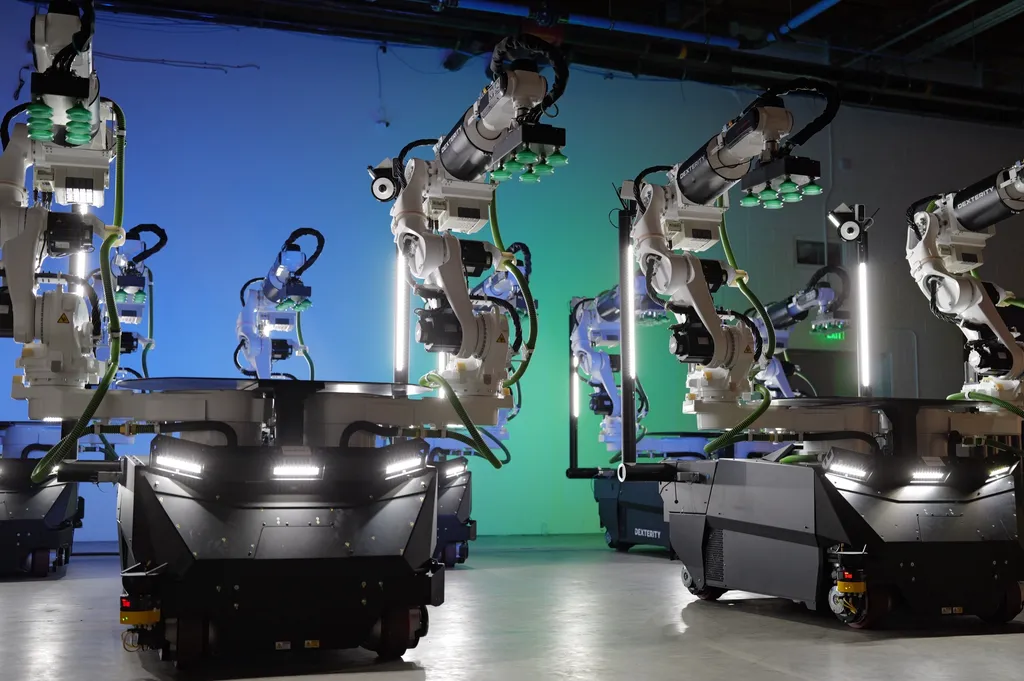
Kawasaki Robotics and Dexterity are expanding their collaboration around the RL030N, an 8-degree-of-freedom robot arm Kawasaki engineered specifically to Dexterity’s specifications, to scale up warehouse deployments of Dexterity’s “Mech” manipulator, starting with trailer loading and unloading. The companies announced the expanded partnership on June 23, 2026, and showcased the arm on the floor at Automate 2026 (June 22-26, Chicago). This piece is a catch-up: Industrial Robotics Hub’s news desk had a three-day scheduling gap, so we’re covering a real, still-developing story a month after the announcement rather than treating it as breaking news.
What was announced
Kawasaki Robotics, Kawasaki Heavy Industries’ industrial-robotics arm, and Dexterity Inc., a Redwood City physical-AI robotics company, jointly announced an expanded collaboration built around two pieces of hardware: Kawasaki’s RL030N arm and Dexterity’s Mech mobile manipulator. According to the joint announcement, Dexterity is now expanding production and scaling deployment of Mech units that use the RL030N as their manipulator arm, targeting warehouse logistics tasks, specifically trailer loading and trailer unloading.
The arm itself is the notable engineering detail. Standard industrial arms, including the bulk of the 56-plus models in our own robot database, use six axes of articulation. The RL030N uses eight. Kawasaki says the extra articulation axis lets the arm avoid kinematic singularities, the orientations where a 6-axis arm’s wrist joints line up and the arm loses a degree of freedom, which matters when a robot has to work in confined, irregular spaces like the inside of a trailer rather than a fixed factory cell. Per Kawasaki’s own RL030N database entry, which lists it as an announced, unverified-spec 2026 model, the arm carries a 30 kg payload rating and 0.03 mm repeatability, figures Kawasaki has published but has not attached to a standard public datasheet.
Critically, the arm is not a Kawasaki concept piece bolted onto someone else’s robot. Per the companies’ joint statement, “Dexterity’s Mech design and warehouse logistics requirements shaped the arm; Kawasaki Robotics and Kawasaki Heavy Industries brought precision engineering and manufacturing expertise to turn those requirements into a production-ready 8 DoF robot arm platform.” That is a reversal of the usual robotics-integration sequence, where a systems integrator picks an off-the-shelf arm and builds tooling around it. Here, the customer’s application defined the arm’s kinematics before Kawasaki finalized the design.
Why warehouse logistics breaks factory-style automation
The companies frame the problem in terms that explain why this required a purpose-built arm rather than an existing catalog model. As Kawasaki put it in the announcement: factory automation is built around “precision, repeatability, fixed workcells, controlled material flow, and minimal unexpected contact.” Warehouse logistics is the opposite. Packages “arrive in different sizes, weights, shapes, orientations, and conditions,” boxes “shift, fall, deform, and stack unpredictably,” and contact with packages, containers, conveyors, or other equipment is treated as a normal part of the job rather than a fault condition a robot has to avoid entirely.
That is the design brief the RL030N answers: an arm that is, in the companies’ words, “lightweight, dexterous, long-reaching, reliable, and robust enough for unavoidable contact.” The arm runs on Kawasaki’s open KRNX real-time control API, which the company built to let external AI software, ROS-based tooling, and third-party orchestration systems drive the arm directly, rather than requiring a robot to be programmed through Kawasaki’s own proprietary teach-pendant workflow for every task variation. Dexterity pairs the RL030N with its Mech mobile hardware and what it calls the Foresight World Model, the proprietary AI system at the center of its “Physical AI” software stack. Dexterity has not published details on Foresight’s training data or independent performance benchmarks in this announcement, so its actual capability, beyond the vendor description, is not independently verified here.
What’s actually new versus what’s still a pitch
What’s concretely confirmed: Kawasaki built a real, shipping 8-DoF arm to Dexterity’s specifications, that arm is now in expanded production for Dexterity’s Mech units, and the initial application is trailer loading and unloading, a task warehouse operators have struggled to automate because trailer interiors are irregular, dimly lit, and packed inconsistently load to load. Both companies showcased the hardware live at Automate 2026 rather than only in press materials, which is a meaningfully higher bar than a slide-deck announcement.
What’s not yet independently confirmed: how well it actually performs in production. Neither company disclosed cycle times, pick-success rates, uptime, or how many Mech/RL030N units are currently deployed versus planned. “Expanding production and scaling deployment” is a statement of direction, not a disclosed volume. The Foresight World Model’s actual generalization performance, how well it handles a package shape or trailer configuration it hasn’t encountered before, is likewise a claim without a public benchmark attached to it in this announcement.
Why the 8-axis design matters beyond this one deal
The RL030N’s extra axis is worth watching independent of Dexterity specifically, because it signals where warehouse-robotics arm design is heading. Fixed 6-axis arms dominate factory floors because factories are engineered to avoid the situations where a 6-axis arm loses a degree of freedom. Warehouses cannot be engineered that way, trailers, totes, and conveyor lines are inherently variable, so an arm built for that environment needs the extra articulation as a structural hedge rather than a nice-to-have. If Kawasaki’s approach, an arm co-designed with the AI software company that will drive it, rather than a general-purpose arm retrofitted with third-party AI, works in production, expect other industrial-arm makers chasing the warehouse-logistics and physical-AI segment to follow with similarly purpose-built, higher-DoF platforms rather than adapting existing 6-axis catalog arms.
Sources
- Kawasaki Robotics and Dexterity Expand Collaboration to Scale Physical AI for Warehouse Logistics — Kawasaki Robotics, Jun 23, 2026
- Kawasaki Robotics and Dexterity Expand Collaboration to Scale Physical AI for Warehouse Logistics — RoboticsTomorrow, Jun 23, 2026
- Kawasaki Robotics and Dexterity Expand Collaboration to Scale Physical AI for Warehouse Logistics — PR Newswire, Jun 23, 2026
Robots mentioned
Tap a card to open the full spec sheet.
Frequently asked questions
Why does the RL030N use 8 axes instead of the usual 6? +
Kawasaki and Dexterity say the extra articulation axis lets the arm avoid kinematic singularities and reach into confined, variable warehouse workflows, such as the tight, irregular interior of a delivery trailer, that a standard 6-axis industrial arm's kinematics struggle with. It also gives Dexterity's motion-planning software an extra degree of freedom to route around obstacles rather than stopping.
What is Dexterity's Foresight World Model? +
Dexterity describes Foresight as the proprietary 'world model' at the core of its Physical AI software stack, paired with the RL030N arm and Dexterity's Mech mobile hardware. The companies' joint announcement does not disclose what data Foresight is trained on or publish independent benchmarks, so treat it as a company-described capability, not an independently verified one.
What tasks is the RL030N actually doing today? +
Per Kawasaki and Dexterity, Dexterity is expanding production and deployment of Mech units built around the RL030N specifically for trailer loading and unloading in warehouse logistics, one of the highest-volume, highest-injury-risk manual tasks in a distribution center.
How is this different from a traditional pre-programmed warehouse robot? +
Conventional warehouse automation is built around fixed cells, consistent box geometry, and pre-taught motion paths, which is why it struggles with logistics' variability: packages that differ in size, weight, and orientation, and boxes that shift, fall, or deform. The RL030N is built on Kawasaki's open KRNX real-time control API specifically so external AI software, including Dexterity's Foresight model and ROS-based tooling, can drive the arm's motion dynamically instead of replaying a fixed program.
More news