Hirebotics Adds Line Tracking, Linear Rail to Cobot Lineup at IMTS
Hirebotics unveiled conveyor line tracking for its Cobot Painter and a modular linear rail for its whole cobot family at IMTS 2026, aimed at parts too large or too mobile for a fixed work envelope.
Hirebotics, the Nashville-based maker of no-code collaborative robot systems, used the opening day of IMTS 2026 to announce two capabilities aimed at a problem every fabricator with cobots eventually runs into: parts that are either too large or too mobile to fit inside a robot’s native work envelope. The company unveiled conveyor line tracking for its Cobot Painter and a modular linear rail that extends the reach of its entire cobot family, spanning welding, plasma cutting, and painting, and put both on the show floor at Booth 236341 in McCormick Place’s North Hall through September 19, according to Hirebotics’ announcement, republished in full by RoboticsTomorrow.
Founded in 2015, Hirebotics built its business on stripping out the two things that traditionally keep small and mid-size fabricators away from robotics: dedicated programmers and fixed, hard-to-move installations. Its cobot welding, cutting, and painting systems all run on Beacon, a cloud-based, no-code platform that lets an operator hand-guide a tool through a path once and run the job from a phone or tablet afterward. The two additions announced this week extend that same philosophy to a harder problem: what happens when the part itself won’t hold still, or won’t fit.
Painting on a moving line
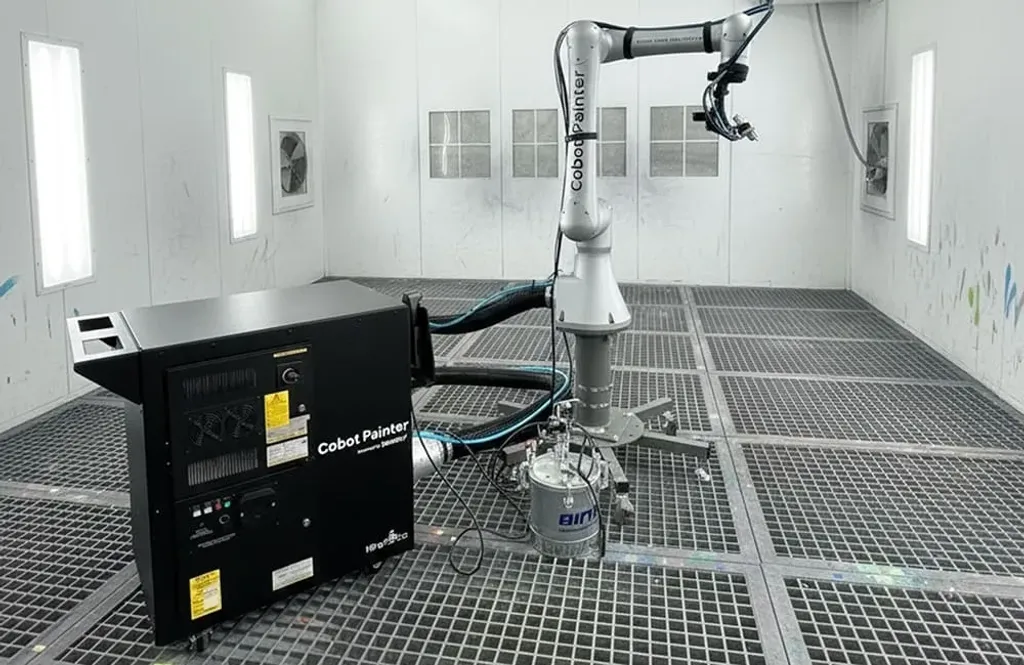
Hirebotics’ Cobot Painter is built on a FANUC CRX-10iA/L Paint arm, a 10 kg-payload, 1,418 mm-reach (55.82-inch) collaborative robot that Hirebotics markets as the industry’s first explosion-proof collaborative paint cobot, IECEx- and ATEX-certified for use in hazardous coating environments across the US, Canada, Japan, Korea, China, Taiwan, and Brazil. The FANUC CRX-10iA/L’s own published specifications back that reach figure exactly: 1,418 mm, a 10 kg payload rating, a 40 kg arm weight, IP67 sealing at both the arm and wrist, and drag-and-drop tablet programming through FANUC’s R-30iB Mini Plus controller, the same underlying hardware Hirebotics wraps in its own Beacon software layer for spray-path teaching.
Until now, that arm painted stationary parts: something rolled into a booth, coated, and rolled back out. The new line-tracking capability changes that. Per Hirebotics, an encoder and sensor combination detects conveyor movement and the arrival of a part, and Beacon is used to calibrate the direction and speed of that conveyor during setup, the same no-code interface used to teach spray paths in the first place. Once running, the system automatically detects an arriving part, begins its programmed operation, and follows the part through the robot’s working area, continuously compensating as conveyor speed changes, without a stop-and-paint cycle interrupting the line.
“If parts already move through finishing on a line, manufacturers shouldn’t have to stop that process just to accommodate the robot,” said Matthew Bush, Hirebotics’ co-founder and CEO, in the company’s announcement. “Line tracking allows the Cobot Painter to work with the way production already moves, while Beacon keeps setup approachable for the people actually running it.”
Hirebotics frames this against traditional robotic line tracking, which the company says typically requires specialized programming and integration work, a nontrivial barrier for the same small-shop customers Hirebotics has built its whole platform around avoiding.
A rail for parts too big for the cobot
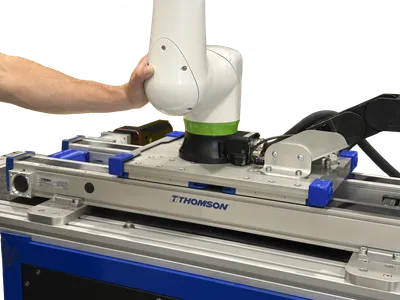
The second announcement is not painting-specific. Hirebotics’ cobots, per the release, have a 68.9-inch native reach; the company’s new modular linear rail, sold in 5-foot increments or custom lengths, lets a cobot travel along the length of a workpiece rather than requiring the part to be repositioned to stay within that reach. Hirebotics puts the practical ceiling for a fixed-position cobot at “nearly 140 inches” of working envelope, well short of what a 12-foot frame, a 20-foot structural assembly, or a large weldment needs.
The rail is designed to work across Hirebotics’ welding, plasma-cutting, and painting product lines rather than being tied to one system, meaning a single rail purchase could, in principle, serve whichever cobot a shop mounts on it. It ships today with manual positioning only; Hirebotics says Beacon-guided position verification is planned next, followed by full automated positioning by the end of 2026, at which point the cobot would move between positions on the rail on its own rather than requiring an operator to slide and lock it manually.
“Manufacturers shouldn’t have to redesign their work around the physical limitations of automation, it should work with the line they already have,” Bush said. “By removing the fixed-position limitation and extending the reach of the cobots through the linear rails or the line tracker or both, manufacturers can accomplish their work without changing the experience that made these cobots approachable in the first place.”
Why this fits Hirebotics’ pattern
This is the same company that told IRH last month it had fielded 58 Cobot Welders at Tate Inc., a data-center infrastructure fabricator, citing a 12x per-welder throughput gain across three plants, and that Tate planned to add Cobot Painter units next specifically because operators trained on the welding cobots wouldn’t need retraining on Beacon to run them. That underlying bet, that one no-code platform can carry a shop from welding to cutting to painting without new specialists at each step, is what the rail and line tracking extend rather than replace. Neither announcement introduces new robot hardware; both are software- and mechanical-accessory layers on cobots Hirebotics already sells, which is consistent with a company whose stated goal, in Bush’s words, has been to avoid “forcing the application to fit the robot’s capabilities” from the start.
Sources
- Hirebotics Expands Cobot Reach and Flexibility with New Line Tracking and Linear Rail Capabilities at IMTS — RoboticsTomorrow, Sep 14, 2026
- Hirebotics at IMTS 2026 — Hirebotics
- Cobot Painter — Hirebotics
Robots mentioned
Tap a card to open the full spec sheet.
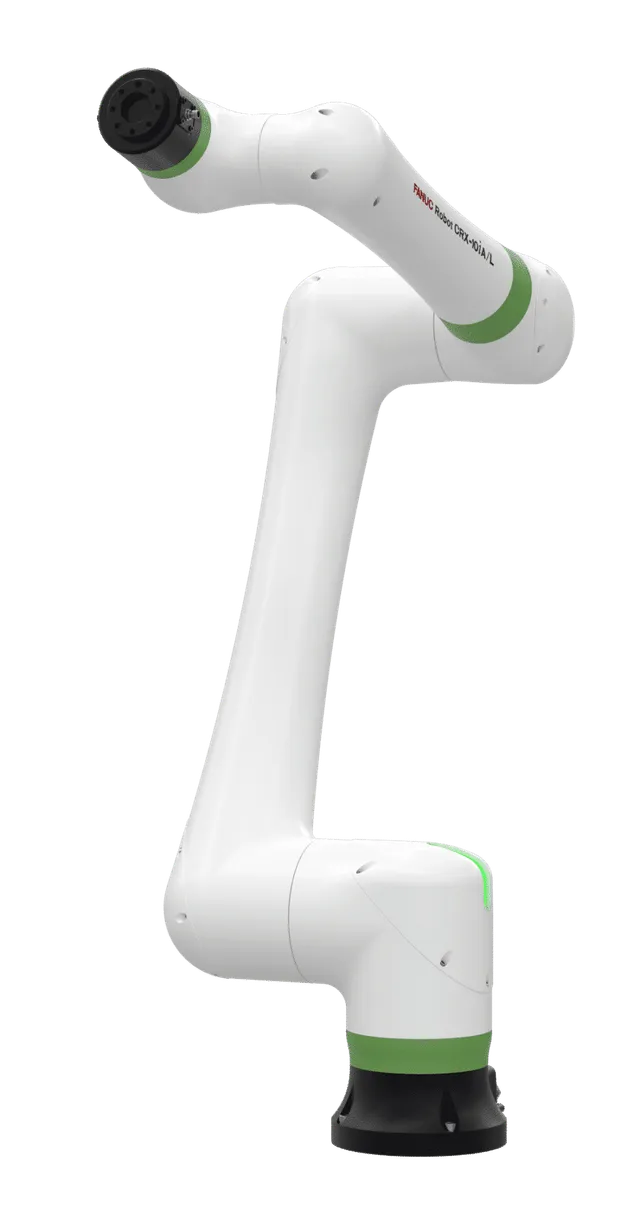
Collaborative
CRX-10iA/LFrequently asked questions
What exactly did Hirebotics announce, and when? +
On September 14, 2026, the opening day of IMTS 2026 in Chicago, Hirebotics announced two extensions to its collaborative robot systems: line tracking for its Cobot Painter, which lets the robot follow parts moving on a conveyor and maintain its programmed spray path while the line keeps running, and a modular linear rail that extends any Hirebotics cobot's working envelope beyond its fixed reach. Both are shown at IMTS Booth 236341 in the North Hall through September 19.
What robot is the Cobot Painter actually built on? +
Hirebotics' own product page lists the Cobot Painter's robot as a FANUC CRX-10iA/L Paint, a 10 kg-payload, 1,418 mm (55.82-inch) reach collaborative arm, IECEx- and ATEX-certified as what Hirebotics calls the industry's first explosion-proof collaborative paint cobot. It ships with a Nordson Encore powder system or Graco/Binks liquid equipment, an operator panel, a portable stand, and Beacon software with a spray-gun-shaped teaching handle, starting at $140,000.
Is the new linear rail fully automated? +
Not yet. Hirebotics says the rail, available now in 5-foot increments or custom lengths, ships today with manual positioning only. Position verification guided through the Beacon platform is planned next, and a fully automated version that moves the cobot between positions on its own is planned for the end of 2026.
How does line tracking actually work without traditional robot programming? +
According to Hirebotics, an encoder and sensor detect conveyor movement and an arriving part, and the Cobot Painter is calibrated to the conveyor's direction and speed entirely through the no-code, cloud-based Beacon platform, the same interface used to teach the robot's spray paths. Once running, it automatically compensates as conveyor speed changes and follows the part through its working area, rather than requiring the specialized programming and integration traditional robotic line-tracking systems typically need.
More news