Vention's MachineAgent Pairs Physical, Agentic AI at IMTS
Vention unveiled MachineAgent, an AI system that turns plain-language prompts into automation programs, timed to IMTS 2026's opening in Chicago.
Vention, the Montreal-based industrial-automation platform company, unveiled a new agentic-AI system called MachineAgent on September 10, timed to debut on the show floor as IMTS 2026 opens today at McCormick Place in Chicago. MachineAgent lets a user describe an automation task in plain language and have the system generate the cell layout, write the underlying industrial program, and later analyze data streaming back from the deployed machine. It is the agentic half of what Vention is calling AI-Defined Automation: pairing that natural-language layer with a second, separate “Physical AI” layer that gives the robots themselves better perception and motion planning.
Vention is not a robot manufacturer. It is a full-stack automation platform, engineering software, modular hardware, cloud tools, and now AI, that other companies’ robots plug into. Universal Robots, FANUC, and other robot brands are the arms; Vention builds the system around them. Nothing here is a new robot. It is new software and a new controller wrapped around robots Vention has always integrated.
What MachineAgent actually does
According to Vention’s press release, MachineAgent operates at what the company calls the “system level.” Through prompts, it generates automation layouts, creates industrial automation programs, and analyzes operating data from machines already in the field, flagging an underperforming system and suggesting remediation. At the IMTS booth, visitors can use a related tool, MachineLogic Copilot, to program a physical Universal Robots UR3 cell through Vention’s cloud platform, and separately run what Vention describes as an “agentic developer workflow” using Claude Code, Vention’s own command-line interface, and a new Developer Toolkit 2.0.
The second layer, Physical AI, lives inside the machines rather than the software that designs them. It runs on Vention’s next-generation MachineMotion AI Controller, powered by NVIDIA Jetson hardware and NVIDIA’s Isaac robotics stack, including CUDA-accelerated libraries and NVIDIA’s FoundationPose model. Vention says the controller is exclusive to its platform and will run its entire IMTS booth.
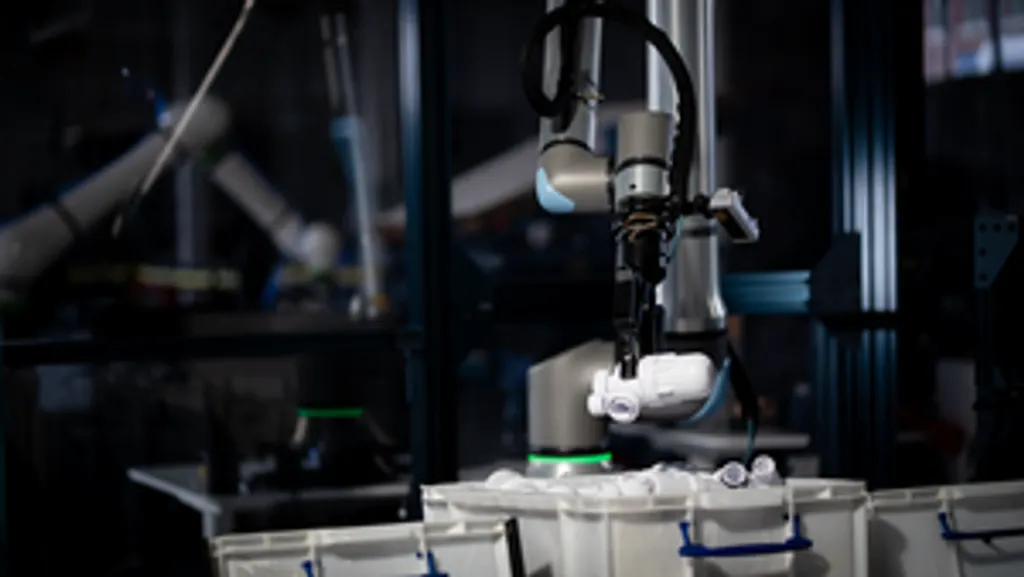
The most concrete Physical AI demo is bin picking. Running on a UR12e cobot, Vention’s GRIIP software uses NVIDIA Isaac foundation models for real-time part detection, 6-DoF pose estimation, and collision-free path planning, which Vention’s release states delivers “up to 99% first-pick success rates.” That figure is Vention’s own claim from a specific demo configuration, not independently audited or reproduced, and should be read as a company-reported spec rather than a verified benchmark. Five other live demos round out the booth: FANUC LR Mate path planning, the UR3-based MachineAgent workflow, a seventh-axis Overhead Range Extender on a UR20, a MachineMotion AI daisy-chain of up to 20 motors, and a FANUC CRX-10iA machine-tending cell.
The scale behind the pitch
Vention’s release states the company has more than 28,000 machines deployed worldwide across a community of more than 6,000 factories. That is a jump from the figure on the company’s own Wikipedia page, which, reflecting an earlier-2026 snapshot, puts the install base at over 28,000 machines across more than 4,000 factories, with 90 Fortune 500 customers including Toyota, Tesla, Boeing, and Airbus. Rather than treat one number as wrong, the two read as genuine growth over 2026: the machine count held steady while the factory count climbed by roughly 2,000 between whenever Wikipedia’s figure was last updated and this month’s release. Founded in 2016 by former GE product manager and McKinsey consultant Etienne Lacroix and co-founder Max Windisch, Vention has grown to roughly 330-360 employees, per BetaKit’s January reporting and Wikipedia respectively.
Why the NVIDIA relationship matters here
The MachineMotion AI Controller’s dependence on NVIDIA Jetson and Isaac is not a new pairing; it is the latest step in a relationship that runs deeper than a component sale. In January 2026, Vention closed a $110 million USD ($150 million CAD) Series D, led by Investissement Québec, the Quebec government’s investment arm, which contributed $55 million of the round, its largest venture bet to date according to The Globe and Mail. NVIDIA’s own venture arm, NVentures, joined that round alongside Desjardins Capital and returning investor Fidelity Investments Canada, bringing Vention’s total funding since 2016 past $260 million USD. At the time, BetaKit reported Vention’s customer base at more than 4,000 factories, roughly 70% in the US, 20% in Europe, and 10% in Canada, with clients including Boeing, L’Oréal, and Lockheed Martin. CEO Etienne Lacroix told BetaKit then: “We’re becoming the default standard, and we’re going to invest to ensure that’s the case.”
The company that just financed Vention’s AI buildout, and the company whose chips and software now sit inside Vention’s flagship controller, are the same one. NVIDIA is both a shareholder and a supplier here, a structure increasingly common across the “physical AI” push but worth naming plainly rather than treating the Jetson/Isaac mention in the September 10 release as an arm’s-length vendor relationship.
MachineAgent itself is not yet independently reviewed; it debuts today. What is confirmable is the architecture Vention describes: two distinct AI layers on one platform, a new NVIDIA-based controller, a live UR3/UR12e/UR20 and FANUC LR Mate/CRX-10iA demo lineup, and the financial and technical relationship with NVIDIA behind it.
For more on the cobot platform used in Vention’s headline demo, see the full specs for the UR3e in our database. Vention’s launch is one of several IMTS 2026 announcements IRH is tracking this week, including FANUC America’s own IMTS preview and, on the broader industrial-AI-silicon theme, Qualcomm’s Dragonwing IQ-2390 edge-AI chip. Vention’s booth demos also touch machine tending and material handling, two of the application categories its platform is built around.
Sources
- Vention Facilitates Manufacturing at IMTS 2026 with Physical AI and Agentic AI in One Platform — PR Newswire (Vention Inc.), Sep 10, 2026
- Vention Facilitates Manufacturing at IMTS 2026 with Physical AI and Agentic AI in One Platform — RoboticsTomorrow, Sep 10, 2026
- Vention — Wikipedia
- Montréal industrial AI scaleup Vention raises $110-million USD Series D — BetaKit, Jan 27, 2026
- Vention raises $150-million as Quebec makes biggest venture bet yet — The Globe and Mail, Jan 27, 2026
Frequently asked questions
What is MachineAgent and how is it different from Vention's existing platform? +
MachineAgent is a new agentic-AI layer on top of Vention's existing engineering software. Instead of using Vention's CAD and MachineLogic tools directly, a user describes what they want in plain language and MachineAgent generates the automation cell layout, writes the underlying program, and can later analyze data from the running machine to flag problems. Vention's platform already let customers assemble automation cells from modular hardware and software; MachineAgent adds a natural-language front end and an ongoing monitoring layer on top of that existing system, rather than replacing it.
What robots or hardware does Vention's platform actually control? Is Vention itself a robot maker? +
No. Vention is a Montreal-based automation-platform and hardware company, not a robot manufacturer. It builds the software, controllers, and modular structural hardware that let a customer's cell combine robots from other companies, at IMTS its own demos run on a Universal Robots UR3, UR12e and UR20, and a FANUC LR Mate and CRX-10iA, with Vention's MachineMotion controller and MachineLogic/GRIIP software tying the cell together.
How reliable is the claimed 99% bin-picking success rate? Is that independently verified? +
It has not been independently tested. Vention's press release states its GRIIP-powered Rapid Operator AI deep-bin-picking demo delivers "up to 99% first-pick success rates," but that figure is a company-reported spec tied to a specific demo setup, not a result published in an audited study or reproduced by a third party. Treat it the same way as any vendor-stated performance claim, useful context, not a substitute for evaluating the system on your own parts and bins.
Who backs Vention financially, and why does NVIDIA's involvement matter for this specific announcement? +
Vention has raised more than $260 million USD since 2016, most recently a $110 million Series D in January 2026 led by Investissement Québec (Quebec's provincial investment arm, which contributed $55 million, its largest VC bet to date), with NVIDIA's venture arm NVentures, Desjardins Capital, and Fidelity Investments Canada also participating. That matters here because NVIDIA is not just an investor, it is the compute supplier: the new MachineMotion AI Controller behind the September 10 announcement runs on NVIDIA Jetson and Isaac, so the company backing Vention financially is the same one whose hardware and software stack the new product depends on.
More news