Repeatability Spans SCARA to Cobot Within One Robot Family
Yaskawa's new NEXT family spans 0.01mm to 0.04mm repeatability across 4 payload tiers, from SCARA-beating precision to a cobot-median spec.
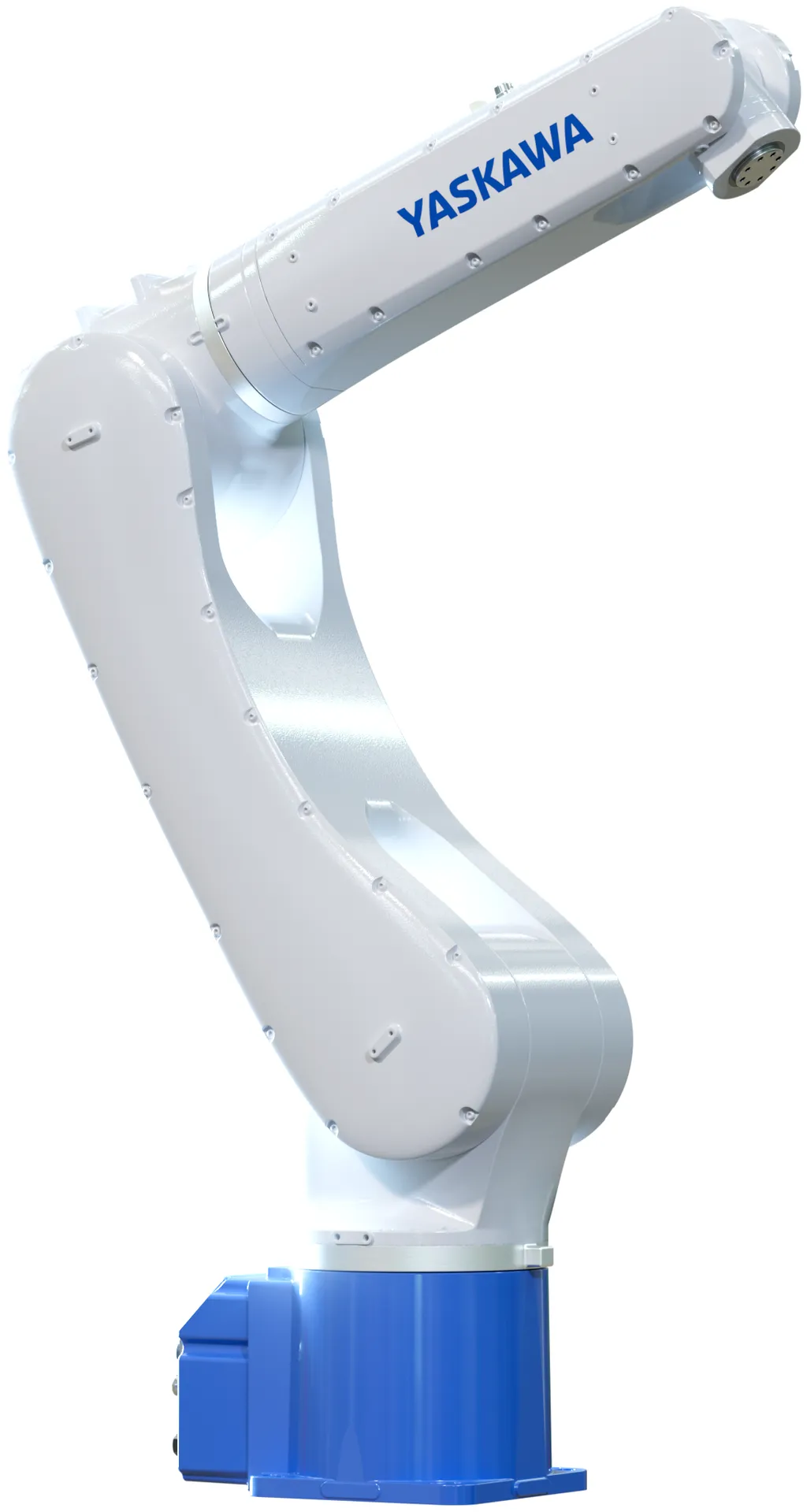
Yaskawa’s new NEXT robot family has a 4x repeatability spread from lightest to heaviest model, and the two ends land in different classes entirely. The 7 kg NEX7 repeats at 0.01 mm, tighter than the current median for every SCARA robot we track (0.015 mm across 56 models). The 35 kg NEX35 repeats at 0.04 mm, exactly the median for every cobot we track (130 models). Same brand, same generation, same controller platform. The spec that changes is payload, and repeatability moves with it.
What is Yaskawa’s NEXT series?
NEXT (branded NEX in model names) is a four-model six-axis arm family Yaskawa Motoman added to its catalog in mid-2026, running from NEX7 up through NEX10, NEX20, and NEX35. Yaskawa markets the line on “adaptive sensor integration” for unstructured-environment work, built on the YNX1000 controller and, per NEX10’s datasheet, high-inertia Sigma-X servomotors. All four are non-collaborative industrial arms aimed at assembly, packaging, and material handling, not cobots competing on a factory floor next to a person.
We track all four in our database as of the 2026-08-31 catalog update, with specs pulled directly from Yaskawa Motoman’s own NEX-series product pages and, for NEX10, its full datasheet PDF.
How much does repeatability change across the family?
Every step up in payload costs precision, and the pattern is close to linear:
| Model | Payload | Reach | Repeatability | vs. NEX7 |
|---|---|---|---|---|
| NEX7 | 7 kg | 927 mm | ±0.01 mm | baseline |
| NEX10 | 10 kg | 1,101 mm | ±0.015 mm | 1.5x looser |
| NEX20 | 20 kg | 1,552 mm | ±0.02 mm | 2x looser |
| NEX35 | 35 kg | 2,063 mm | ±0.04 mm | 4x looser |
Payload rises 5x from NEX7 to NEX35 (7 kg to 35 kg). Reach rises 2.2x (927 mm to 2,063 mm). Repeatability degrades 4x. The three specs do not move in lockstep, but they all move in the same direction, inside one family built on one controller platform. There is no brand difference, no generation gap, and no marketing-tier split to explain the spread. It is a straight structural tradeoff: more mass to move, more reach to hold rigid, less positioning precision at the end of the arm.
Does NEX7 actually beat SCARA on precision?
Yes, against the current median. Across the 56 SCARA robots in our 425-robot database that publish repeatability, the median is ±0.015 mm. NEX7, a six-axis articulated arm, repeats at ±0.01 mm, tighter than that median. It is not the tightest robot we track (Epson’s G1-221 SCARA holds that at ±0.008 mm, and 23 of the 56 SCARA robots also hit ±0.01 mm or better), but a light-payload NEX7 sits inside SCARA territory on this one spec, which is unusual for its type.
Across all 189 articulated arms in our database, only 181 publish a repeatability figure, and only 14 of those 181 (7.7%) reach ±0.015 mm or tighter. NEX7 and NEX10 are two of those 14. That confirms what our original repeatability-by-type analysis found across the whole catalog: precision tracks a robot’s size and payload class more than the “articulated” or “SCARA” label on its spec sheet. NEXT just proves it inside a single product line instead of across brands.
Does NEX35 look more like a cobot than an industrial arm?
On this one number, yes. NEX35 repeats at ±0.04 mm, which is exactly the median across the 130 cobots in our database. NEX35 is not a cobot. It carries more payload than most cobots, has no collaborative safety rating, and is built for a fenced industrial cell, not a shared workspace. But once a family’s payload climbs into the 20-35 kg range, the repeatability spec lands in the same neighborhood as the collaborative arms that share that payload class, not the tight tolerances its own lighter sibling can hit.
What does this mean for buyers?
Don’t shop repeatability by robot type. Shop it by the specific model at the specific payload tier you actually need. A buyer choosing between an articulated arm and a SCARA for a light, precise pick-and-place job should check whether a family’s entry-level model already clears the tolerance they were assuming only a SCARA could hit, since NEX7 shows a 6-axis arm can. A buyer specifying the top of a payload range should expect the tolerance to loosen toward what a cobot in the same weight class would publish, not stay pinned to whatever the family’s lightest model advertises in the brochure headline.
The NEXT series is a small sample, four models from one brand. But it is the cleanest version of this argument we have seen: hold the brand, the generation, and the controller constant, vary only payload and reach, and repeatability moves 4x on its own.
Compare these robots