AGIBOT Debuts Four Robots at WAIC, Points to a Factory Deployment as Proof
AGIBOT unveiled four new robots at WAIC 2026 and leaned on a real deployment, not a demo, for credibility: 3,000 G2 units per shift on a Longcheer tablet line, per the company.
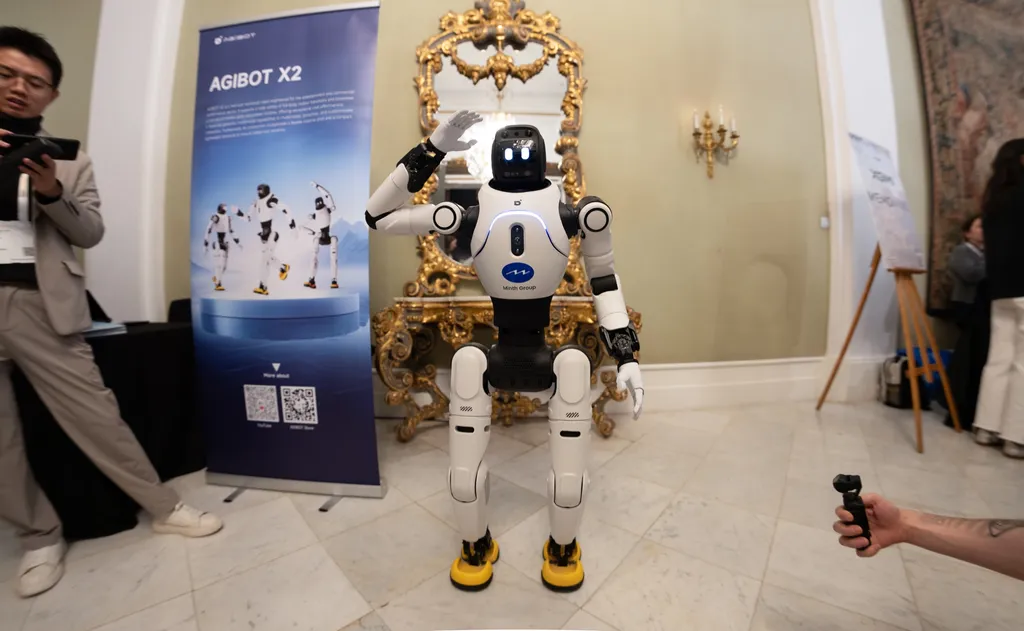
AGIBOT used its WAIC 2026 booth to make an argument that goes beyond a product launch: that its robots are already earning their keep on a real production line, not just walking across a demo stage. The Shanghai-based startup unveiled four new products at the World Artificial Intelligence Conference in Shanghai, July 18-20, and paired the launch with claimed operating data from an industrial customer, Longcheer Technology, where AGIBOT says its G2 robots have been running a tablet quality-inspection line since earlier this year.
The four products, shown across a 200-square-meter booth (H3-C101) at the Shanghai World Expo Exhibition and Convention Center, span AGIBOT’s full stack: the A3 Ultra, a full-size humanoid; the X2 Edu, a scaled-down development and education platform; the G2 Max, the company’s first heavy-payload, force-controlled industrial task robot; and the OmniHand 3 Ultra-M, a direct-drive dexterous hand. AGIBOT co-founder, president and CTO Peng Zhihui framed the launch around reliability over spectacle: “The industry should no longer judge embodied AI by whether a robot can complete an impressive demonstration once, but by whether it can be manufactured, delivered and integrated reliably into real operating environments.”
Four products, four different jobs
The A3 Ultra is the flagship: a 1.74-meter, 60-kilogram full-size humanoid with 51 active degrees of freedom, a 5-kilogram payload per arm, and up to 8 hours of combined operating time, according to AGIBOT’s own specification sheet. Its perception stack layers 3D LiDAR, RGB-D cameras, fisheye cameras and binocular vision, with GPS, RTK and UWB support for positioning and coordinated multi-robot operation, and it computes on an NVIDIA Thor module (AGIBOT did not publish a compute-throughput figure for this configuration, and none is independently verified, so none is stated here).
The X2 Edu strips that down into a roughly 1.3-meter development and education platform: 29 degrees of freedom, 7 per arm, a 3-kilogram end-effector payload, and a fully modular architecture AGIBOT says can be disassembled and reconfigured, with open motion-control and hardware interfaces aimed at classrooms, competitions and research labs rather than factories.
The G2 Max is the more industrially interesting of the two: AGIBOT’s first purpose-built heavy-payload, force-controlled task robot, combining force-controlled arms, an adjustable working height and omnidirectional wheeled mobility for material-handling and palletizing work rather than free-standing bipedal mobility. AGIBOT did not publish a numeric payload rating for it, so none is cited here. Its energy system supports battery swapping and autonomous charging, which matters more than it sounds: a robot that has to walk itself to a charger and wait isn’t running your line.
The OmniHand 3 Ultra-M rounds out the launch: a 630-gram direct-drive dexterous hand with 20 active degrees of freedom, a 5-kilogram whole-hand grip load, a 0.3-second open/close cycle and ±0.2-millimeter repeatability, with vision-based tactile sensors at the fingertips and a tactile array in the palm to detect contact, force and slip. AGIBOT positions it as a standalone research and teleoperation tool as much as an end-effector for its own humanoids.
The Longcheer number AGIBOT wants you to notice
The specs are the pitch; the deployment claim is the evidence AGIBOT is leaning on to back it up. According to AGIBOT’s own release, G2 robots developed with manufacturing partners including Longcheer Technology and PIA Automation are running tablet quality-inspection loading and unloading, chip handling, and production-line material movement. At Longcheer’s Nanchang facility, AGIBOT says production-line integration was completed within 36 hours, and the deployment has supported roughly 3,000 units per shift and more than 64 hours of cumulative continuous operation, with downtime loss kept below 4%. Independent trade coverage of the same deployment, citing a six-day public livestream AGIBOT ran of the line, put the throughput at more than 64,800 completed production-line tasks over that stretch and cited a company-reported 99.99% task success rate.
Every one of those figures is AGIBOT’s own reporting, not an independently audited number, a distinction independent coverage of the deployment made explicitly rather than passing the figures through uncritically. Independent reporting also puts a number on where this goes next: Longcheer is said to be planning to scale the G2 fleet at the Nanchang site to 100 robots by the end of the third quarter of 2026, up from the current deployment, though AGIBOT’s own materials don’t state a current unit count for the site directly. That doesn’t make the claim worthless. A named customer, a named facility, a stated integration time and a livestream that outside observers could watch is a meaningfully different evidence bar than a stage demo, even before any of it is independently audited.
Why AGIBOT is pushing this now
AGIBOT, founded in 2023 by Deng Taihua and Peng Zhihui, both former Huawei robotics engineers, says it passed its 15,000th robot off the production line in June 2026. Separately reported market research, an Omdia estimate cited by Tech Times, puts its share of global humanoid robot supply at roughly 39% (Industrial Robotics Hub has not reviewed the underlying Omdia report directly and cites it only as attributed third-party research). At WAIC, Peng framed the company’s ambitions past China plainly: “China should take on the responsibility of a major country and export its technologies and products globally.” AGIBOT is not currently listed in Industrial Robotics Hub’s own robot database.
That export framing is drawing scrutiny in Western trade press, too: coverage of the WAIC debut noted that Chinese robotics exporters, AGIBOT included, operate under China’s National Intelligence Law, which raises compliance and due-diligence questions for buyers outside China regardless of where a robot is deployed, a consideration AGIBOT’s own launch materials didn’t address. That’s a real factor for procurement teams evaluating Chinese-made embodied-AI hardware in general, not a claim specific to any wrongdoing by AGIBOT, and it sits alongside the deployment data above, not instead of it.
The push arrives in the same stretch as Agility Robotics’ SPAC merger announcement and AI² Robotics’ roughly $735M raise, part of a mid-2026 pattern of humanoid and industrial-embodied-AI companies converting capital and launches into deployment proof points, a throughline this desk also tracked in its Japan physical-AI coverage and most recent weekly recap. Readers can compare specs across the broader field in Industrial Robotics Hub’s robot database.
Sources
- AGIBOT Unveils Four New Products at WAIC 2026, Showcasing Embodied AI in Real-World Operations — AGIBOT (official), Jul 20, 2026
- AGIBOT Unveils Four New Products at WAIC 2026, Showcasing Embodied AI in Real-World Operations — PR Newswire, via Sina HK, Jul 20, 2026
- AGIBOT Unveils Four New Products at WAIC 2026, Showcasing Embodied AI in Real-World Operations — RoboticsTomorrow, Jul 19, 2026
- AGIBOT Debuts Four Robots at WAIC 2026: Global Export Push Meets China's Spy Law Obligation — Tech Times, Jul 18, 2026
Frequently asked questions
What four robots did AGIBOT unveil at WAIC 2026? +
AGIBOT showed the A3 Ultra, a full-size humanoid built for long-duration operation; the X2 Edu, a scaled-down development and education platform; the G2 Max, its first heavy-payload, force-controlled industrial task robot; and the OmniHand 3 Ultra-M, a direct-drive dexterous hand, all shown at its 200-square-meter booth (H3-C101) at the Shanghai World Expo Exhibition and Convention Center, July 18-20, 2026.
What are the A3 Ultra's specs? +
Per AGIBOT, the A3 Ultra stands 1.74 meters tall, weighs 60 kilograms, has 51 active degrees of freedom, carries a 5-kilogram payload per arm, and runs up to 8 hours combined operating time. Its perception stack combines 3D LiDAR, RGB-D cameras, fisheye cameras and binocular vision, with GPS, RTK and UWB for positioning, and it computes on an NVIDIA Thor module.
What is the Longcheer Technology deployment, and how solid is the claim? +
AGIBOT says its G2 industrial robots have run tablet quality-inspection loading and unloading at Longcheer Technology's Nanchang facility, supporting roughly 3,000 units per shift and more than 64 hours of cumulative continuous operation, with downtime loss kept below 4% and a claimed 99.99% task success rate. These are AGIBOT's own reported operational figures; no independent auditor has verified them, a point independent trade press covering the story flagged explicitly.
Is AGIBOT in Industrial Robotics Hub's robot database? +
Not yet. AGIBOT does not currently have an entry in Industrial Robotics Hub's specification database; this story covers the WAIC 2026 product launch and deployment claims as reported.
More news