ABB's PoWa: Real Specs, Still No 5.8 m/s Number
ABB's PoWa page now lists reach, IP ratings, and dual-mechanism safety for all 6 cobots, but the 5.8 m/s speed claim still covers only 2 of them.
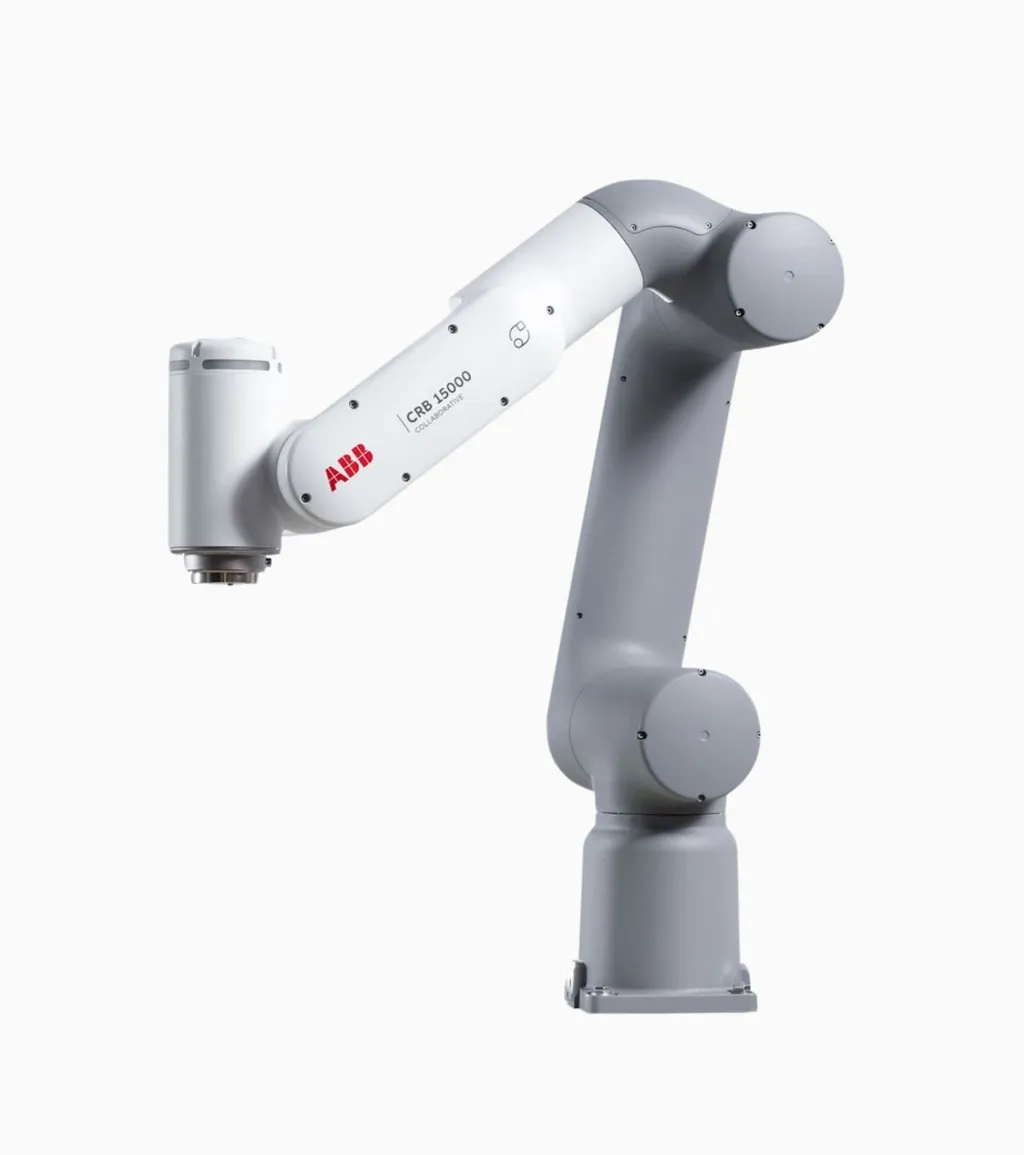
ABB’s PoWa product page now publishes a per-model reach figure, an IP rating, and a safety-mechanism spec for its high-speed cobot family, the exact data it did not have at launch. But the 5.8 m/s top speed that made headlines in April still is not on that page anywhere. ABB’s own footnote restricts its “exceeding 5 m/s” speed language to just 2 of the 6 PoWa models. Four months after launch, the spec sheet caught up. The speed claim did not.
What does ABB’s PoWa page publish now that it didn’t in April?
We covered PoWa’s launch on August 10 and flagged a real gap: ABB had not published a per-model reach figure, a repeatability spec, a weight, or an IP rating for any of the six PoWa models, and it had not published a Performance Level or SIL safety-function rating for the line either. At the time, that made the 5.8 m/s speed claim impossible to weigh against anything concrete.
ABB’s current PoWa product page closes part of that gap. It now lists wrist and flange reach for all six models, an IP65/IP67 rating, ISO Class 4/5 cleanroom compatibility, the OmniCore controller, and a plain description of the safety architecture: “Built in Power and Force Limiting (PFL) and Speed and Separation Monitoring (SSM) enable PoWa to operate safely alongside people in fenceless shared workspaces.” That is a real, citable answer to two of the four gaps we flagged in August. Repeatability and a named Performance Level or SIL rating still are not published anywhere on the page.
How many PoWa models does ABB actually sell, and how many are in our database?
ABB sells six PoWa variants. Our spec database currently tracks 425 robots, and only two of the six PoWa models, PoWa 10 and PoWa 30, have entries. Both match ABB’s own page exactly: our stored reach of 1,520 mm for PoWa 10 and 1,350 mm for PoWa 30 line up to the millimeter with ABB’s 1.52 m and 1.35 m wrist-reach figures. The two entries we have are accurate. The gap is coverage, not error.
| Model | Payload (kg) | Reach, wrist (m) | Reach, flange (m) | kg per m of reach | In IRH database? |
|---|---|---|---|---|---|
| PoWa 7 | 7 | 0.91 | 1.05 | 7.7 | No |
| PoWa 10 | 10 | 1.52 | 1.67 | 6.6 | Yes |
| PoWa 13 | 13 | 1.34 | 1.49 | 9.7 | No |
| PoWa 16 | 16 | 1.96 | 2.10 | 8.2 | No |
| PoWa 20 | 20 | 1.67 | 1.82 | 12.0 | No |
| PoWa 30 | 30 | 1.35 | 1.50 | 22.2 | Yes |
Source: ABB’s PoWa product page (payload and reach for all six models) and the Industrial Robotics Hub database (coverage column, kg-per-m column computed from ABB’s own published figures).
Does reach scale with payload across the family?
No, and this is the part that trips up a quick read of the spec sheet. PoWa 16, the 16 kg model, has the longest wrist reach in the entire family at 1.96 m, 45.2 percent farther than PoWa 30’s 1.35 m despite carrying barely half the payload. PoWa 13 reaches less than PoWa 10 (1.34 m versus 1.52 m) despite rating 3 kg more payload. If PoWa were one arm simply de-rated across six payload classes, reach would fall in a straight line as payload climbs. It does not.
That tells you ABB engineered six genuinely distinct arm geometries, each tuned for a different reach-versus-rigidity trade-off, not one platform stretched or shortened by firmware. The payload-to-reach efficiency ratio spans 6.6 to 22.2 kg per meter across the family, a 3.4x internal spread. PoWa 30 is the standout for weight efficiency inside its own product line, not just against competitors, and PoWa 10 sits at the opposite end of that same family.
Is PoWa really a 5.8 m/s cobot?
Not as a blanket claim. ABB’s own page states speeds “exceeding 5 m/s with rated payload” as the headline benefit, then attaches this footnote directly beneath it: “*Speed of PoWa10 and PoWa13.” That is ABB’s own text, not our interpretation. The specific 5.8 m/s figure used in ABB’s April launch press release and picked up by The Robot Report does not appear anywhere on ABB’s current product page at all, and the “exceeding 5 m/s” language that replaced it is explicitly scoped to 2 of the 6 models.
Put plainly: a buyer looking at “PoWa” and picturing a 5.8 m/s cobot is picturing one third of the family. PoWa 7, PoWa 16, PoWa 20, and PoWa 30 carry no published top-speed claim of any kind on ABB’s own page today.
Is PoWa really ABB’s first dual-mechanism cobot?
Yes, checked directly against our own database’s safety.collaborativeFeatures field for every ABB cobot we track. ISO/TS 15066 defines two separate mechanisms for collaborative operation, Power and Force Limiting (PFL) and Speed and Separation Monitoring (SSM), and ABB has historically picked one per product line, not both.
| ABB cobot family | Models tracked | PFL | SSM |
|---|---|---|---|
| GoFa | 3 | Yes | No |
| YuMi | 2 | Yes | No |
| SWIFTI | 1 | No | Yes |
| PoWa | 2 | Yes | Yes |
Source: Industrial Robotics Hub database, safety.collaborativeFeatures field, all ABB cobot entries.
PoWa is the only ABB cobot family in our database running both mechanisms on the same robot, which matches the safety language on ABB’s own current page and its listed SafeMove compatibility. Widen the lens to the full database and the picture holds up but gets more crowded than our own July coverage suggested. Of 132 cobots that publish a collaborativeFeatures value at all, 64 do, and of those, 30 (46.9 percent) combine both PFL and SSM. (Minor data-hygiene note: the raw field carries two spellings of the same SSM value, “speed-and-separation-monitoring” and “speed-separation-monitoring,” merged before counting.)
Our July 26 piece on PFL versus SSM reported that dual-mechanism design as a two-brand story, Doosan and Techman, on a smaller 60-cobot slice of the database. That is no longer accurate. Five brands now appear in the dual-mechanism group: Techman (14), Doosan (12), ABB (2), Kawasaki (1), and Mitsubishi (1). Techman and Doosan still account for 26 of 30 (86.7 percent), so they still dominate the category, but ABB, Kawasaki, and Mitsubishi are recent, minority entrants. ABB’s arrival is the most notable of the three because PoWa is a major brand’s flagship high-speed line, not a peripheral model.
Where does PoWa rank against every cobot we track on payload efficiency?
PoWa 30’s 22.2 kg-per-meter payload-to-reach ratio ranks 4th among all 132 cobots in our database that publish both figures, behind the FANUC CR-35iB, Universal Robots UR30, and ROKAE xMate CR45. That is a genuinely strong number and it holds up under scrutiny.
PoWa 10 does not share that distinction. Its 6.6 kg-per-meter ratio sits around 87th of that same 132-robot set, well down the list. The lesson is not “PoWa is efficient,” it is “PoWa 30 is efficient.” Those are different claims, and ABB’s own product family spans both ends of that range.
So what does a buyer actually do with this?
Real spec sheets landing on ABB’s page is progress over an unverifiable April vendor claim, and it is fair to credit ABB for publishing reach, IP ratings, and a clear safety-mechanism description four months later. But the progress is per-model, not per-family. “PoWa” is not one data point. It is six arms with a 3.4x internal spread in payload efficiency, a speed claim that covers a third of the lineup, and a dual-mechanism safety architecture that is real but currently only verified in our database on 2 of the 6 models. A buyer comparing PoWa against a competing cobot needs to say which PoWa they mean before that comparison means anything.
Compare these robots