Dürr Launches EcoRS Generation 2 Sealing-Robot Platform
Dürr introduced a four-model EcoRS Generation 2 robot line for paint-shop sealing, cleaning, and handling, moving axis 3-6 motors and cabling inside the arm to cut its footprint and simplify service.
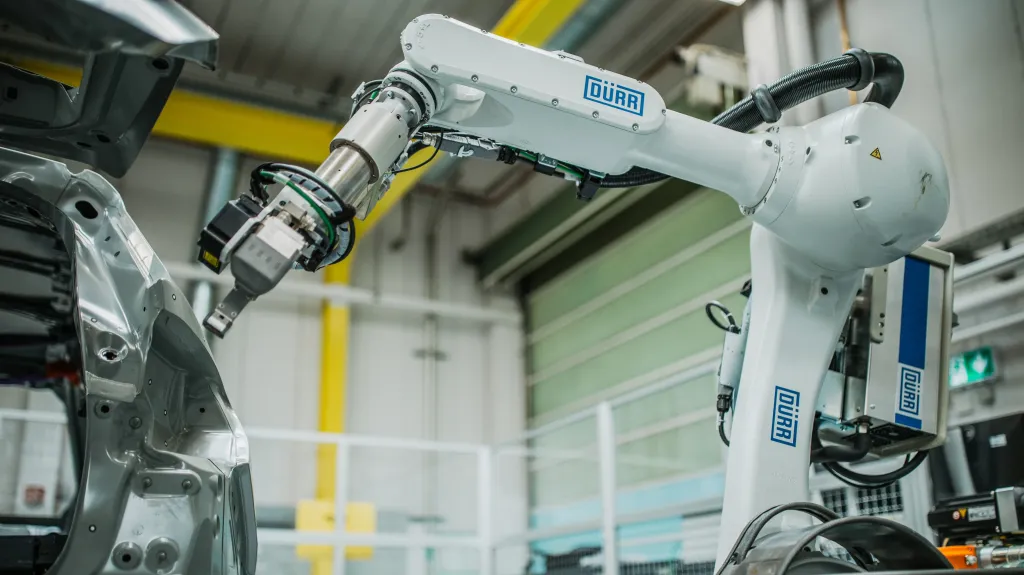
Dürr AG, the German mechanical- and plant-engineering group best known for building automotive paint shops rather than the robots inside them, announced a new robot platform on September 14, 2026, aimed squarely at one corner of that business: sealing, cleaning, and handling inside the paint shop itself. The EcoRS Generation 2 line comprises four robot models spanning 20 to 150 kg of payload capacity and up to 3,100 mm of reach, according to Dürr’s own press release, issued from the company’s headquarters in Bietigheim-Bissingen.
Dürr is not a robot brand in the conventional sense; it is an automation and plant-engineering integrator whose paint-shop systems, established across decades of automotive manufacturing, typically incorporate robotics as one component of a larger line rather than being sold as standalone arms the way FANUC, ABB, or KUKA sell theirs. Automotive OEMs and their suppliers account for roughly 55% of Dürr’s sales, with the rest split across mechanical engineering, chemical and pharmaceutical, and woodworking industries. The EcoRS line specifically targets sealing, the process of applying sealant to body seams for corrosion protection and noise reduction, along with related cleaning and handling tasks that sit inside the paint shop’s broader finishing process.
What changed: motors and cabling move inside the arm
The release frames the core engineering advance as internalization. “Among the most important advancements in the EcoRS Generation 2 are internal motors for axes 3 through 6 and internal cabling,” Dürr states. Moving those motors and cables inside the arm rather than mounting them externally reduces what Dürr calls the robot’s “interference contour,” the physical bulk and protrusions a robot presents to its surrounding environment, and the company says this improves cleanability, a meaningful detail in a process where sealant, primer, and coating overspray routinely coat everything nearby. Dürr also states the change reduced the robots’ overall space requirements and weight, though the release does not give specific before-and-after figures for either.
Notably, Dürr’s release never names a specific prior EcoRS model, or generation, that Generation 2 supersedes. It refers throughout to “establishing” a standardized platform, language that describes consolidation across sealing applications generally rather than a direct swap for a named predecessor. IRH could not independently confirm any specific EcoRS Generation 1 model number from the source material, and none should be inferred.
“With the new Eco RS generation, we are establishing a standardized platform for sealing applications,” said Martin Wurst, Product Manager at Dürr, in the release. “Customers benefit from high process quality, maximum availability, and significantly reduced complexity throughout the entire lifecycle.”
One control platform, fewer spare parts
Beyond the mechanical redesign, Dürr is positioning EcoRS Generation 2 as a consolidation play on the software and service side. The release states the platform “uses the same control technology as Dürr’s painting robotics and is fully integrated into the Dürr control architecture and the DXQ platform,” which Dürr says lets operators analyze process and operational data across different areas of a facility from one system rather than juggling separate control environments per robot type. The practical pitch is standardization: fewer spare-part variants and reduced inventory across a customer’s sealing-robot fleet, which Dürr says lowers total cost of ownership and simplifies maintenance and troubleshooting over the robots’ operating life. That argument echoes an industry-wide trend among paint-shop equipment suppliers toward platform consolidation, reducing the number of distinct robot types a plant has to keep spare parts, trained technicians, and control software for, rather than pursuing the raw performance gains that dominate marketing for general-purpose industrial arms.
The release also emphasizes what Dürr calls the platform’s fine-seam accuracy: “high path accuracy, consistent material application, and consistently high seam quality in the sealing area,” which it ties to the growing demands of visible and functional seams on modern vehicle bodies, alongside an enlarged work envelope Dürr says gives customers flexibility to accommodate different vehicle models and future vehicle programs on the same equipment.
One clarification worth stating plainly: although Dürr’s announcement is dated September 14, 2026, the same day IMTS 2026 opened in Chicago, neither Dürr’s own release nor its independent republication by RoboticsTomorrow mentions IMTS, a booth number, or the Chicago show at all. This reads as a standalone platform announcement that happened to land during a busy week of manufacturing-trade-show news, not a trade-show product debut, and should not be reported as one.
Sources
- Dürr's EcoRS Generation 2 combines process quality and flexibility in the paint shop — Dürr AG, Sep 14, 2026
- Dürr's EcoRS Generation 2 combines process quality and flexibility in the paint shop — RoboticsTomorrow, Sep 14, 2026
Frequently asked questions
What is Dürr's EcoRS Generation 2, and when was it announced? +
Dürr AG announced it on September 14, 2026, from its headquarters in Bietigheim-Bissingen, Germany. It's a new robot platform for paint-shop applications, sold as four models spanning 20 to 150 kg payload capacity and up to 3,100 mm of reach, covering sealing, cleaning, and handling tasks in automotive paint shops.
What actually changed from the prior EcoRS generation? +
Dürr's release doesn't name a specific prior model being replaced, but it describes the core engineering change as moving the motors for axes 3 through 6, plus their cabling, inside the robot arm itself. Dürr says this reduces the robot's external 'interference contour,' improves cleanability in wet sealing and coating environments, and cuts the robot's weight and space requirements.
Was this shown at IMTS 2026? +
Dürr's own press release, and its independent republication by RoboticsTomorrow, make no mention of IMTS 2026, a booth number, or Chicago at all, despite being dated the same day IMTS 2026 opened. It reads as a standalone platform announcement rather than a trade-show unveiling, so this should not be characterized as an IMTS product debut.
How does EcoRS Generation 2 fit into Dürr's existing control systems? +
Dürr says the new robots use the same control technology as its existing painting robotics and are fully integrated into Dürr's DXQ control architecture, letting operators analyze process and operational data across different areas of a paint shop from one system rather than managing separate control platforms per robot type.
More news