ABB's PoWa Cobot Claims 5.8 m/s. None We Track Hit 5.0
ABB's new PoWa cobot claims a 5.8 m/s top speed. Of 126 cobots in our database, the fastest ties at 5.0 m/s, and ABB's own GoFa caps at 2.2.
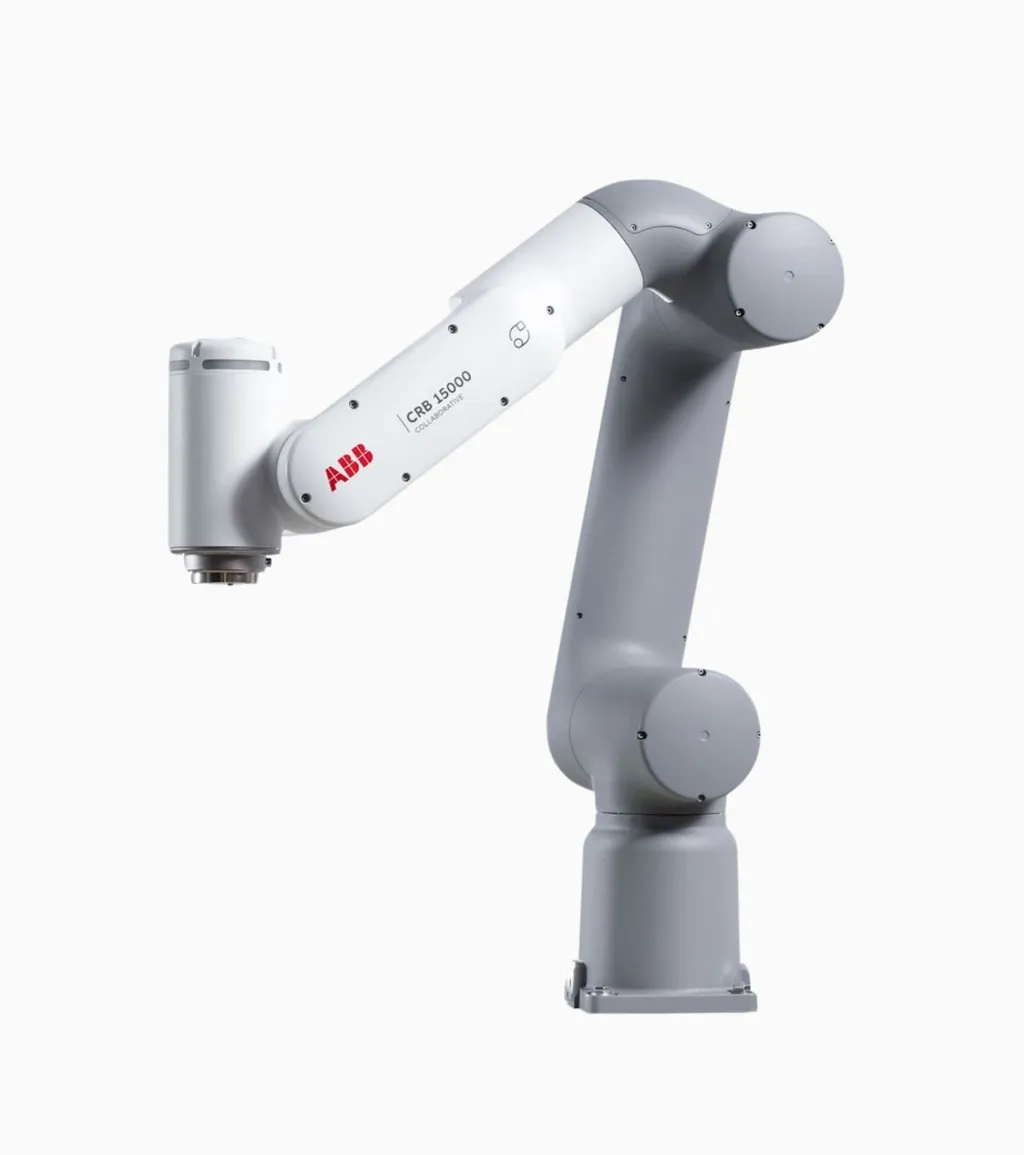
ABB says its new PoWa cobot family will hit 5.8 m/s (5,800 mm/s) TCP speed. We checked that number against every cobot in our database. The fastest one we track, a four-way tie at 5,000 mm/s, is 16 percent slower. Nothing in our 126-cobot catalog has ever broken 5,000 mm/s. If ABB’s number holds up, PoWa would not just win, it would open a speed tier that does not currently exist in collaborative robotics.
What is ABB’s PoWa cobot family?
ABB launched PoWa between April 22 and 25, 2026, as a six-model cobot line spanning payload classes from 7 kg to 30 kg, all running on the ABB OmniCore controller platform. ABB’s own product page and coverage from The Robot Report confirm the two fastest variants, PoWa 10 and PoWa 13, are the ones rated at that 5.8 m/s top speed. RoboticsTomorrow’s writeup corroborates both the model names and the April 22, 2026 launch date.
The stated target applications are the ones you would expect from a speed-first cobot: high-speed machine tending, palletizing, screwdriving, and arc welding. ABB is pitching PoWa as no-code out of the box, programmable through arm-side buttons, the OmniCore controller, RobotStudio, and Wizard Easy Programming, with a claim of being “operational within an hour of unboxing.”
Andrea Cassoni, ABB Robotics’ Head of Collaborative Robots, framed the launch this way:
“We are meeting these needs with…our high-speed PoWa cobot family - a name that symbolizes its powerful, industrial-grade performance in a compact collaborative robot form.”
ABB also describes PoWa as having “the longest reach and highest arm load on the market” among cobots. That is ABB’s own marketing language, not a claim we can independently verify. As of this writing, ABB has not published a per-model reach figure, a repeatability spec, a weight, or an IP rating for any of the six PoWa models. It also has not published a Performance Level or SIL safety-function rating for the line. We are treating the 5.8 m/s figure the same way: as ABB’s own stated claim, checked against our own already-verified data, not as an independently measured result. PoWa is not yet in our robot database for the same reason, there is no independent spec sheet to source it from yet.
How fast is 5.8 m/s compared to every cobot we track?
Our database currently holds 400 robots, 126 of which are catalogued as cobots (31.5 percent of the catalog). Of those 126, 60 (47.6 percent) publish a maximum TCP speed figure. Here is the top of that list.
| Rank | Robot | Brand | Payload | Max TCP speed |
|---|---|---|---|---|
| 1 | Dobot CR10A | Dobot | 10 kg | 5,000 mm/s |
| 2 | Dobot CR12A | Dobot | 12 kg | 5,000 mm/s |
| 3 | Universal Robots UR15 | Universal Robots | 17.5 kg | 5,000 mm/s |
| 4 | Universal Robots UR20 | Universal Robots | 20 kg | 5,000 mm/s |
| 5 | AUBO i10 | AUBO | 10 kg | 4,000 mm/s |
| 6 | AUBO i16 | AUBO | 16 kg | 4,000 mm/s |
| 7 | AUBO iS25 | AUBO | 25 kg | 4,000 mm/s |
| 8 | Dobot CR16A | Dobot | 16 kg | 4,000 mm/s |
| 9 | Dobot CR7A | Dobot | 7 kg | 4,000 mm/s |
| 10 | JAKA Pro 16 | JAKA | 16 kg | 3,900 mm/s |
| - | ABB PoWa 10/13 (claimed) | ABB | 10-13 kg | 5,800 mm/s |
Source: our analysis of 60 speed-publishing cobots in the Industrial Robotics Hub database, cross-referenced against ABB’s own PoWa launch materials. PoWa row is ABB’s stated claim, not yet an independently verified database entry.
Narrow the field to PoWa’s own payload bracket, 7 to 30 kg, which covers all six PoWa models, and the picture does not change. Of our 126 cobots, 77 (61.1 percent) fall in that same 7-30 kg range. Of those 77, only 37 (48.1 percent) publish a speed figure, and the fastest of them is the same 5,000 mm/s four-way tie. The median across that bracket is also 1,500 mm/s, identical to the full-catalog median. PoWa is not claiming a speed advantage in a soft corner of the market. It is claiming one in the exact payload band where the current record already sits.
Below is the chart version of the same comparison, with PoWa’s claimed figure marked separately since it is not yet a verified database entry.
Put the numbers side by side and the gap is real but not enormous. The 5.8 m/s claim is 16.0 percent faster than the current 5,000 mm/s tie (5,800 / 5,000 = 1.16). Against the median of the 60 speed-publishing cobots, 1,500 mm/s, it is 3.87 times faster. And against ABB’s own current fastest cobot in our database, the GoFa 10 and GoFa 12, both capped at 2,200 mm/s, PoWa’s claim is 2.64 times faster. ABB is not incrementally improving on its own lineup here. It is claiming a different class of machine.
For context on where the rest of the speed distribution sits: of the 60 speed-publishing cobots, none are under 1,000 mm/s, 33 (55.0 percent) sit in the 1,000-1,999 mm/s band, 11 (18.3 percent) in 2,000-2,999, 5 (8.3 percent) in 3,000-3,999, 7 (11.7 percent) in 4,000-4,999, and 4 (6.7 percent) sit exactly at the current ceiling of 5,000 mm/s. Zero robots currently occupy the gap between 5,000 and 5,800. If PoWa ships at its claimed spec, it would be the first cobot to land there.
We covered a related but mirror-image story in our fenceless-robot piece: the Mantis Robotics MR-X hit 10.6 m/s by stepping outside the cobot safety category entirely, using SafetyCore vision-based sensing instead of the power-and-force-limited (PFL) or speed-and-separation-monitoring (SSM) mechanisms that define collaborative operation under ISO/TS 15066. That was an external speed record, set by a robot that does not claim to be a cobot. PoWa is the opposite case: a robot marketed and sold as a cobot, claiming to break the cobot speed ceiling from the inside.
Does going this fast mean giving up collaborative safety?
Here is where the honest caution belongs. Speed above 5,800 mm/s is not new in our database. It is common, just not among cobots. 31 robots in our catalog exceed 5,800 mm/s today, and every single one is a SCARA, a delta, or a non-collaborative articulated arm. The Staubli TX2-200L hits 14,000 mm/s. The FANUC M-3iA delta runs 10,000 mm/s. The Epson G20 SCARA reaches 11,000 mm/s. None of them carry collaborative safety features, and none of them are rated to work in the same space as a person without a fence.
That is the real tension in the PoWa launch. ABB is claiming a cobot that hits industrial-arm speed, keeps collaborative-grade safety, and clears up to 30 kg payload, all at the same time. That specific combination does not exist anywhere else in our 400-robot catalog today. It is a genuinely new claim, not an incremental one, and it is the kind of claim that lives or dies on a number ABB has not published yet.
We checked every brand’s Performance Level and SIL disclosures earlier this month and found that only 92 of 316 rated robots in our database name an actual Performance Level, and only 17 name a SIL rating at all. A safety-function rating is not a marketing detail. It is the number that says whether a robot’s collaborative claim holds up under a real risk assessment, and it can vary model to model within the same product family. Until ABB publishes reach, repeatability, and a Performance Level or SIL rating for PoWa specifically, the speed claim is a spec sheet number, not a verified safety envelope. The open question is not whether PoWa can move at 5.8 m/s. It’s whether its safety-function rating, once ABB publishes one, actually holds at that speed and payload combination simultaneously. That is the same scrutiny we apply to every other brand in our database, and PoWa should get no exception just because it is new.
For now, PoWa sits outside our database because there is nothing independently verifiable to put in it. We will be watching for ABB’s own reach and repeatability figures, and for the safety-function rating that determines whether this genuinely is a faster cobot, or a fast industrial arm wearing a cobot’s marketing.
Compare these robots