PLd, PLe and SIL 2 by Robot Brand: Only 92 of 316 Publish a Performance Level
A Performance Level is not a quality grade for a robot. It is the reliability a specific safety function has to reach for a specific risk, which is why ABB certifies YuMi's speed supervision to Performance Level b while KUKA states PL d Cat 3 and SIL 2 for arms up to 1,000 kg. Across 369 robots, 92 name a Performance Level, 17 name a SIL, and eight of twenty brands never name one at all.
If you are trying to work out what PLd, PLe or SIL 2 means on a robot quote, start by discarding the reading almost everyone brings to it. A Performance Level is not a grade for the robot. It is a measure of how reliably one safety-related control function does its job, on a five step scale from PLa to PLe, and the level a function needs is set by the risk it is there to reduce. That is why a 1,000 kg KUKA palletising arm and a 0.5 kg ABB cobot can carry different levels in the direction you would not predict.
Two numbers frame the rest of this piece. Across the 369 robots in our database, 316 publish something in the safety ratings field, and only 92 of those 316 name a Performance Level at all. Seventeen name a Safety Integrity Level, and every single one of those seventeen is a KUKA or a Stäubli. Eight of our twenty brands never name a level on any model.
What PLd, PLe and SIL 2 actually mean
SICK’s own explainer defines a Performance Level as “a discrete level used to specify the ability of the safety related parts of the control system to perform a safety function under foreseeable conditions”, running from PLa to PLe with “a being the lowest and e being the highest”. What sets the level is not the brand but, in SICK’s words, “the structure of the control system, the reliability of the components used, the ability to detect faults, as well as the resistance to multiple common faults in multiple channel control systems”.
Three consequences follow, and each one is routinely lost in a sales conversation.
The level attaches to a function, not to a machine. A robot does not have a Performance Level. Its emergency stop has one, its joint speed limit has one, its safe zone monitoring has one, and they need not be identical.
The level is a requirement, not an achievement. It comes out of the risk assessment for the application. A function that has to prevent a crushing injury needs more integrity than one that has to prevent a bruise.
PL and SIL are the same idea in two dialects. SICK states that the standards “assign different labels, but use similar thresholds”, with ISO 13849-1 calling them performance levels and IEC 62061 calling them safety integrity levels. When KUKA writes that its safe inputs and outputs “comply with safety standards in accordance with ISO 13849: PL d category 3, as well as according to IEC 62061, SIL 2”, that is one claim stated twice, not two stacked claims.
How many robots publish a rating, and what kind
| What the model’s safety ratings contain | Robots | Share of the 316 that publish anything |
|---|---|---|
| Nothing at all (53 of 369 robots) | 53 | not applicable |
A bare ISO 10218-1 and nothing else | 177 | 56.0% |
| A reference to ISO/TS 15066 | 111 | 35.1% |
| A named Performance Level (PLd or PLe) | 92 | 29.1% |
| A named Safety Integrity Level | 17 | 5.4% |
| An edition year on ISO 10218-1 | 7 | 2.2% |
CE listed as though it were a rating | 16 | 5.1% |
Source: our analysis of all 369 robots in the Industrial Robotics Hub database, safety.safetyRatings field, 4 August 2026. Rows overlap, because most records cite several standards at once.
The dominant answer, by a wide margin, is a bare ISO 10218-1 with no level attached. That is 56% of every robot in the catalog that says anything about safety at all. ISO 10218-1 is the product safety standard for the robot itself, and citing it tells a buyer that the manufacturer built to it. It does not tell you how reliably any individual safety function performs, which is precisely what a Performance Level is for. If your risk assessment concludes that a safeguard has to be PLd, a bare ISO 10218-1 on the datasheet does not close that requirement.
Which brands name a Performance Level
| Brand | Robots publishing any rating | Naming a Performance Level | Naming a SIL | Bare ISO 10218-1 only |
|---|---|---|---|---|
| KUKA | 19 of 29 | 15 | 14 | 4 |
| Techman | 15 of 15 | 15 | 0 | 0 |
| Doosan | 12 of 12 | 12 | 0 | 0 |
| AUBO | 12 of 12 | 11 | 0 | 0 |
| Universal Robots | 9 of 9 | 9 | 0 | 0 |
| Dobot | 8 of 11 | 7 | 0 | 0 |
| Rokae | 11 of 21 | 6 | 0 | 0 |
| FANUC | 17 of 25 | 5 | 0 | 12 |
| ABB | 24 of 28 | 4 | 0 | 17 |
| Yaskawa | 21 of 30 | 4 | 0 | 17 |
| Stäubli | 14 of 14 | 3 | 3 | 11 |
| Mitsubishi | 11 of 11 | 1 | 0 | 10 |
| Estun | 29 of 29 | 0 | 0 | 29 |
| Inovance | 21 of 21 | 0 | 0 | 21 |
| Kawasaki | 20 of 24 | 0 | 0 | 15 |
| Siasun | 19 of 19 | 0 | 0 | 15 |
| Omron | 17 of 17 | 0 | 0 | 10 |
| Epson | 16 of 16 | 0 | 0 | 16 |
| JAKA | 13 of 18 | 0 | 0 | 0 |
| Hans Robot | 8 of 8 | 0 | 0 | 0 |
Source: our analysis of 369 robots, safety.safetyRatings by brand, 4 August 2026.
Three things stand out. First, the eight brands at zero are not fringe names. Estun, Inovance, Kawasaki, Siasun, Omron, Epson, JAKA and Hans Robot publish 143 records between them that do carry a safety citation, and not one of those records names a level. Second, every SIL figure in a 369 robot catalog comes from two companies. Third, the two brands at the bottom of that table are there for a different reason than the six above them: JAKA and Hans Robot never fall back to a bare ISO 10218-1 either, because their records pair ISO 10218-1 with ISO/TS 15066, the collaborative operation specification. They are documenting the collaborative claim and skipping the control system integrity claim.
A separate group is not really in this comparison at all. Omron’s seven mobile robots cite the ISO 3691-4 family, the safety standard for driverless industrial trucks, rather than ISO 10218-1. Different machine, different standard, and a reasonable one.
The rating does not track how dangerous the robot is
Here is the finding that should change how you read a spec sheet. Of the 118 collaborative robots in our database that publish any safety citation, 39 do not name a Performance Level. Meanwhile, thirteen of the 92 records that do name one are not cobots at all.
| Robot | Type | Payload | Published safety ratings |
|---|---|---|---|
| KUKA KR 1000 titan | articulated | 1,000 kg | ISO 10218-1, PLd Cat.3, SIL 2 |
| KUKA KR 500 R2830 | articulated | 500 kg | ISO 10218-1, PLd Cat.3, SIL 2 |
| KUKA KR 120 R2700-2 | articulated | 120 kg | ISO 10218-1, PLd Cat.3, SIL 2 |
| KUKA KR 70 R2100 | articulated | 70 kg | ISO 10218-1, PLd Cat.3, SIL 2 |
| KUKA KR 30 R2100 | articulated | 30 kg | ISO 10218-1, PLd Cat.3, SIL 2 |
| KUKA KR 20 R1810 | articulated | 20 kg | ISO 10218-1, PLd Cat.3, SIL 2 |
| KUKA KR 20 R3100 iontec | articulated | 20 kg | ISO 10218-1, PLd Cat.3, SIL 2 |
| KUKA KR 10 R900 sixx | articulated | 10 kg | ISO 10218-1, PLd Cat.3, SIL 2 |
| KUKA KR 6 R700 sixx | articulated | 6 kg | ISO 10218-1, PLd Cat.3, SIL 2 |
| KUKA KR 3 AGILUS | articulated | 3 kg | ISO 10218-1, PLd Cat.3, SIL 2 |
| Stäubli TX2-200 | articulated | 170 kg | ISO 10218-1, SIL3/PLe (optional) |
| Stäubli TX2-200L | articulated | 110 kg | ISO 10218-1, SIL3/PLe (optional) |
| Doosan P3020 | palletizer | 30 kg | ISO 10218-1, ISO/TS 15066, PLd Cat.3 |
Source: our analysis of 369 robots, the non-collaborative records whose safety ratings name a Performance Level, 4 August 2026.
The payload range across all 92 Performance Level records runs from 3 kg to 1,000 kg, with a median of 12 kg. So the level is not a cobot feature and it is not a proxy for how gentle the machine is. It is a statement about the safety controller, which is exactly where the next section leads.
Where the PLd on a spec sheet actually comes from
This is the part worth checking before you quote a figure back to an integrator. We read the primary documents behind three of the strongest rows above, and in all three cases the level does not live on the model’s own datasheet.
KUKA. The KR 1000 titan is the largest robot in our catalog carrying PLd Cat.3 and SIL 2. Its own KUKA specification document, 81 pages, lists EN ISO 13849-1 and EN ISO 10218-1 among the standards applied, and states no Performance Level and no SIL anywhere in the document. The public KR 1000 titan product page does not state one either. Where KUKA does state it is at the interface level, on the KR QUANTEC HC page: “KUKA robots such as the KR QUANTEC HC offer safe inputs and outputs for better system integration. These comply with safety standards in accordance with ISO 13849: PL d category 3, as well as according to IEC 62061, SIL 2: based on IEC 61508.” The rating belongs to the safe I/O of the controller, and it is inherited by every arm that runs behind that controller.
Stäubli. The TX2-200 product data sheet, Stäubli’s own two page technical sheet dated May 2026, publishes reach, payload, joint speeds, inertia, IP rating and cleanroom class, and no Performance Level or SIL at all. The one line that matters for functional safety is the controller row: CS9 HP. The SIL3 and PLe capability sits with the CS9 controller and its safety options, which is why our record for that arm carries the word optional. Optional is doing real work in that string. It means the level is a configuration you buy, not a property of the arm that shipped.
Universal Robots. UR is the brand most associated with PLd Cat.3 in the cobot market, and the UR10e product page states only that UR robots are “designed with certified functional safety at their core, supporting collaborative and traditional applications with documented compliance”. No level, no category, no standard number. The figure lives in a separate UR-hosted document titled “UR e-Series Safety Functions and Safety I/O are PLd, Category 3 according to ISO 13849-1”, certified by TÜV NORD under certificate 44 207 14097610.
The pattern is consistent. A Performance Level is a controller and safety architecture property, restated across a product family, and it is usually one document away from the page a buyer is actually reading. That is the practical reason so many records in our catalog stop at a bare ISO 10218-1: the level exists, but it was never printed where the datasheet scrape could see it.
ABB certifies YuMi to performance level b, and that is the right answer
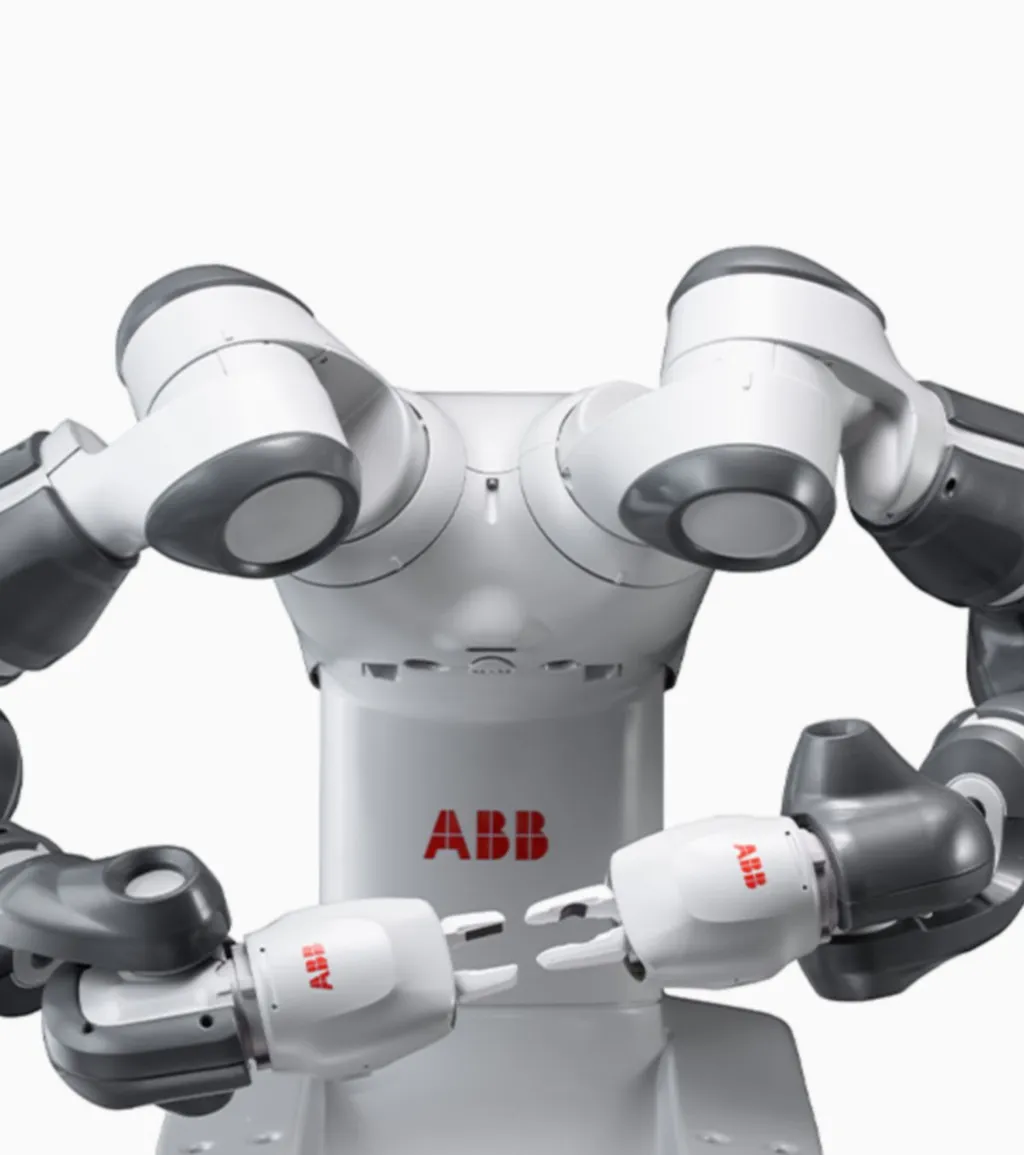
The single most instructive record in this whole exercise is ABB’s dual arm cobot. Our database has YuMi IRB 14000 publishing ISO 10218-1 and ISO/TS 15066, and no Performance Level. ABB’s own current product specification for the machine, document 3HAC052982-001 revision V, is more specific than that and more surprising:
The following safety functions are inherent design measures in the control system, contributing to power and force limiting. They are certified to category B, performance level b, according to EN ISO 13849-1.
Performance level b, the second of five, on the most recognisable collaborative robot ever built. Read against the reflex that PLd is the bar a cobot has to clear, that looks like a failure. It is not. Four lines further down the same page, ABB states why:
The maximum power of all the motors, integrated in IRB 14000 (YuMi), is less than 80W.
That is an inherent design measure, in the language of ISO 12100’s hierarchy: the hazard is limited by the machine’s construction rather than by a control function. When the arm physically cannot deliver enough energy to cause the injury you were guarding against, the control function supervising its speed is not carrying the risk reduction, so it does not need a dual channel, fault detecting Cat 3 architecture to be adequate. A required Performance Level falls out of a risk assessment. Lower risk, lower required level.
Turn that around and the buying implication is uncomfortable but correct. A PLd Cat.3 badge on a 30 kg payload cobot is not a sign of a better engineered machine than YuMi. It is a sign that the machine needs more integrity in its control system, because it can do more damage. Reading Performance Levels as a league table gets the causation exactly backwards.
The number that actually decides your cell is PFHd
Underneath a Performance Level is a probability. PFHd, the probability of a dangerous failure per hour, is the quantity ISO 13849-1 uses to place a function on the a to e scale. Almost nobody publishes it.
Universal Robots does, and the way it does is the most useful safety disclosure of any brand in our catalog. Its functional safety document tabulates each safety function separately with its own PFHd, ranging from 4.70E-08 to 1.50E-07 per hour across emergency stop, safeguard stop, joint position limit, joint speed limit, pose limit, TCP speed limit, force limit, momentum limit and the safety outputs. Then it says the thing every integrator needs to hear:
For safety I/O, the resulting safety function including the external device or equipment is determined by the overall architecture and the sum of all PFHds, including the UR robot safety function PFHd.
That sentence is the whole reason “the robot is PLd” is not an answer. A safeguard is a chain: sensor, logic, actuator. The robot supplies one link and one PFHd. Your light curtain, your safety relay and your contactors supply the rest, and the chain’s total dangerous failure rate decides the level of the integrated function. Buy a PLd robot, wire it to a single channel proximity switch, and the function you have built is not PLd. The same document also notes that on the e-Series the pendant emergency stop reaches the safety controller “by safety communications according to SIL 2”, a detail that matters if you are documenting the chain rather than assuming it.
If you want the wider design context for that chain, our guides to CE marking for robot cells and safety clearance under ISO 13857 cover the paperwork and the geometry that sit on either side of it.
What to ask before you accept a PLd on a quote
- Which safety functions carry it? A blanket PLd is meaningless. Ask for the list, function by function, the way UR publishes it. Speed limiting, position limiting and the safety I/O may not be identical.
- Is it standard or an option? Stäubli’s own record in our database says the quiet part out loud with the word optional. If the level comes from a safety option on the controller, confirm it is on the order.
- Which controller? The level travels with the safety controller, not the arm. Two robots from the same brand on two controller generations are not the same claim. Our breakdown of controller platforms by brand shows how many families a single brand can be selling at once.
- Ask for the PFHd. If you are integrating external devices into the safety function, you need the number, not the letter. Most vendors will have it in a functional safety document even when it is not on the website.
- Which edition of ISO 10218-1? Only seven records in our entire catalog attach an edition year, and all seven say 2011. The 2025 edition is live, and what changed in it matters most for exactly the collaborative applications where Performance Levels get quoted.
- Do not accept CE as the answer. Sixteen records in our database list CE among their safety ratings. CE is a conformity declaration, not a graded measure. If a supplier answers a question about Performance Level with the letters CE, the question is still open.
The honest summary of a 369 robot survey is this. Most robots do not tell you their Performance Level, the ones that do are usually restating a controller specification, and the level itself is a requirement derived from risk rather than a score a manufacturer earns. The buyers who get this right are the ones who stop looking for the highest letter on the datasheet and start asking which function, on which controller, at what probability.
How we counted
Every figure above comes from the safety.safetyRatings field across all 369 robot records in the Industrial Robotics Hub database as of 4 August 2026, tabulated in a single pass rather than assembled from prior articles. A record counts as naming a Performance Level if its ratings string contains PLd or PLe, and as naming a SIL if it contains SIL. Where a record’s rating is a controller level claim rather than something printed on that model’s own datasheet, we say so above rather than smoothing it over: the KUKA, Stäubli and Universal Robots primary documents were opened and read for this piece, and the ABB quotations are verbatim from ABB’s product specification 3HAC052982-001 revision V, which is served over a link that returns 404 to a HEAD request and the full 130 page PDF to a GET. Our earlier ISO 10218-1:2025 analysis tabulated the same field against a 336 robot snapshot, so its counts and these will differ; these are the current ones.
Frequently asked questions
What does PLd mean on a robot spec sheet? +
PLd is Performance Level d under ISO 13849-1, the fourth of five levels from a to e. It describes how reliably one safety-related control function performs, based on the architecture of the circuit, the reliability of its components, and how well it detects its own faults. It is not a rating of the robot's build quality or of how safe the robot is in your cell. A robot that carries PLd on its safety functions can still be installed dangerously, and a robot rated lower can be perfectly compliant if its inherent design limits the hazard.
Is PLd the same as SIL 2? +
They are separate labels from separate standards that describe similar levels of risk reduction. ISO 13849-1 uses Performance Levels a through e, and IEC 62061 uses Safety Integrity Levels. As SICK puts it, the standards assign different labels but use similar thresholds. KUKA states both for the same equipment, describing its safe inputs and outputs as PL d category 3 under ISO 13849 and SIL 2 under IEC 62061. Treat a SIL figure as the same claim in the other standard's vocabulary, not as an additional one.
Why is ABB's YuMi rated performance level b and not PLd? +
Because the hazard is limited by the machine itself rather than by the control system. ABB's own product specification for the IRB 14000 states that the Cartesian speed supervision functions are certified to category B, performance level b, according to EN ISO 13849-1, and the same page states that the maximum power of all the motors integrated in YuMi is less than 80 W. When inherent design already limits what the robot can do to a person, the safety-related control function does not have to carry the risk reduction, so it does not need a Cat 3 architecture. A lower Performance Level here reflects a lower required risk reduction, not a weaker product.
Which robot brands publish a Performance Level? +
Twelve of the twenty brands in our database publish one on at least one model, and eight never do. KUKA, Techman, Doosan, AUBO, Universal Robots, Dobot, Rokae, FANUC, ABB, Yaskawa, Stäubli and Mitsubishi each have at least one model whose recorded safety ratings name PLd or PLe. Estun, Inovance, Kawasaki, Siasun, Omron, Epson, JAKA and Hans Robot publish none across 143 records that do carry some safety citation, most of them stopping at a bare ISO 10218-1.
Does a PLd robot make my robot cell PLd? +
No. Universal Robots states this explicitly in its own functional safety document: for safety input and output functions, the resulting safety function including the external device is determined by the overall architecture and the sum of all PFHd values, including the robot's. PFHd is the probability of a dangerous failure per hour, and it is what the Performance Level is derived from. Your light curtain, your safety relay and your wiring all add their own PFHd. The robot's rating is one term in that sum, not the answer.
Is CE marking a safety rating? +
No, and 16 records in our database list CE alongside real safety standards as if it were one. CE marking is a declaration that a product meets the applicable EU directives, made by the manufacturer, and it carries no level. A Performance Level or a SIL is a graded measure of how reliably a specific function works. If a quote answers a question about functional safety with the letters CE, it has not answered the question.
Is a robot with no published Performance Level unsafe? +
Not necessarily, and this is the most common misreading of the gap. Of the 316 robots in our database that publish any safety citation, 177 publish only a bare ISO 10218-1 and no level at all. In most of those cases the manufacturer simply does not print the figure on the material we hold, not that no rating exists. What it does mean is that you cannot verify the claim from the datasheet, so ask for the functional safety document by name before you design a safeguard around an assumed PLd.
Compare these robots