Cobot Safety: Only 2 Brands Add Speed Monitoring to PFL
60 of 339 robots publish their collaborative safety mechanism. Only 27 layer speed monitoring onto PFL, and 85% of those are just two brands.
“Collaborative” is not one safety mechanism, it is at least four, and most cobots only use one of them. Of the 339 robots in our database, 60 (17.7%) publish exactly which collaborative safety mechanisms back their rating. Of those 60, 58 are cobots, and 96.7% of them list power-and-force limiting, the baseline. Only 27 (45.0%) also layer speed-and-separation monitoring on top, and 23 of those 27 (85%) come from exactly two brands: Doosan and Techman. Every other collaborative brand in our database that documents this field, ABB, FANUC, KUKA, Universal Robots, Yaskawa, Hans Robot, Mitsubishi, Kawasaki, and Staubli, ships PFL alone or PFL with a minor variant, with no disclosed second layer.
How many robots actually document their safety mechanism?
ISO/TS 15066 recognizes several distinct ways a robot can be rated for human collaboration: power-and-force limiting (PFL, the robot itself is inherently weak or padded enough that contact stays below injury thresholds), speed-and-separation monitoring (SSM, the robot slows or stops based on how close a person is), hand-guiding, and a safety-rated monitored stop. A robot can use one of these or several stacked together, and which combination it uses changes what “collaborative” actually means on your floor: a PFL-only cobot is safe because it cannot hit hard, an SSM-equipped cell is safe because it senses you and reacts, and those are different engineering guarantees with different integration requirements.
Our database’s safety.collaborativeFeatures field records this directly, and only 60 of 339 robots (17.7%) populate it: 58 cobots, one collaborative-rated palletizer (Doosan’s P3020), and one AMR (Omron’s LD-250, whose zone-based safety works the same way SSM does for a fixed arm). That is a thin slice of the catalog, and we are stating that plainly rather than implying every collaborative-capable robot is represented here. But among the robots that do disclose a mechanism, the pattern is sharp enough to be worth reading closely.
What’s the baseline collaborative safety stack?
Power-and-force limiting is close to universal among the 60: 58 of 60 (96.7%) list it. Hand-guiding and a safety-rated monitored stop are nearly as common, each appearing on 55 of 60 (91.7%). Put together, the modal stack, PFL plus hand-guiding plus a safety-rated stop and nothing else, covers 23 of the 60 robots on its own, spanning ABB’s GoFa line, FANUC’s CRX line, most of Universal Robots’ catalog, Yaskawa’s HC line, and single entries from Doosan, KUKA, and Techman. That three-mechanism combination is the industry’s default answer to “what makes this collaborative.”
safety.collaborativeFeatures. “Other single-robot combinations” groups three one-off cases: FANUC’s PFL-plus-stop-only entry, Kawasaki’s PFL-plus-SSM-only entry, and Staubli’s capacitive-skin-sensing entry, each too rare to chart as its own row.Which robots add speed-and-separation monitoring on top?
Twenty-seven of the 60 (45.0%) list SSM in some form, and that group is not evenly spread across the industry. Doosan documents SSM on 11 of its own 12 collaborative-tagged models (91.7% of its lineup), and Techman documents it on 12 of its own 13 (92.3%). Between them, Doosan and Techman account for 23 of the 27 robots in the entire database that disclose SSM at all, 85%. The remaining four SSM entries are one robot each from ABB, Kawasaki, Mitsubishi, and Omron.
| Brand | Collaborative-tagged robots | SSM-documented | Share |
|---|---|---|---|
| Doosan | 12 | 11 | 91.7% |
| Techman | 13 | 12 | 92.3% |
| ABB | 6 | 1 | 16.7% |
| FANUC | 5 | 0 | 0% |
| Universal Robots | 9 | 0 | 0% |
| Yaskawa | 4 | 0 | 0% |
| KUKA | 5 | 0 | 0% |
| Kawasaki, Mitsubishi, Omron | 1 each | 1 each | 100%* |
Source: our analysis of the Industrial Robotics Hub database. *Kawasaki, Mitsubishi, and Omron each have exactly one collaborative-tagged robot, so a single SSM entry reads as 100% of that brand’s own tiny sample, not a stated brand policy.
For Doosan and Techman, SSM is not a premium option bolted onto a few flagship models, it is close to a catalog-wide default, the same “brand policy, not per-model spec” pattern we found when checking humidity ratings across brands. For everyone else publishing this field, PFL alone (plus hand-guiding and a safety-rated stop) is the stated ceiling.
Does layering on SSM cost you speed?
Here is the counter-intuitive part. SSM’s usual pitch is that it buys you more speed when the cell is clear, since the robot only has to slow down when a person is actually nearby, unlike PFL, which caps contact force everywhere, all the time. The published top-speed numbers in our own database say the opposite, at least among what these two brand cohorts choose to sell.
The 23 baseline (PFL-only) cobots that publish a top TCP speed average 2,080.0 mm/s (n=20, range 1,000-5,000 mm/s). The 23 full-stack (PFL-plus-SSM) cobots that publish one average 1,158.8 mm/s (n=17, range 1,000-1,500 mm/s), just over half as fast. That is not proof SSM inherently limits speed: it is much more likely a catalog effect, Doosan and Techman’s SSM-equipped lineups sit in the compact-to-midsize cobot class by design, while the PFL-only group includes several of the industry’s fastest-rated cobots (Universal Robots’ UR20 and UR30, FANUC’s CRX line). But it does mean a buyer cannot assume “this one also has SSM” translates to “this one runs faster.” On the spec sheet, in this dataset, it runs the other way.
What about the outliers?
Four robots break from both the baseline and the full stack in a way worth naming directly. KUKA’s LBR line, four of its five collaborative-tagged models, KUKA LBR iiwa 14 R820 among them, lists joint-torque-sensing as a fifth mechanism alongside PFL, hand-guiding, and a safety-rated stop. That is KUKA’s real engineering differentiator: torque sensors built into every joint (the “LBR” in the name stands for Leichtbauroboter, lightweight robot), giving the arm direct force feedback at each axis rather than relying on the whole-arm compliance most PFL cobots use.
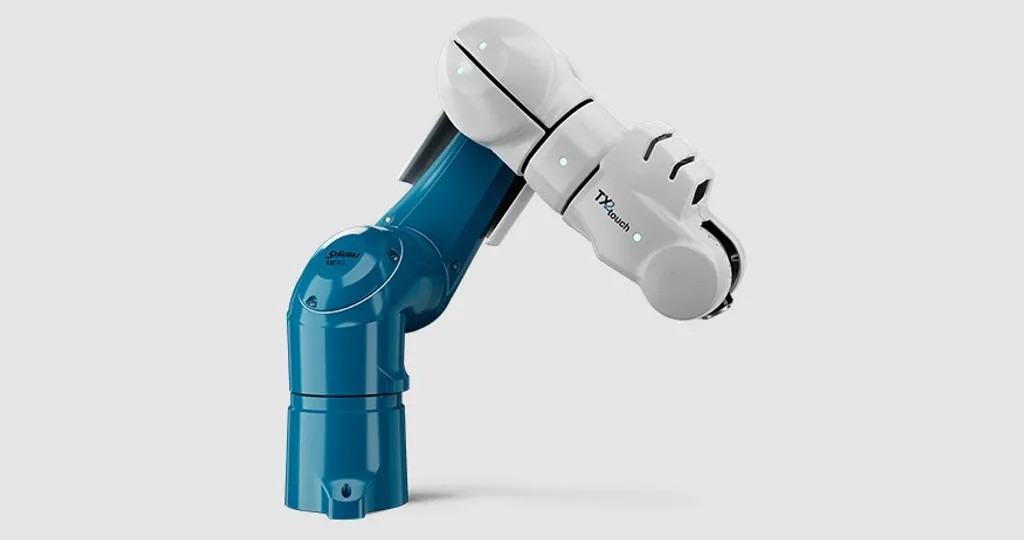
Staubli’s TX2touch-90 is the only robot in our database that lists capacitive-skin-sensing. The arm is wrapped in a pressure-sensitive skin roughly 20 mm thick that reacts to contact in about 10 milliseconds, a different physical approach from either PFL’s inherent softness or SSM’s proximity sensing: the robot feels contact directly, everywhere on its surface, rather than inferring safety from force limits or distance zones.
The two robots that pair SSM with a safety-rated stop but list no PFL and no hand-guiding, ABB’s SWIFTI CRB 1100 and Omron’s LD-250, make physical sense together once you notice what they have in common: a fast-moving pick-and-place cobot built for throughput over compliant contact, and a mobile robot chassis. Neither is a good candidate for “inherently weak enough not to hurt on contact,” so both lean on distance-based monitoring instead.
What should you actually ask a vendor?
“Collaborative” on a spec sheet answers almost nothing about how a robot stays safe near a person until you ask which mechanism backs it. If the quote sheet says PFL only, plan your cell assuming every surface can make contact and stays within force limits, that is the whole safety case. If it says PFL plus SSM, ask for the actual protective separation distance the SSM zone requires, since that eats into your cell’s floor space the way we mapped in our robot cell floor space piece. And if a vendor markets “fenceless” speed the way we covered in our look at the Mantis MR-X launch, ask specifically which ISO/TS 15066 method is doing the work, PFL, SSM, or something proprietary, because a fenceless claim without a named mechanism is a marketing claim, not a safety rating. Only 60 of 339 robots in our own catalog answer that question at all. Absence of the field on the other 279 is not proof they lack a real safety architecture, but it is a question worth asking before you sign the PO, not after the cell is installed.
Compare these robots