Chinese Cobots vs Universal Robots: JAKA & AUBO Head-to-Head (2026)
JAKA and AUBO match or beat Universal Robots class-for-class on payload, reach, repeatability, and IP rating -- the gap is ecosystem, service density, and a 25% US tariff, not the arm.
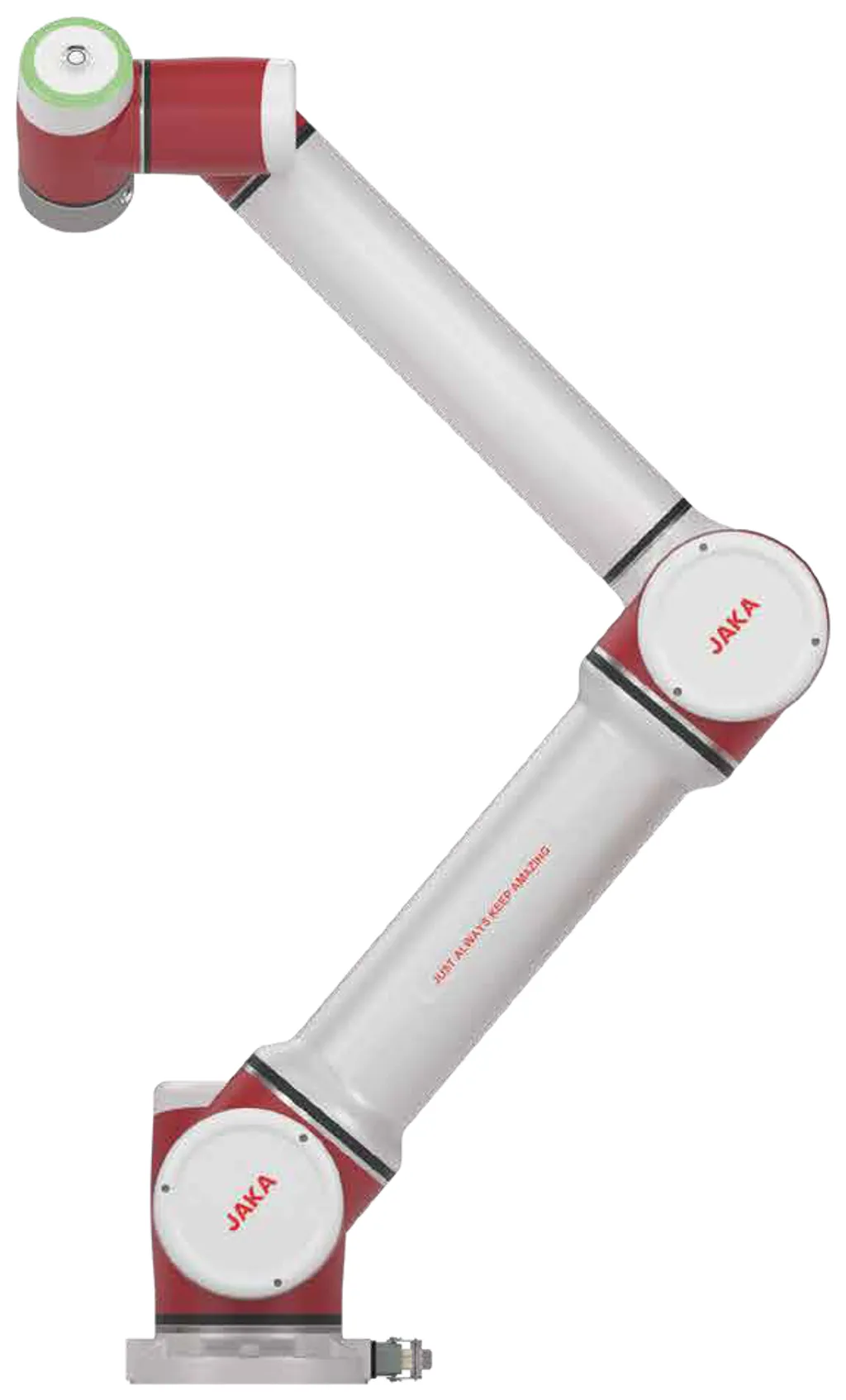
On the datasheet, JAKA and AUBO match or beat Universal Robots in every payload class we compared: tighter repeatability in most cases, better IP protection in nearly every case, and comparable or longer reach across the range. The JAKA Pro 12 carries IP68 and ±0.02 mm repeatability; the UR10e it competes with carries IP54 and ±0.05 mm. The AUBO iS35 runs to 35 kg at IP67 and 2,100 mm reach; the UR30 hits 35 kg but only stretches to 1,300 mm. On the arm alone, the Chinese case is strong. Where UR pulls ahead is everything around the arm: 1,000+ certified integrations in the UR+ marketplace, a dense Western service network with known parts lead times, fifteen-plus years of field history, and resale value that the Chinese brands have not yet established. For EU buyers without a tariff headwind, JAKA and AUBO represent the most compelling hardware-per-dollar cobots on the market right now. For US buyers, a 25% Section 301 tariff on Chinese-origin arms shifts the landed cost calculation substantially and narrows the price gap that is supposed to offset the ecosystem difference. The right choice depends on which factor is the binding constraint for your cell.
How this comparison is structured
All specifications below come from the Industrial Robotics Hub database. No manufacturer marketing pages, no third-party databases. Where a figure is not in our database it is shown as ”—” rather than estimated. The comparison is organized by payload class so you are always looking at like against like. You can build any custom side-by-side at the compare engine, which pulls live figures for every robot in the database.
Three payload classes cover the core cobot range: 5 kg (light assembly, small parts), 10-12 kg (mid-range machine tending and assembly), and 16-20 kg (heavier machine tending, packaging). The 30-35 kg heavy class is included because both AUBO and UR now field arms there and the comparison is instructive.
For the broader context on Chinese cobot brands — service network depth, parts logistics, the Section 301 tariff, and fieldbus commissioning time — see the Chinese industrial robots buyer’s reality check. This post focuses on the hardware comparison class by class.
5 kg class: UR5e vs JAKA Pro 5 vs AUBO i5
The 5 kg class is where most cobot conversations start. Light assembly, screwdriving, small-part handling, inspection. In this class, both Chinese arms beat UR on IP rating and repeatability; UR’s reach is the shortest of the three.
| Spec | UR5e | JAKA Pro 5 | AUBO i5 |
|---|---|---|---|
| Payload | 5 kg | 5 kg | 5 kg |
| Reach | 850 mm | 954 mm | 886 mm |
| Repeatability | ±0.03 mm | ±0.02 mm | ±0.02 mm |
| IP rating (arm) | IP54 | IP68 | IP54 |
| Max TCP speed | 1,000 mm/s | 3,000 mm/s | 2,800 mm/s |
Payload is identical at 5 kg for all three. JAKA’s Pro 5 stands out on three specs simultaneously: IP68 (full immersion-proof, versus the UR5e’s IP54 splash resistance), tighter repeatability (±0.02 mm versus ±0.03 mm), and 104 mm more reach than the UR5e. The AUBO i5 matches the JAKA on repeatability and beats the UR on reach, while sitting at the same IP54 as the UR. If the environment is wet — coolant mist, food processing, even a regular wipe-down — the JAKA Pro 5’s IP68 is in a different class. If the environment is dry and IP54 is fine, the AUBO i5 and UR5e are closer, though AUBO still edges repeatability.
AUBO also offers the iS7 in this general class — 7 kg payload, 886 mm reach, ±0.02 mm, IP67 — which gives buyers who need a bit more payload headroom an option that UR does not offer at this reach.
Speed is not usually the governing spec in collaborative cells because human co-presence enforces reduced speeds anyway, but the Chinese arms show notably higher published TCP speeds than the UR5e (3,000 mm/s and 2,800 mm/s versus 1,000 mm/s). In unmanned windows — lights-out periods or guarded cells — that gap in rated speed could matter for cycle time.
10-12 kg class: UR10e vs JAKA Pro 12 vs AUBO iS10
The 10-12 kg class is the most widely deployed cobot range. Machine tending of compact CNC cells, assembly, lab automation, packaging. The UR10e is the UR workhorse here; JAKA fields the Pro 12 and Zu 12; AUBO fields the iS10.
| Spec | UR10e | JAKA Pro 12 | AUBO iS10 |
|---|---|---|---|
| Payload | 12.5 kg | 12 kg | 10 kg |
| Reach | 1,300 mm | 1,327 mm | 1,300 mm |
| Repeatability | ±0.05 mm | ±0.02 mm | ±0.03 mm |
| IP rating (arm) | IP54 | IP68 | IP67 |
| Max TCP speed | 1,000 mm/s | 3,000 mm/s | — |
This is the class that most clearly illustrates the datasheet story. The UR10e carries 12.5 kg, which is 0.5 kg ahead of JAKA’s 12 kg — the one area where UR holds a factual edge here. Reach is essentially equal (1,300 mm for UR and AUBO; 1,327 mm for JAKA). But the protection rating gap is sharp: the JAKA Pro 12 is IP68 and the AUBO iS10 is IP67, both significantly better than the UR10e’s IP54. Repeatability favors the Chinese arms by a meaningful margin: ±0.02 mm for JAKA, ±0.03 mm for AUBO, versus ±0.05 mm for UR. The best cobots for machine tending analysis ranked the JAKA Pro 12 seventh overall and highlighted its IP68 rating as the best sealing of any arm in the ranking — the UR20 placed sixth in that same ranking primarily on ecosystem grounds, not hardware grounds.
For a flood-coolant CNC cell, the Pro 12 and iS10 are more suitable on the hardware specs alone than the UR10e. For a dry or light-mist process where the integration priority is plug-and-play with a pre-certified gripper and vision kit, the UR10e’s UR+ ecosystem advantage re-enters the picture.
16-20 kg class: UR20 vs JAKA Zu 20 / Pro 16 vs AUBO iS20L
The 16-20 kg class stretches toward heavier machine tending, palletizing, and larger-part assembly. UR fields the UR20; JAKA has both the Zu 20 (20 kg) and Pro 16 (16 kg); AUBO’s standout in this range is the iS20L with 2,000 mm reach.
| Spec | UR20 | JAKA Zu 20 | JAKA Pro 16 | AUBO iS20L |
|---|---|---|---|---|
| Payload | 20 kg | 20 kg | 16 kg | 20 kg |
| Reach | 1,750 mm | 1,780 mm | 1,713 mm | 2,000 mm |
| Repeatability | ±0.10 mm | ±0.05 mm | ±0.02 mm | ±0.03 mm |
| IP rating (arm) | IP65 | IP65 | IP68 | IP67 |
| Max TCP speed | 5,000 mm/s | — | 3,900 mm/s | — |
UR’s UR20 is the fastest arm in this comparison by a clear margin: 5,000 mm/s versus 3,900 mm/s for the JAKA Pro 16, with the Zu 20 and AUBO iS20L speeds not published in our database. If cycle time in an unmanned cell is the priority, the UR20’s published speed advantage is real. On everything else, the Chinese arms are ahead: the AUBO iS20L reaches 2,000 mm against the UR20’s 1,750 mm (a 250 mm advantage that can eliminate a track or a robot reposition in a large cell), JAKA’s Pro 16 carries IP68 against IP65 for the UR20, and repeatability is tighter across the Chinese field (±0.02 to ±0.05 mm versus ±0.10 mm for the UR20).
The ±0.10 mm repeatability on the UR20 is worth noting directly: it is the loosest repeatability figure in the UR cobot range and the loosest of any arm in this comparison. For general tending and palletizing that is not an issue, but for precision fixture-loading or tight-tolerance assembly it could matter. JAKA’s Pro 16 at ±0.02 mm is five times tighter than the UR20 — a genuine hardware difference, not a rounding artifact.
30-35 kg class: UR30 vs JAKA Zu 30 vs AUBO iS35
The heavy cobot class is where the reach gap between UR and the Chinese arms is most visible. UR’s UR30 carries 35 kg; both JAKA and AUBO offer 30-35 kg arms, but the reach and IP picture is very different.
| Spec | UR30 | JAKA Zu 30 | AUBO iS35 |
|---|---|---|---|
| Payload | 35 kg | 30 kg | 35 kg |
| Reach | 1,300 mm | 1,350 mm | 2,100 mm |
| Repeatability | ±0.10 mm | ±0.05 mm | ±0.05 mm |
| IP rating (arm) | IP65 | IP65 | IP67 |
| Max TCP speed | 4,000 mm/s | — | — |
The AUBO iS35 stands out here in a way that is hard to dismiss. It matches the UR30 at 35 kg payload, runs IP67 against the UR30’s IP65, posts tighter repeatability (±0.05 mm versus ±0.10 mm), and reaches 2,100 mm against the UR30’s 1,300 mm. That 800 mm of additional reach is substantial — it is the kind of difference that in a large cell can mean one fewer robot position or one fewer track. The AUBO iS35 also ranked fourth overall in the machine-tending comparison specifically because of that combination of heavy payload, IP67, and long reach.
The UR30’s advantage is the same as the rest of the UR range: ecosystem, service network, and 4,000 mm/s published TCP speed. For a buyer in the EU deploying on a high-payload cell where the integrator has a strong AUBO relationship, the iS35 is a compelling hardware argument. For a buyer in the US who needs the Western service SLA and the UR+ integration library, the service and tariff picture still favors UR.
The real gap: what the specs do not show
The hardware comparison above is clear: JAKA and AUBO match or beat UR on most datasheet specs across all four payload classes, and on IP rating and repeatability specifically, the Chinese arms are frequently ahead. The UR edge is speed at the top of the range (UR15/UR20 at 5,000 mm/s, UR30 at 4,000 mm/s), the UR15’s IP65 upgrade over the lower range, and — the part that does not appear in a spec table — the ecosystem.
The UR+ marketplace lists over 1,000 certified integrations: grippers, vision systems, safety scanners, conveyor interfaces, force-torque sensors, all pre-tested with the UR controller and available as plug-and-play URcaps. The JAKA and AUBO software ecosystems are functional and open, but the catalog of tested third-party integrations is a fraction of that depth. For a buyer who wants to configure a tending cell by selecting from a verified component catalog rather than running a custom integration project, the UR+ library has real practical value that does not appear on a payload chart.
Service is the second off-spec gap. UR has regional service centers, trained field engineers, and parts available within days in most Western markets. For Chinese cobot brands in 2026, Western service is primarily delivered through distributor networks. The exact first-response times and parts lead times vary by distributor and region; for a high-uptime production line where an unplanned stoppage is expensive, that uncertainty changes the risk calculus. We covered this in detail in the Chinese industrial robots 2026 analysis and will not re-derive it here — the short version is that if your OEE model penalizes downtime heavily, the service-network depth of UR is worth real money even when the arm costs more.
For US buyers specifically, the 25% Section 301 tariff on Chinese-origin industrial goods adds directly to the landed cost of a JAKA or AUBO arm. A Chinese cobot at $40,000 list price enters the US at an effective landed cost closer to $50,000 before integration — which compresses the price advantage that motivates most Chinese cobot evaluations in the first place. EU buyers face no equivalent tariff, which is why the EU market is where Chinese cobots are most straightforwardly competitive right now.
Class-by-class verdict
| Class | UR | JAKA | AUBO | Datasheet verdict | Where UR wins |
|---|---|---|---|---|---|
| 5 kg | UR5e | Pro 5 | i5 | JAKA Pro 5 (IP68, ±0.02 mm, +104 mm reach) | UR+ ecosystem |
| 10-12 kg | UR10e | Pro 12 | iS10 | JAKA/AUBO (IP68/IP67 vs IP54; tighter repeat.) | Payload (0.5 kg), ecosystem |
| 16-20 kg | UR20 | Zu 20 / Pro 16 | iS20L | AUBO iS20L reach; JAKA Pro 16 repeat + IP | Speed (5,000 mm/s) |
| 30-35 kg | UR30 | Zu 30 | iS35 | AUBO iS35 (35 kg, IP67, 2,100 mm reach) | Speed (4,000 mm/s), ecosystem |
How to decide
Work through four questions in order and the comparison above will narrow to a short list.
Is the cell environment wet or dry? If coolant, washdown, or regular liquid exposure is part of the process, set your IP floor first. IP68 covers full immersion; IP67 covers temporary immersion; IP65 covers water jets; IP54 covers splash and mist only. The UR range tops out at IP65 on the UR15/UR20/UR30 and sits at IP54 on the UR5e and UR10e. JAKA’s Pro series runs IP68 across the range; AUBO’s iS series runs IP67 across the range. If your process involves flood coolant, the IP54 on the UR5e and UR10e is the wrong rating class. If the cell is dry — electronics assembly, clean-room, light logistics — the IP difference is irrelevant and the ecosystem argument for UR becomes more decisive.
What is the total payload, tooling included? Add the gripper or end-effector weight to the part weight and apply at least 20-25% headroom. The spec tables above show that UR holds a narrow payload edge only in the 10-12 kg class (12.5 kg versus 12 kg for JAKA); everywhere else the Chinese arms are at payload parity or above (AUBO iS35 matches UR30 at 35 kg). If tooling headroom is tight in the 12 kg class, the UR10e’s half-kilogram advantage matters.
How important is plug-and-play integration? If your integrator plans to pair the arm with a certified gripper and vision system from the UR+ library, the switching cost away from UR is real — you are trading a verified integration for a custom one. If your integrator is building a bespoke cell from first principles, the UR+ catalog advantage shrinks considerably. Talk to your integrator about whether they have deployed the specific Chinese arm in their simulation environment before committing.
What does the service and tariff picture look like for your market? EU buyers: no tariff on Chinese cobots, and several established JAKA and AUBO distributors in Germany, France, and the Netherlands mean that the hardware case for the Chinese arms is strong and the cost case is intact. US buyers: the 25% tariff adjusts the economics; run a landed-cost calculation before comparing sticker prices. High-uptime buyers everywhere: quantify what an unplanned day of downtime costs your line, and compare that to the service-network gap. If the number is large, UR’s service density has measurable value. If the number is modest and you have in-house electrical engineering and a spare-parts buffer, a thinner service network is manageable.
If you want to put any two arms from either brand side by side on every spec, the compare engine pulls live figures from the full database. For a broader evaluation of what a cobot can and cannot do in a given cell type, the cobot vs industrial robot guide is the place to start before the brand comparison. For machine-tending cells specifically, the machine tending applications page lists the cobots in our database tagged for that duty.
All specifications sourced from the Industrial Robotics Hub database, current as of June 2026. Payload and reach are headline manufacturer figures; effective payload at full reach is lower and varies by model. IP ratings reflect arm ratings as recorded in our database. TCP speed figures are shown where available in the database; ”—” indicates not published. Section 301 tariff rate (25%) is current as of June 2026; consult your customs broker for landed-cost calculations. UR+ integration count (1,000+) is a publicly stated UR figure.
Compare these robots