Electronics Robots Need 2.5x the Precision of Automotive
Teradyne cobot unit just posted a record $100M quarter tied to electronics demand. Our 400-robot database shows the real precision cost: 2.5x automotive.
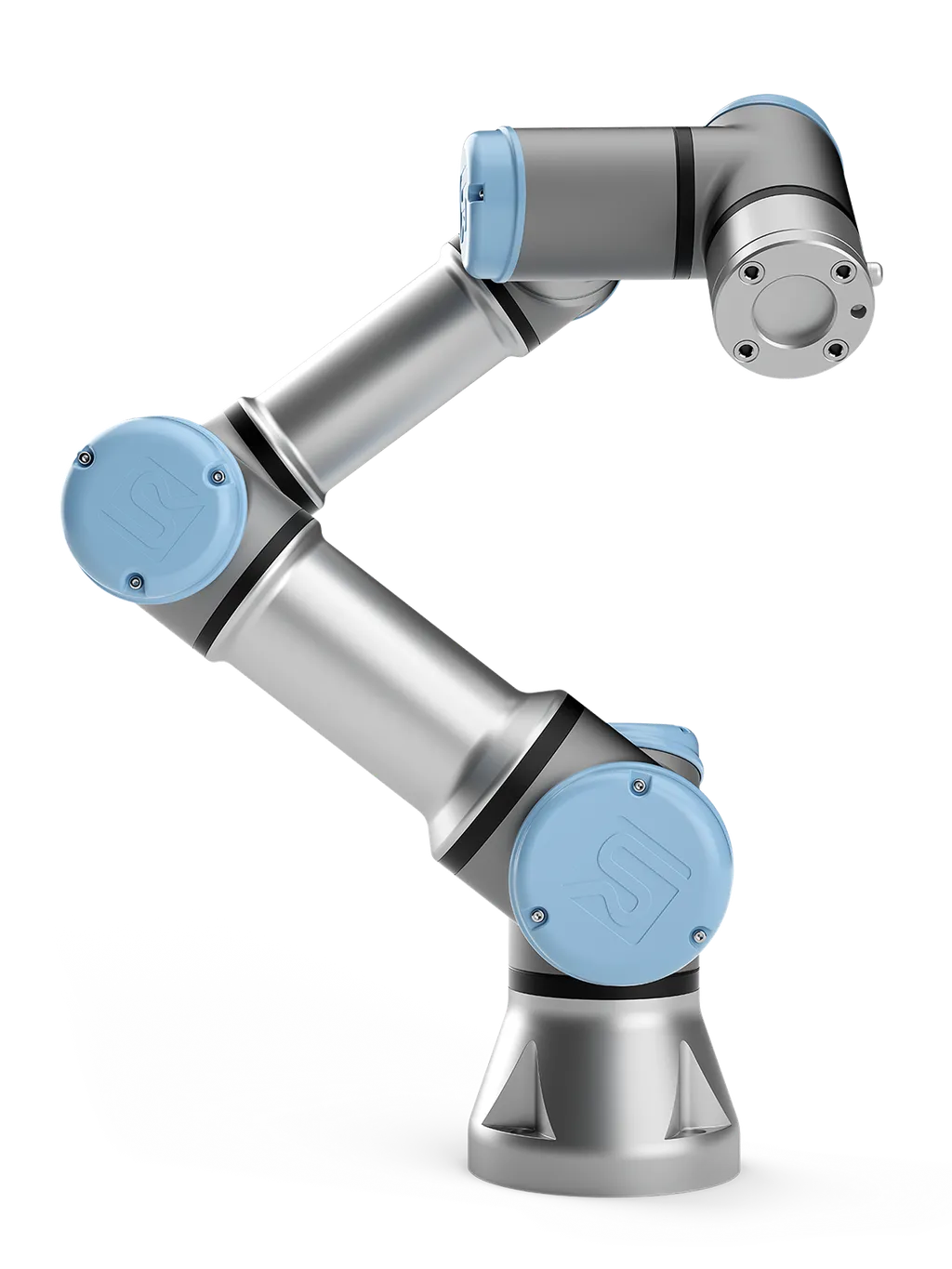
Teradyne’s Robotics segment, Universal Robots’ cobots plus MiR’s AMRs, just posted a record $100 million quarter, up 33% year over year, its fifth straight quarter of growth. On the earnings call, company commentary named electronics and semiconductor manufacturing as the fastest-growing part of that business. We went and checked what that market actually demands. In our own 400-robot spec database, robots tagged for electronics-only work carry a median repeatability of 0.02 mm. Robots tagged for automotive-only work carry a median of 0.05 mm. That is 2.5x tighter, and it is not a marketing number, it is the physical spec that separates the two jobs.
What did Teradyne’s robotics business just report?
The headline numbers are clean and already independently reported: $100 million in Q2 2026 Robotics segment revenue, up 33% year over year from $75 million, the fifth consecutive quarter of growth for the segment, according to The Robot Report. Teradyne’s own investor press release puts that $100 million inside $1,329 million in total company revenue, with CEO Greg Smith framing the AI buildout as running “from wafer to AI data center.”
On the earnings call, company commentary singled out electronics manufacturing and semiconductors as the fastest-growing end markets inside Robotics, per The Robot Report’s coverage. Worth being precise here: that is earnings-call characterization, not a disclosed revenue split. Teradyne has not published a dollar or percentage breakdown of Robotics revenue by end market, and we are not going to manufacture one. For the full earnings detail, see our earnings breakdown. What we can do is answer a more useful question: if electronics work really is pulling ahead, what does a robot built for that job actually look like on paper, compared to one built for automotive?
What does “electronics-grade precision” cost in repeatability?
We pulled every robot in our database tagged for industry work and split them into two mutually exclusive groups: robots tagged electronics and not automotive, and robots tagged automotive and not electronics. That split matters because a lot of robots straddle both markets, 150 of them in our database carry both tags, so we are deliberately excluding the generalists to compare the two specialist populations head to head.
- Electronics-only: 80 robots, 77 with a published repeatability figure, median 0.02 mm
- Automotive-only: 138 robots, 133 with a published repeatability figure, median 0.05 mm
- Both tags: 150 robots (versatile arms that work either floor)
Ratio: 0.05 mm / 0.02 mm = 2.5x. An automotive-class robot can be off by two and a half times more distance than an electronics-class robot and still be doing its job correctly. That is not a rounding difference, it is a different tier of hardware, from the encoder resolution to the gearbox backlash to the frame stiffness.
Zoom out to the full database and the pattern holds across every industry tag, not just this one pair:
Median repeatability by industry tag, all robots in the Industrial Robotics Hub database with a published figure. Semiconductor combines the semiconductor and semiconductors tag spellings, a data-hygiene inconsistency we are flagging rather than silently fixing.
Medical devices and semiconductor work tie electronics at 0.02 mm, which makes sense, they are all applications where the part being placed is small and the tolerance for drift is measured in microns, not millimeters. Food and beverage and metal work sit loosest at 0.05 mm, where the parts are bigger and the job is closer to “get it in the general vicinity, fast” than “hit the same point ten thousand times running.”
Is Universal Robots’ own catalog built for this shift?
Teradyne owns Universal Robots, so its own current cobot lineup is the direct test case. Here is every model UR sells today, with the industries our database tags it for:
| Model | Payload | Repeatability | Industries tagged |
|---|---|---|---|
| UR3e | 3 kg | 0.03 mm | Electronics, medical devices, consumer goods |
| UR5e | 5 kg | 0.03 mm | Automotive, electronics, food & beverage |
| UR7e | 7.5 kg | 0.03 mm | Automotive, electronics, food & beverage |
| UR10e | 12.5 kg | 0.05 mm | Logistics, automotive, food & beverage |
| UR12e | 12.5 kg | 0.05 mm | Logistics, automotive, food & beverage |
| UR15 | 17.5 kg | 0.05 mm | Logistics, food & beverage, consumer goods, automotive |
| UR16e | 16 kg | 0.05 mm | Automotive, metal fabrication, electronics |
| UR20 | 20 kg | 0.1 mm | Logistics, metal, automotive |
| UR30 | 35 kg | 0.1 mm | Logistics, metal fabrication, automotive, food & beverage |
Look at the industries column and one thing stands out: the UR3e is the only current UR model not tagged for automotive work at all. It is also the smallest cobot in the lineup, 3 kg payload, and it carries the tightest repeatability UR publishes. Every model above it in payload class carries an automotive tag, and repeatability loosens in lockstep with payload, 0.03 mm through the small-payload tier, 0.05 mm through the mid tier, 0.1 mm at the top with the UR20 and UR30.
That is the honest read on Teradyne’s own catalog. If electronics and semiconductor work really is the growth engine, UR has exactly one model purpose-built for that precision tier. Every other SKU in the lineup is an automotive-class arm that also happens to be capable enough for electronics, which is a different claim than being built for it.
Which robot brands already build for electronics work?
Some brands lean into this harder than others. Techman ships 13 of its 16 cobots with an electronics tag, the highest share of any brand we track, and every Techman cobot, including the TM5S, comes with built-in AI vision as standard, which is presumably no coincidence for a market where sub-millimeter component placement is the job. Behind Techman, Dobot, Doosan, JAKA and ROKAE each tag 8 of their models for electronics work. ABB, Kawasaki and KUKA each tag 5. Universal Robots tags 4 of its own 9 current models, roughly in line with the mid-pack, not a leader on this specific metric despite the segment being the one its parent company just called out as its fastest grower.
What should a buyer actually do with this?
Don’t shortlist a cobot by brand reputation on automotive work and assume it clears electronics tolerances. The data says that assumption breaks down fast: a brand’s flagship automotive-proven line can sit at 0.05 mm or looser, nowhere close to the 0.02 mm median that electronics-only robots hit. Check the specific model’s own published repeatability figure and its own industry tag, not the brand’s general standing. If your line is placing components at the scale semiconductor and electronics work demands, the cobot selection page and our Universal Robots guide are the places to start, and our companion piece on repeatability by robot type is worth reading alongside this one, that post cuts the same spec by robot type (SCARA vs articulated vs cobot), a different angle than this post’s cut by industry. Two different lenses on the same number, and buyers chasing electronics-grade work should check both before they sign a purchase order.
Compare these robots