ALVEST Folds EasyMile Into New Driverless-Vehicle Firm TLD Robotics
ALVEST bought EasyMile and launched TLD Robotics, claiming 35+ driverless operations in 10 countries. Price, closing date and fleet size undisclosed.
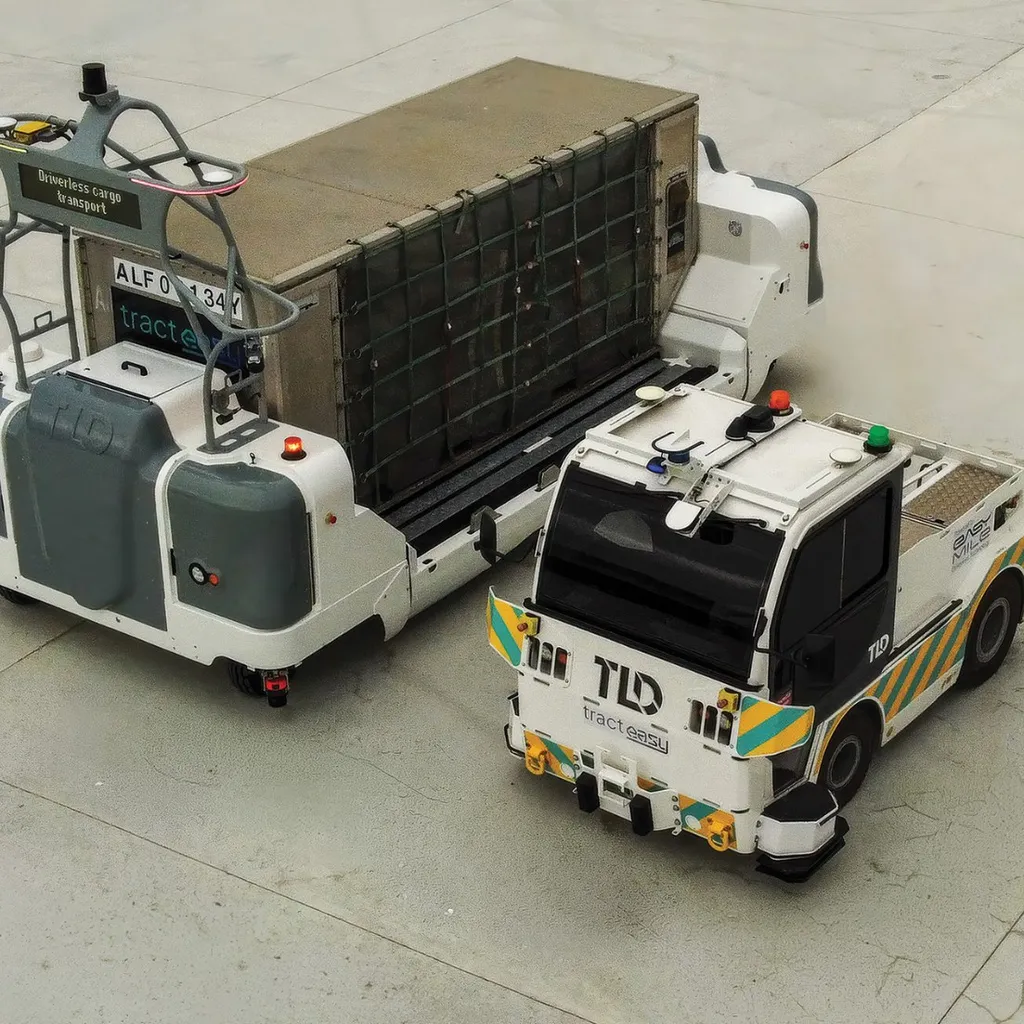
ALVEST, the airport ground-support-equipment (GSE) group, has acquired autonomous-vehicle developer EasyMile and combined it with the TractEasy joint venture and TLD’s own driverless activities into a new company, TLD Robotics. The launch release, datelined Chicago on September 16, 2026, claims more than 35 operations across 10 countries and more than 50,000 autonomous missions. It gives no purchase price, no closing date and no vehicle count.
What was announced
TLD Robotics calls itself “an ALVEST company dedicated to autonomous ground operations.” It was announced at GSE Expo Europe and is led by Richard Reno as CEO. Reno was previously CEO of TractEasy, according to EasyMile’s June 2025 release. The company operates under ALVEST Group and, per the release, “brings together capabilities that previously existed across EasyMile and TLD, and were deployed commercially via the TractEasy joint venture.”
For existing customers the release is explicit: TLD Robotics “maintains and executes all business engagements and deployments previously attributed to the TractEasy name.” Existing TractEasy engagements carry over to the new company.
The stack ALVEST says it now controls runs from supervision software (fleet-level mission coordination) and on-board software, through purpose-built vehicle platforms and fleet and operation management, to TLD’s manufacturing and integrated R&D. TLD is described as the world’s largest GSE manufacturer, with 12 factories in 7 countries. ALVEST president and CEO Valentin Schmitt framed the strategy this way: “Automation is the future of our business… Our customers are not buying a pilot; they are investing in decades of operations.” The release names safety, labor availability, cost and decarbonization as the drivers.
The numbers, and whose they are
Every operating figure below comes from the company’s own release:
- More than 35 operations in 10-plus countries on four continents: more than 15 airports plus more than 20 industrial sites.
- More than 50,000 autonomous missions, with “many” sites running 24/7.
- A fleet “tripling every year,” which the company says is more than a year ahead of earlier projections.
- Reno: “Since creating TractEasy three years ago, we have scaled tenfold,” with ambition to “scale another 10x over the coming years.”
None of the growth multiples comes with a base. Without a vehicle count, “tripling” and “tenfold” cannot be turned into fleet sizes. The customers named are dnata, BMW Group Dingolfing, Daimler Truck AG, Bosch, John Deere, Munich and Narita Airports, Japan Airlines (JAL) and Lufthansa Cargo. The release does not say which are live deployments and which are pilots. Some trade rewrites drop JAL from the list; the release itself includes it.
The industrial side of the book is worth a second look. By the company’s own count, industrial sites (20-plus) outnumber airports (15-plus), even though the parent’s heritage is airside equipment.
What an industrial deployment looks like
The best public evidence of the industrial pattern predates the acquisition. In June 2025, EasyMile described two EZTow autonomous tow tractors at “a major European automotive parts manufacturer in Germany,” which it called the “most complex and fully integrated Level 4 autonomous logistics deployment to date” (a company characterization). The release body does not name the site.
The operating details are concrete. The tractors pull a 16.1-metre tandem load, with vehicle and trailers up to 20 m overall, across nine production stations on a mixed indoor and outdoor circuit shared with forklifts and manually driven trucks. Operators dispatch the vehicles from stations along pre-defined routes. The customer eliminated its external transport services, and the deployment is backed by a long-term operational contract. EasyMile says it is “expected to generate a full return on investment within two years”, a forward-looking company and customer claim, not a measured result.
That is one site and two vehicles. It shows the complexity the company is aiming at; it says nothing about how the other 20-plus industrial sites perform.
The 14-ton versus 20-ton problem
EasyMile’s June 2025 release says EZTow is capable of towing 14-ton and 20-ton payloads. TractEasy’s product page, read on September 19, 2026, shows the same split on one page. Its specification table lists “Autonomous towing capacity: 14 tons / 28,000 lbs,” a 15 km/h (9.3 mph) maximum speed, dimensions of 3200 x 1940 x 2050 mm and a 4750 mm turning radius. The marketing copy elsewhere on the same page claims “an impressive 20 tons autonomous towing capacity.”
The two figures may describe different configurations or conditions, but the page does not say. We publish both and pick neither. For a buyer, this is a specification to pin down in writing before a site survey.
Why it matters to industrial buyers
The consolidation gives buyers one accountable vendor. Autonomy software, a vehicle maker with a large factory base and fleet-management software now sit inside a single ALVEST company, not a joint venture between two. According to PAI Partners’ July 2025 release, PAI and an ADIA subsidiary took a majority stake in Alvest, with Ardian keeping a minority stake. PAI said the investment would focus on electric GSE and offerings including automated or autonomous units and fleet management systems. That release put Alvest at more than 4,000 employees and 11 factories; the 2026 release cites 12 factories for TLD. These are different entities and dates, so each figure stays with its source.
This is also a different class of machine from the articulated arms that dominate the Industrial Robotics Hub catalog, and none of these vehicles is in our robot database. Readers weighing driverless tuggers against other mobile platforms can start with our autonomous mobile robot overview. Mobile robots carry a different risk profile from fixed cells, as our analysis of injury data for stationary arms versus AMRs shows. For neighboring examples, see ABB’s F712 visual-SLAM autonomous forklift and another recent consolidation, Neura Robotics’ Adlatus acquisition.
Sources
- TLD Robotics Launched as ALVEST Group Acquires EasyMile and TractEasy — EasyMile (press release), Sep 16, 2026
- TLD Robotics Launched as ALVEST Group Acquires EasyMile and TractEasy — RoboticsTomorrow, Sep 16, 2026
- TLD Robotics launches as ALVEST Group acquires EasyMile and TractEasy — Robotics 24/7, Sep 18, 2026
- TLD Robotics launches as Alvest acquires EasyMile and consolidates autonomous vehicle operations — Robotics & Automation News, Sep 17, 2026
- TLD Robotics combines EasyMile and TractEasy operations — Automotive World, Sep 16, 2026
- PAI Partners and ADIA complete acquisition of majority stake in Alvest — PAI Partners, Jul 9, 2025
- EasyMile sets new standard with record-length autonomous tandem tow at major European Tier 1 automotive supplier — EasyMile, Jun 24, 2025
- EZTow — Autonomous Tow Tractor — TractEasy (product page), Sep 19, 2026
Frequently asked questions
What is TLD Robotics and who owns it? +
TLD Robotics is a new company, announced September 16, 2026, that ALVEST describes as dedicated to autonomous ground operations. It combines EasyMile, TractEasy and TLD's own driverless activities following ALVEST's acquisition of EasyMile, and it operates under ALVEST Group with Richard Reno as CEO.
How many sites and missions does TLD Robotics claim? +
The launch release claims more than 35 operations across 10 countries and more than 50,000 autonomous missions, split between more than 15 airports and more than 20 industrial sites. These are company figures. The release does not give a vehicle count or say which sites are live deployments and which are pilots.
What was the price of the EasyMile acquisition? +
It has not been disclosed. Neither the launch release nor the trade coverage reviewed by the Industrial Robotics Hub news desk gives a purchase price, a closing date or EasyMile's prior ownership and valuation.
What is the towing capacity of the EZTow autonomous tractor? +
TractEasy's own product page gives two answers. Its specification table lists 14 tons (28,000 lbs) of autonomous towing capacity, while its marketing copy on the same page claims 20 tons. EasyMile's June 2025 release also cites both 14-ton and 20-ton payloads. The sources do not reconcile the figures.
More news