How Much Does an Industrial Robot Weigh? A 1,600x Spread
Across 240 robots that publish a weight, the arm itself runs from 7 kg to 11,200 kg, a 1,600x spread. It is the spec buyers ignore until the foundation quote arrives. The breakdown by type, and why the robot's own mass decides your floor.
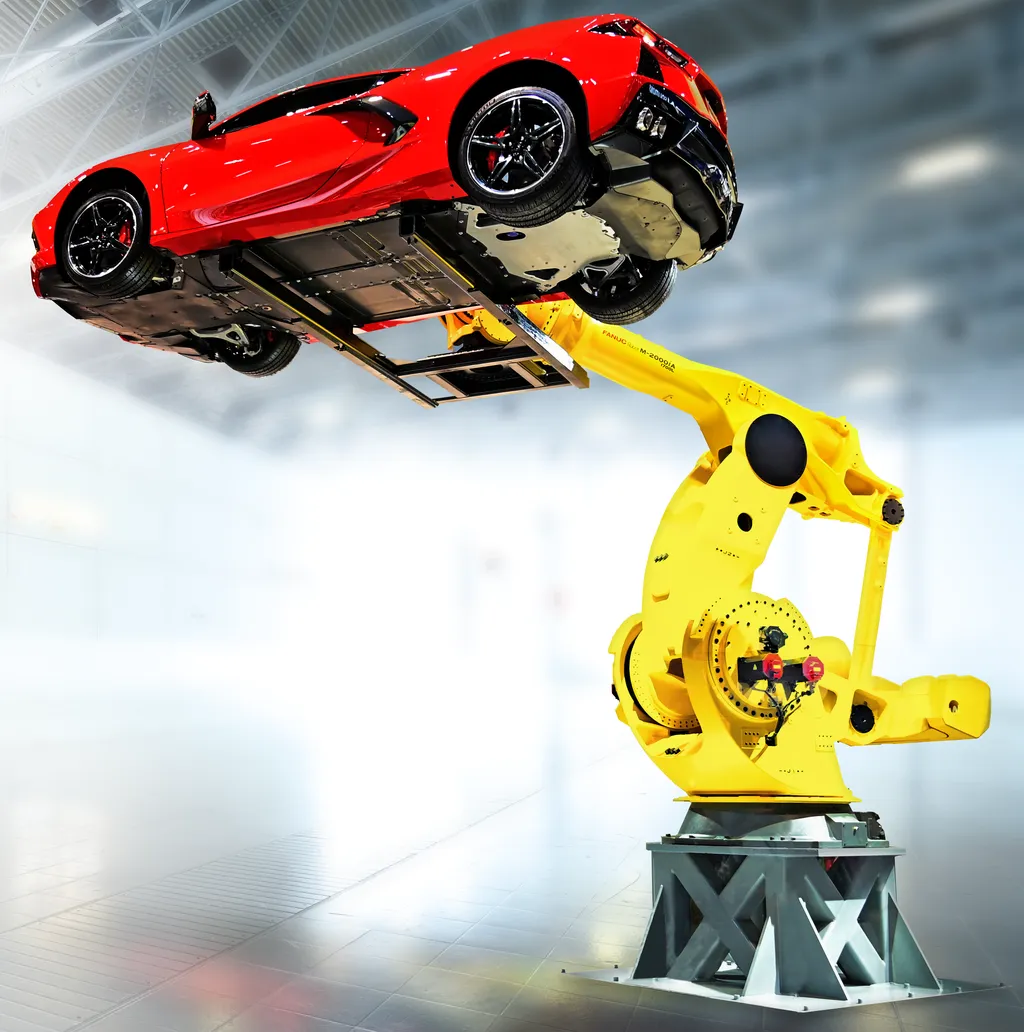
Buyers spec payload, reach, and repeatability down to the decimal. Almost nobody checks how much the robot itself weighs until the foundation quote lands. Across the 240 robots in the Industrial Robotics Hub database that publish a weight, the arm alone runs from 7 kg to 11,200 kg. That is a 1,600x spread, and it decides things that show up on the installation invoice long before the robot does any useful work: the base plate, the anchor bolts, and whether your floor can hold it at all.
The short version: a cobot weighs about as much as a full beer keg and bolts to a cart. The heaviest arm in our database weighs more than two mid-size cars and needs an engineered concrete foundation poured for it.
How much does an industrial robot weigh, by type?
Robot mass sorts by type almost as cleanly as power draw does, because both are driven by the same thing: the structure and gearing needed to hold a given payload rigid at reach. Here is the median arm weight for each type in our database.
Median arm weight by robot type. Source: analysis of 240 robots in the Industrial Robotics Hub database that publish a weight. Bar length uses a compressed (square-root) scale so lighter types stay visible; the kilogram figures are exact. AMR and painting types omitted as single-model samples.
The jump from a 35 kg cobot to a 1,620 kg palletizer is a 46x step, and it is the single biggest driver of what your install actually costs. A SCARA or cobot at a few dozen kilograms is a two-person lift onto a bench or a wheeled base. A palletizer at over a tonne and a half needs a forklift to place and a foundation designed to hold it. Everything between those two is a question of how heavy is heavy enough to change the plan.
The robot weighs far more than what it lifts
Here is the part that surprises buyers most. A robot’s own weight is not a small multiple of its payload, it is a large one, and the multiple depends on type.
In our data the median cobot weighs about 3.8x its rated payload, and the median SCARA about 3.7x. But a median six-axis articulated arm weighs roughly 8x its payload, and a welding robot about 12x. The FANUC CR-35iB, a collaborative arm rated to lift 50 kg, weighs 990 kg itself, close to 20x its payload. That mass is not there to lift the part. It is there to hold the arm stiff enough to place that part to a fraction of a millimeter, over and over, without deflecting under its own weight at full reach.
This is why “my floor can hold a tonne” is the wrong question, and why the weight spec deserves a look before you shortlist. Two robots that do the same 20 kg job can differ threefold in what they weigh, and therefore in what they cost to anchor.
What each weight class needs under it
Weight is not just a number on the datasheet, it maps directly to a mounting decision. Here is a spread of real models from our database, lightest to heaviest, with what each realistically needs to sit on.
| Robot | Type | Payload | Arm weight | What it needs under it |
|---|---|---|---|---|
| Yaskawa MotoMINI | Articulated | 0.5 kg | 7 kg | A benchtop; no anchoring |
| Universal Robots UR5e | Cobot | 5 kg | 21 kg | A sturdy table, cart, or light frame |
| Epson G20 | SCARA | 20 kg | 48 kg | A bolted steel frame or machine base |
| FANUC CR-35iB | Cobot | 50 kg | 990 kg | An industrial pedestal; forklift to move |
| Yaskawa PL320 | Palletizer | 320 kg | 1,680 kg | An engineered, anchored concrete foundation |
| FANUC M-410iB/700 | Palletizer | 700 kg | 3,700 kg | A reinforced foundation; crane to place |
| KUKA KR 1000 TITAN | Articulated | 1,000 kg | 4,690 kg | A deep, engineered foundation |
| FANUC M-2000iA/1700L | Articulated | 1,700 kg | 11,200 kg | A dedicated ground-floor foundation; no mezzanine |
Arm weights and payloads from the Industrial Robotics Hub database. Mounting notes are general guidance; the controlling number for any real install is the manufacturer’s dynamic base-load figure, not the static weight, and a structural engineer signs off the foundation.
Of the 240 robots with a published weight, 125 come in at 50 kg or under, and 23 weigh a tonne or more. Those two groups live in completely different installation worlds.
Static weight is the smaller half of the problem
The number on the datasheet is the static weight, and it is not what actually loads your floor. A robot accelerating and braking a heavy arm through fast arcs generates dynamic reaction forces and moments at the base that can far exceed its standing weight. The base plate has to resist downward load, uplift, and bending all at once, which is why manufacturers publish a separate maximum base-load figure for the foundation designer rather than just quoting the arm mass.
Get the anchoring wrong and it shows up as lost accuracy, not a dramatic failure. As Industrial Monitor Direct documents, when base anchor bolts loosen or pull out, the base rocks during rapid axis moves, which degrades positioning and drives premature wear in joint bearings and gearboxes. Their guidance: M16 (5/8 inch) anchors are the practical minimum for small robots, stepping up to M20 (3/4 inch) for arms around 100 kg payload and above, with embedment of at least 100 mm or five bolt diameters, whichever is greater. Chemical or epoxy-bonded anchors carry far more: an M16 in 25 MPa concrete reaches roughly 80 to 120 kN of pullout versus 30 to 50 kN for a mechanical expansion anchor.
The slab itself matters just as much. Robotic-install foundation guides such as this concrete recommendation for a FANUC riser call for a level surface and anchor holes on the order of 200 mm deep into sound concrete, with every hole anchored for stability. A thin or cracked slab is a real constraint, not a formality. Integrators regularly hit it in the field, as in this discussion of mounting a heavy ABB IRB 7600 to a 4-inch slab, where the existing floor was too thin for the arm and had to be reworked.
Where weight fits in the buying decision
For a light cobot or SCARA, weight barely registers: it bolts to a frame, a person or two places it, and you move on to the specs that decide the job. For anything in the hundreds of kilograms, the arm’s own mass quietly pulls in three line items buyers routinely forget to budget: an engineered foundation, larger chemical anchors, and lifting gear to set it. Those belong in the true cost of the robot, not discovered after the purchase order.
Two practical rules fall out of the data. First, if you are floor-constrained or looking at a mezzanine or upper floor, weight is a shortlist filter, not an afterthought, and the lighter-per-payload types (cobots, SCARAs) earn a serious look. Second, if two candidates do the same job, check their weight before their price. The heavier one can cost more to install than it saves at purchase, and the payload-to-weight ratio tells you which is which. Weight is a published spec on every robot in our database that reports it, sitting one click away on each model’s page and on the mounting-options guide for where it can actually go.
Know which end of the 1,600x spread you are buying, and get the foundation into the quote before you sign.
Analysis based on the 240 of 265 robots in the Industrial Robotics Hub database that publish an arm-weight specification. Mounting and foundation notes are general guidance; every real installation is governed by the manufacturer’s dynamic base-load figure and a structural engineer’s sign-off, not by static weight alone.
Frequently asked questions
How much does an industrial robot weigh? +
It depends almost entirely on type and payload. Across the 240 robots in the Industrial Robotics Hub database that publish a weight, the arm alone runs from 7 kg (a Yaskawa MotoMINI) to 11,200 kg (a FANUC M-2000iA/1700L), a 1,600x spread. The median SCARA weighs about 26 kg and the median cobot about 35 kg, while the median six-axis articulated arm is 228 kg and the median palletizer is 1,620 kg.
How much does a robot arm weigh compared to what it lifts? +
Far more than the payload. In our data the median cobot weighs about 3.8x its rated payload and a SCARA about 3.7x, but a six-axis articulated arm weighs about 8x its payload and a welding robot about 12x. A robot that lifts 50 kg can easily weigh 500 to 1,000 kg itself, because most of the mass is structure and gearing that hold the arm rigid, not lift the part.
Does the robot's weight affect installation cost? +
Yes, often more than buyers expect. The robot's own mass decides the base plate size, anchor bolt spec, and whether the floor slab needs reinforcing. Anything past a few hundred kilograms typically needs an engineered concrete foundation, larger chemical anchors, and a forklift or crane to place. A light cobot bolts to a cart; an 11-tonne arm needs a dedicated ground-floor foundation and cannot go on a mezzanine.
Can I mount a heavy industrial robot on an upper floor or mezzanine? +
Usually not without a structural engineer signing off. Mezzanines and upper floors have strict distributed and point-load limits, and a heavy arm concentrates both static weight and dynamic reaction forces onto a small base. Cobots and small SCARAs are often fine on a sturdy frame or bench; anything in the hundreds-of-kilograms range generally belongs on a ground-floor slab designed for it.
Compare these robots