Kawasaki Robots: 15 Models From 3 kg to 500 kg Payload
Kawasaki built Japan's first industrial robot in 1969. Today its 15-model range spans 3 kg cobots to a 500 kg palletizer with 3,255 mm reach.
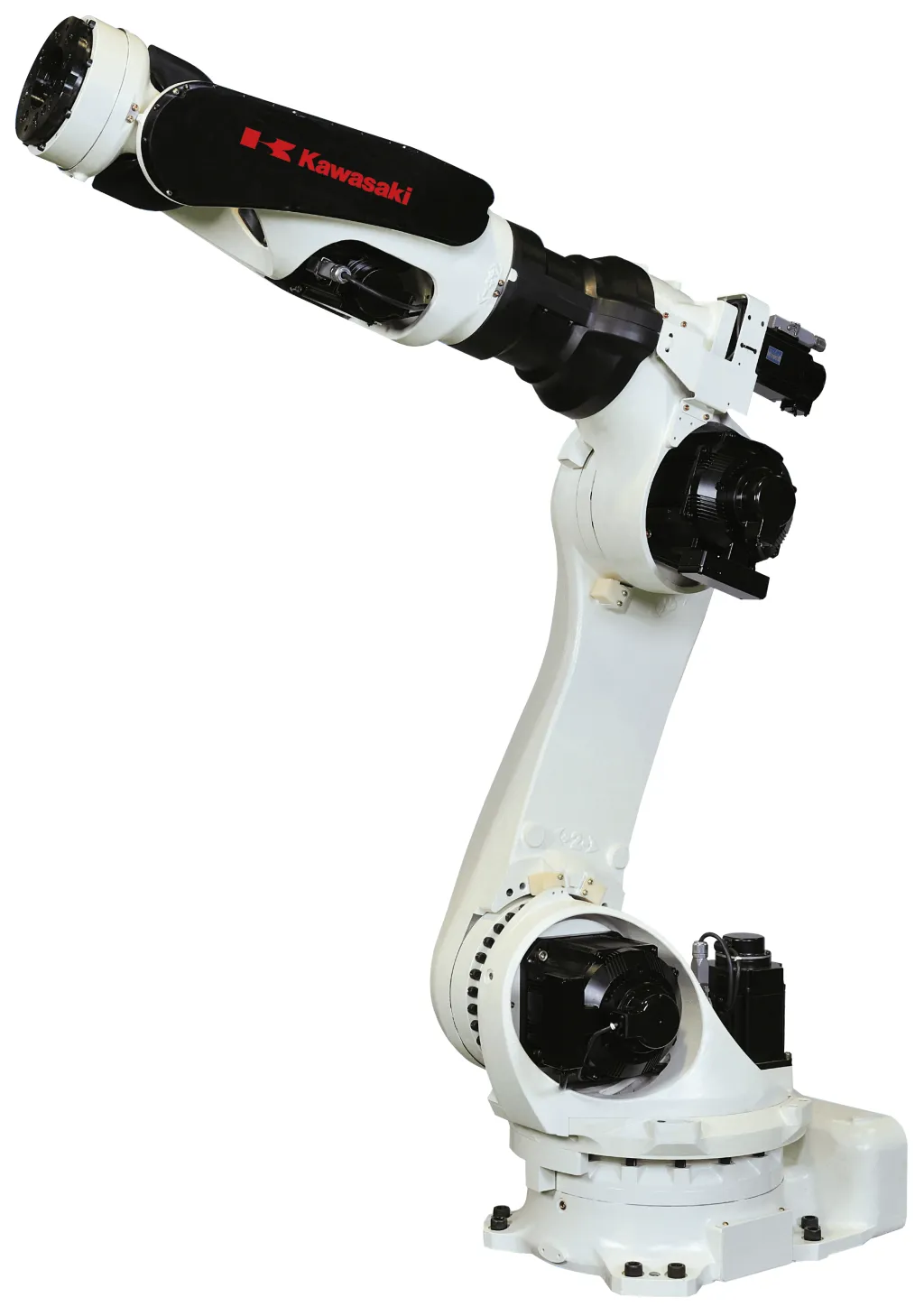
Kawasaki shipped Japan’s very first industrial robot in 1969, and 57 years later its lineup still stretches from a 3 kg dual-arm cobot to a 500 kg palletizing brute - 15 models covering a payload span that few brands can match. If your application sits anywhere between precise small-part assembly and end-of-line pallet stacking, there is a Kawasaki built for it. The question is which one, and whether the brand’s deep automotive roots and conservative control architecture fit your shop floor.
Who makes Kawasaki robots?
Kawasaki’s robot business lives inside Kawasaki Heavy Industries, Ltd. - the same conglomerate that builds motorcycles, aircraft components, and gas turbines. The Robot Division is headquartered in Akashi, Japan. North American customers deal with Kawasaki Robotics (USA), Inc., based in Wixom, Michigan, which handles sales, integration support, and field service across the Americas.
The origin story matters here. In 1968 Kawasaki Aircraft signed a technical agreement with Unimation Inc., the American company that invented the industrial robot. One year later, in 1969, Kawasaki produced the Kawasaki-Unimate 2000 - the first industrial robot ever built in Japan. That is not marketing copy; it is a documented industrial first. By 1973 Toyota and Nissan had adopted Kawasaki-Unimate robots for auto-body spot welding, locking in the automotive DNA that still shows up in the BX and RS series today.
That history gives Kawasaki something genuinely useful: 50-plus years of field data from high-volume, high-demand automotive lines. The RS007N’s 0.02 mm repeatability did not come from a marketing team. It came from a company that has been refining the same kinematic architecture since the 1970s. The U.S. subsidiary provides additional corporate context on the division’s current structure and global reach.
What types of robots does Kawasaki make?
The 15-model catalog is dominated by articulated robots - six-axis arms covering the widest range of payload and reach. Two dedicated palletizer models handle heavy end-of-line stacking. One cobot, the duAro2, rounds out the catalog for human-collaborative assembly tasks.
Eight-in-ten Kawasaki robots are articulated arms, which is a deliberate strategic choice rather than a portfolio gap. Kawasaki has stayed disciplined about the categories where it has process expertise: welding, material handling, assembly, and general-purpose automation. There is no SCARA line, no delta picker series, and no linear-axis product. If your application demands a SCARA robot for high-speed horizontal pick-and-place, Kawasaki is not your vendor. If you need a 6-axis arm that can handle anything from 7 kg to 350 kg, you have twelve variants to consider before you talk to a competitor.
The palletizer pair - CP180L and CP500L - deserve a note. These are not rebranded articulated arms. The CP series uses a purpose-built four-axis kinematic optimized for layer-pattern palletizing at sustained high cycle rates. In February 2026 Kawasaki expanded this series with the CP110L, the first palletizer in the 110 kg class to use a hollow-wrist structure, enabling internal cable routing for cleaner integration and reduced wear on wrist cabling.
Payload range: 3 kg to 500 kg
The RS and BX series articulated arms stack neatly from 7 kg to 350 kg. The CP palletizers extend the ceiling to 500 kg. The duAro2 cobot sits at 3 kg per arm. That is a 167-to-1 payload ratio across a single brand’s catalog - unusual breadth for a company that does not make SCARAs or deltas.
Source: Industrial Robotics Hub database, 15 Kawasaki robots.
The RS series clusters tightly from 7 kg to 80 kg, which is where most general-purpose automation lives. These arms share a common control platform (the E series controller) and nearly identical mounting footprints across the range - a practical advantage when you are specifying multiple robots for one line and want to standardize spares. The BX200L at 200 kg and MX350L at 350 kg handle heavy casting extraction and large-part transfer where the RS series runs out of capacity. At the top end, the CP500L operates with a 3,255 mm reach - long enough to span a full euro-pallet from center-of-robot mount.
The repeatability numbers hold up well across payload classes. Median across all 15 is 0.06 mm. The RS007N hits 0.02 mm, which is competitive with high-end FANUC and KUKA small-arm specs. Even the 350 kg MX350L holds 0.1 mm - acceptable for casting extraction and press-tending where workpiece tolerances are not sub-millimeter. Only the palletizers operate at looser tolerance (0.5 mm), which is appropriate for a task where the target zone is a pallet cell rather than a machined bore.
Kawasaki performance specs at a glance
| Type | Robots | Payload median (kg) | Repeat median (mm) | IP67+ |
|---|---|---|---|---|
| Articulated | 12 | 30 | 0.06 | 0% |
| Palletizer | 2 | 340 | 0.50 | 0% |
| Cobot | 1 | 3 | 0.05 | 0% |
IP rating is the one clear gap in the Kawasaki catalog. None of the 15 models in the database carry IP67 or higher as a standard rating. For food processing, pharmaceutical washdown, or outdoor environments with water ingress risk, this matters. Kawasaki does offer protected variants through integrators, but out-of-the-box ingress protection is not a catalog feature the way it is with some FANUC or Staubli models. If IP67 is a hard requirement for your application, check the articulated robot type page to compare vendors before committing.
Complete Kawasaki robot lineup
All 15 robots, sorted by payload. Reach and repeatability are nominal values from manufacturer data. Speed data is not published for this lineup.
| Model | Type | Payload (kg) | Reach (mm) | Repeat (mm) | Max Speed (mm/s) | IP |
|---|---|---|---|---|---|---|
| duAro2 | cobot | 3 | 785 | 0.05 | - | - |
| RS007N | articulated | 7 | 730 | 0.02 | - | - |
| RS007L | articulated | 7 | 930 | 0.03 | - | - |
| RS013N | articulated | 13 | 1460 | 0.03 | - | - |
| RS015X | articulated | 15 | 3150 | 0.06 | - | - |
| RS020N | articulated | 20 | 1725 | 0.04 | - | - |
| RS025N | articulated | 25 | 1885 | 0.06 | - | - |
| RS030N | articulated | 30 | 2100 | 0.06 | - | - |
| RS050N | articulated | 50 | 2100 | 0.06 | - | - |
| RS080N | articulated | 80 | 2100 | 0.06 | - | - |
| BX100N | articulated | 100 | 2200 | 0.06 | - | - |
| BX200L | articulated | 200 | 2597 | 0.06 | - | - |
| CP180L | palletizer | 180 | 3255 | 0.50 | - | - |
| MX350L | articulated | 350 | 3018 | 0.10 | - | - |
| CP500L | palletizer | 500 | 3255 | 0.50 | - | - |
The RS015X at 15 kg payload with 3,150 mm reach is the outlier worth flagging. That is an unusually long arm for a 15 kg payload class - it exists for applications where the robot needs to span a wide work envelope but is only handling light parts, such as sealant application along a long vehicle body panel.
Which Kawasaki robot fits your application?
Precision small-part assembly (electronics, connectors, sensors). Take the RS007N. Seven kilograms of payload covers most end-effector-plus-part combinations in electronics assembly. The 0.02 mm repeatability is the tightest in the entire Kawasaki lineup and is competitive against any small-arm in the industry. The 730 mm reach is intentionally compact - this robot is designed for a small workcell footprint, not extended-reach tasks. If you need slightly more reach with only a minor repeatability tradeoff, the RS007L gives you 930 mm at 0.03 mm.
Automotive spot welding and body assembly. This is Kawasaki’s founding application and where the RS050N and RS080N sit most comfortably. Both offer 2,100 mm reach and 0.06 mm repeatability - sufficient for gun positioning on body-in-white lines - and both run on the same E controller as the lighter RS arms, which simplifies programming when you have mixed-payload lines. The BX100N at 100 kg extends the same architecture to handle heavier welding guns or transfer tasks between presses.
High-volume end-of-line palletizing. The CP500L is the answer if you are stacking heavy sacks, drums, or bulk containers. At 500 kg payload and 3,255 mm reach, it handles full layers in a single pick. If your case weight is lower and cycle rate is the priority, the CP180L operates at the same reach with 180 kg payload and is optimized for faster layer cycling on consumer-goods lines. The CP series can reach approximately 2,050 cycles per hour at full throughput - compare that against your line rate before committing to footprint.
Large casting extraction and press tending. The MX350L handles payloads up to 350 kg with a 3,018 mm reach, which covers most die casting extraction and forging transfer scenarios. The 0.1 mm repeatability is adequate for placing a casting onto a fixture or conveyor. For lighter press-tending work in the 200 kg range with longer dwell cycles, the BX200L at 2,597 mm reach and 0.06 mm repeat is the cleaner fit.
Human-collaborative assembly on a mixed line. The duAro2 is Kawasaki’s only cobot and it takes an unconventional approach: dual arms on a single column base, designed to mirror a human torso working at a bench. Each arm carries 3 kg. This suits kitting, small-part insertion, and tray loading where the dual-arm geometry reduces repositioning moves that a single-arm cobot would require. Repeatability at 0.05 mm is competitive. The tradeoff is that 3 kg per arm is a hard ceiling - the duAro2 is not a general-purpose cobot for heavier collaborative tasks.
Long-reach light-payload tasks (sealant, dispensing, large-body inspection). The RS015X at 15 kg payload and 3,150 mm reach is specifically built for this scenario. You get the reach of a heavy-payload arm with the cycle speed and footprint of a mid-range unit. This is a specialized choice - do not buy it for general welding or handling where the RS020N or RS025N would be a better match.
The bottom line
Kawasaki’s catalog is built around a straightforward proposition: deep expertise in articulated arms, serious repeatability numbers, and a proven record in automotive production environments. The RS series from 7 kg to 80 kg is the core product. These are not the fastest arms on the market, and the published spec sheets are light on cycle-time data. What you get instead is a conservative, well-validated design that has been running in Toyota and Nissan plants since the 1970s - and that matters more than benchmark throughput numbers when you are committing to a 10-year production run.
The CP palletizer series is a stronger case than it might appear. The 2026 CP110L launch with hollow-wrist architecture signals that Kawasaki is actively investing in this line, not coasting on legacy products. If your palletizing volume justifies a dedicated 4-axis unit rather than a repurposed 6-axis arm, the CP series belongs on your shortlist.
Three reasons to look elsewhere. First, if you need IP67 as a standard catalog feature for washdown or outdoor duty - Kawasaki does not offer it off the shelf in this lineup. Second, if speed and cycle time are your primary selection criteria and you have flexibility on brand, FANUC and Yaskawa publish more detailed throughput data and have faster small-arm options in some payload classes. Third, if you need a SCARA, delta, or parallel-link architecture - Kawasaki does not make them.
Three reasons to buy Kawasaki. First, the RS and BX series give you a common controller across a 7 kg to 350 kg payload range - a real advantage for standardized spare parts, programming consistency, and technician training. Second, the RS007N’s 0.02 mm repeatability is best-in-class for a 7 kg arm and is appropriate for electronics and precision assembly where competitors at the same payload class spec only 0.03 to 0.05 mm. Third, if your facility already runs Kawasaki equipment - motorcycles, gas equipment, precision machinery - Kawasaki Robotics’ service network and parts availability align with an existing vendor relationship.
The spec table in section 6 is your starting filter. Match payload and reach to your application first. Then check repeatability against your process tolerance. If you need IP protection or SCARA kinematics, the table will tell you that Kawasaki is not the answer. If you land on an RS or BX model, you are buying 57 years of automotive-grade refinement in a product line that still ships with competitive specifications in 2026. That is a defensible choice.
Marcus Renner covers industrial automation hardware for Industrial Robotics Hub. All specifications sourced from manufacturer data and the Industrial Robotics Hub database. Pricing not listed - contact Kawasaki Robotics (USA) directly for quotation.
Compare these robots