Agility Unveils Digit 5, Discloses $300M+ in Orders
Agility Robotics unveiled Digit 5 on Sept. 15 with new legs, a 50 lb payload and 10:1 charge ratio, plus $300M+ in orders contingent on milestones.
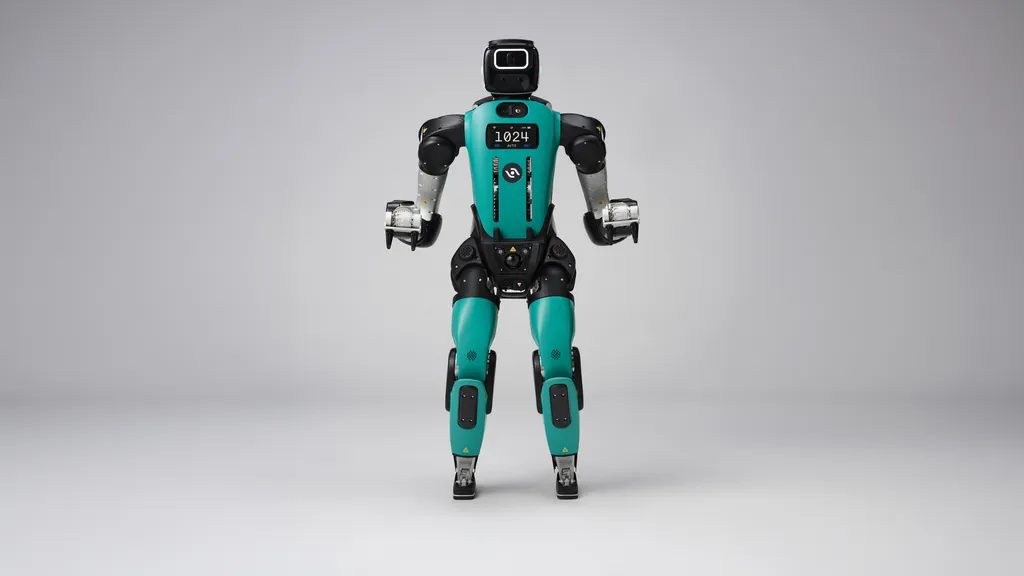
Agility Robotics unveiled Digit 5 on September 15, the next hardware generation of its bipedal warehouse humanoid, rebuilt around new legs, a faster-charging battery and a heavier payload, and disclosed more than $300 million in multi-year customer orders for the machine. That figure comes with an explicit catch straight from the company’s own release: it’s “subject to satisfaction of certain contractual milestones,” not revenue already booked. Early customer access starts in the first half of 2027, with general availability by the end of that year.
What actually changed
Digit 5’s most visible redesign is its legs. Earlier Digit generations used a backward-bending, ostrich-like knee configuration tuned for efficient walking and running. Digit 5 switches to more conventional, human-like legs built on new proprietary cycloidal actuators. Jonathan Hurst, Agility’s co-founder and chief robot officer, told The Robot Report: “The previous leg configuration was really optimized for very good walking and running. The new configuration is optimized for lifting heavy things and getting up and down off the ground a lot.”
That trade-off shows up directly in the spec sheet. Digit 5 can repeatably lift up to 50 lb. (22.7 kg), which Agility says is 40% more than Digit 4, and reach 7.2 ft. (2.2 m), up from 5.5 ft. The robot itself is bigger too: 5 ft. 11 in. (1.81 m) tall and 284 lb. (129 kg), versus the lighter Digit 4 frame. New knee padding lets it kneel, and the redesigned legs let it squat down into a stable seated position, a capability that does double duty as a safety feature, discussed below.
Battery and charging changed just as much. Digit 5 runs 90 minutes per charge and recharges in about 9 minutes, a 10:1 run-to-charge ratio, up from Digit 4’s 2:1, which Agility says lets one robot deliver more than 20 hours of productive work across a 24-hour day. Swappable, ISO-standard-mount grippers round out the hardware changes, letting operators, and eventually the robot itself, change end effectors across a facility’s workflow: depalletizing, machine tending, kitting and sequencing, quality inspection, and palletizing.
Built on three years of real deployments
Digit 5 isn’t a clean-sheet concept. Agility says Digit 4 has logged more than 65,000 hours of operational time across customer sites including GXO, Schaeffler, Amazon and Toyota Motor Manufacturing Canada, with nearly three years of continuous commercial deployment. At GXO’s Flowery Branch facility near Atlanta, the company reports Digit reached a cumulative 100,000-tote milestone at roughly 98% accuracy, a real operational figure, but company-reported, not independently audited. That track record is Agility’s basis for saying Digit 5’s requirements come directly from customer feedback, not an engineering wish list. “We built it to the exact requirements our customers gave us after three years of Digit 4 working on their production floors,” said Peggy Johnson, Agility’s CEO, “and the market has responded with more than $300 million in multi-year orders and a growing pipeline of customers across manufacturing, warehousing, and logistics.”
The safety claim, and what it doesn’t cover
Agility markets Digit 5 as its “first cooperatively safe” humanoid, able to work near people without the fencing traditional industrial robots require. The mechanism: 360-degree human detection using multiple sensor types, an independent safety controller that can trigger the robot to autonomously avoid, slow, stop or drop into a seated, statically-stable pose before a person can make contact, plus visual and auditory cues signaling the robot’s intent. Agility says it’s also the first launch partner for NVIDIA’s Halos for Robotics platform, pairing this safety architecture with NVIDIA’s IGX Thor compute module, a partnership Industrial Robotics Hub covered in August when it centered on the IGX Thor chip’s IEC 61508 SIL 3 certification.
What’s new in this announcement is a separate claim: Agility says Digit became “the first humanoid to pass an independent field evaluation on a customer production line for industrial safety standards administered by” OSHA. That’s worth reading precisely. An OSHA field evaluation checks compliance with workplace safety regulations at a specific site; it is not a robot collaborative-safety standards certification, and Agility’s materials don’t describe it as one. No ISO 10218-2:2025 or ISO/TS 15066 certification, the standards that actually define “collaborative robot” performance requirements, appears anywhere in Agility’s announcement or in either outlet that covered it. Tellingly, Agility’s release states the company is a “project leader and active contributor” to ANSI/A3 TR R15.108 (a technical report in development for dynamically stable mobile robots, including humanoids) and to ISO 25785-1, which it calls “the first international safety standard for the humanoid category.” Both are still under development, meaning the standard that would let a third party certify “cooperatively safe” for a humanoid like Digit doesn’t fully exist yet, and Agility is helping write it.
The order book, against a shaky balance sheet
The $300 million figure is the headline number, and it deserves the same scrutiny. Agility’s own release frames it as orders “subject to satisfaction of certain contractual milestones” as of May 2026, meaning conditional, multi-year commitments, not revenue collected. That framing matters more than usual here: Agility is mid-process on a SPAC merger with Churchill Capital Corp XI (Nasdaq: CCXI) at a stated $2.5 billion valuation, and its SEC Form S-4 for that deal, which Industrial Robotics Hub examined on September 12, discloses just $1.8 million in actual 2025 net sales alongside going-concern language. A $300 million pipeline of milestone-gated orders and $1.8 million in booked sales are not contradictory facts, but they describe very different stages of a business, and reporting the first without the second would flatter the story considerably.
Sources
- Agility Unveils Digit 5 Humanoid Robot Built for Cooperatively Safe Work at Scale — Agility Robotics, Sep 15, 2026
- Agility's Digit 5 humanoid has new legs, batteries, safety upgrades — The Robot Report, Sep 15, 2026
- Agility unveils Digit 5 humanoid as orders exceed $300 million ahead of public listing — Robotics and Automation News, Sep 17, 2026
Frequently asked questions
What actually changed between Digit 4 and Digit 5? +
The biggest visible change is the legs: Digit 5 replaces the earlier ostrich-like backward-knee configuration with more traditional, human-like legs built around new cycloidal actuators, which Agility says are optimized for lifting and for getting up and down off the ground rather than for walking efficiency alone. That, plus a redesigned battery and charger, lets Digit repeatably lift up to 50 lb. (22.7 kg, 40% more than Digit 4), reach 7.2 ft. versus 5.5 ft., run 90 minutes per charge, and recharge in about 9 minutes, a 10:1 run-to-charge ratio versus Digit 4's 2:1.
Is the $300 million order figure real, booked revenue? +
No. Agility's own release states the figure as 'more than $300 million in multi-year customer orders for Digit 5, subject to satisfaction of certain contractual milestones' as of May 2026, meaning a pipeline of conditional commitments, not recognized sales. Agility's SEC Form S-4, filed as part of its SPAC merger, separately discloses just $1.8 million in actual 2025 net sales, a gap Industrial Robotics Hub covered in detail on Sept. 12.
Has Digit 5 been independently certified as safe to work around people? +
Not under an existing robot collaborative-safety standard. Agility calls Digit 5 'cooperatively safe' and says it passed 'an independent field evaluation on a customer production line for industrial safety standards administered by' OSHA, which is a workplace safety-compliance evaluation, not a robot-specific standards certification. No ISO 10218-2:2025 or ISO/TS 15066 collaborative-robot certification is cited anywhere in Agility's materials. Notably, Agility itself says it is a 'project leader' helping draft ANSI/A3 TR R15.108 and ISO 25785-1, the first international safety standard aimed at humanoids specifically, which confirms that standard doesn't exist yet in finished form for this robot class.
When can a customer actually get a Digit 5? +
Agility says early access begins in the first half of 2027, with general availability for manufacturing, warehouse and distribution customers by the end of 2027. Initial deployment is North America only; Agility says it plans to expand to the EU, UK and Northern Ireland afterward, with Digit 5 expected to carry a CE mark for that market.
More news