KUKA and Contoro Robots Now Unload 4-5 Trailers a Shift
A KUKA arm running Contoro Robotics' AdaptAI software is unloading floor-loaded trailers at States Logistics' California DC, lifting shift throughput from 2-3 trailers to 4-5.
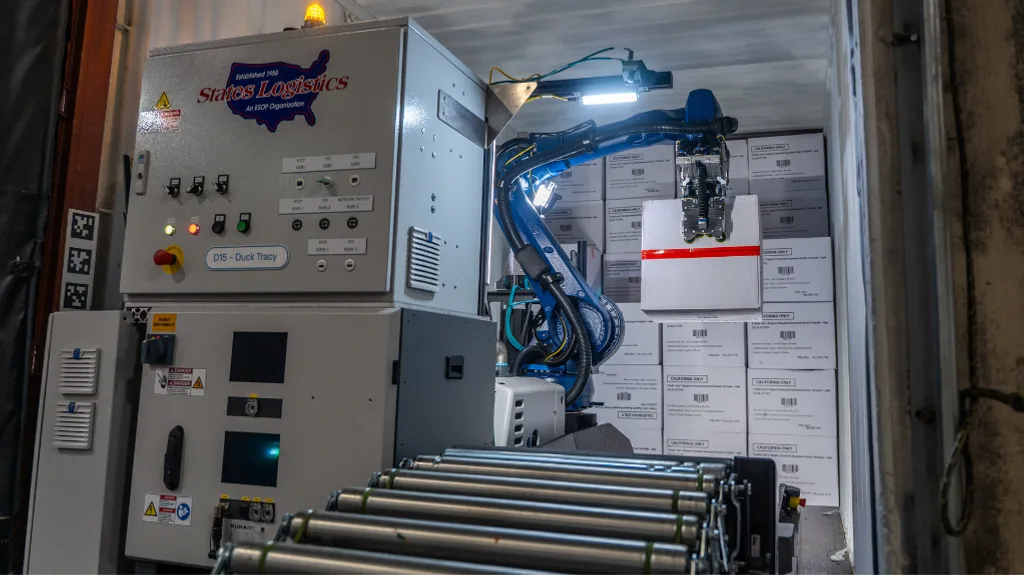
States Logistics Services Inc., a third-party logistics provider running distribution centers in California and Arizona, is now unloading four to five semi-trailers per shift with a KUKA robotic arm and Contoro Robotics’ AI software, up from the two to three trailers a shift its own employees could manually unload before the system went in [1][2]. The deployment automates one of the most physically punishing jobs in a warehouse — pulling loose, floor-loaded cases out of a trailer by hand — and it did so at a company that says it was seeing a meaningful volume of back-strain-related health insurance claims tied directly to that work [2].
What the system actually does
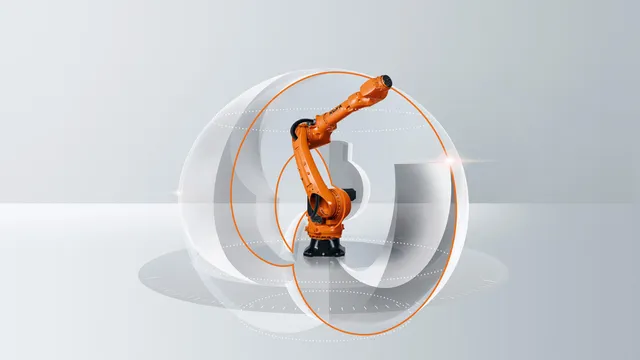
The installation pairs a KUKA robotic arm from the KR IONTEC line with Contoro Robotics’ AdaptAI software and a mobile platform that lets the whole unit move dock-to-dock rather than sitting bolted to one bay [2]. KUKA’s own case study does not disclose which specific KR IONTEC payload-and-reach variant is installed; IRH’s database carries one member of that family, the KUKA KR 20 R3100 IONTEC (20 kg payload, 3,101 mm reach, built for long-reach work like arc welding and machine tending), as an example of the line’s general capabilities, not a confirmed match to the exact unit at States Logistics.
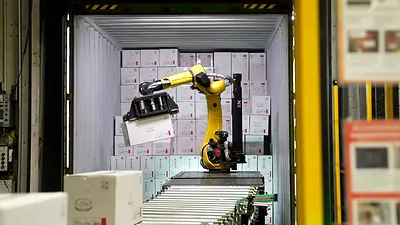
Setup starts with a person. An operator drives the mobile robot from one dock to the next using a handheld control, an operation KUKA compares to driving a forklift, then uses a joystick to align the robot with the open end of a trailer — a process that takes roughly 15 minutes per container [2]. From there, the system takes over: a LIDAR unit and AI-driven vision give the robot spatial awareness of the trailer’s interior — wall locations, box positions, stacking patterns, sizes — and AdaptAI uses that data to generate what KUKA describes as hundreds of optimized, collision-free grasp paths based on each case’s size, location, condition and weight [2]. Contoro’s own gripper, which it calls DuoGrasp, grabs cartons from two sides simultaneously, which the company says gives it payload capacity that a single-sided gripper couldn’t match. Picked cases go onto a powered roller conveyor that carries them out of the trailer, and the robot advances further into the container autonomously as each layer clears [1][2].
Why a 3PL went looking for this
States Logistics — which employs more than 800 people across its facilities and handles more than 50 truck-trailer containers a month at the site in question — started running into labor problems with manual unloading after 2020, according to the company: not only pandemic-driven disruption, but a harder time finding people willing to spend a shift inside hot, cramped, non-climate-controlled trailers doing repetitive lifting [2]. “The need for change wasn’t just about throughput,” Jesse Sevilla, States Logistics’ director of sales and operations, said in KUKA’s case study, “but also the well-being of our employees. Safety is a top priority with us, and at the time, we were experiencing a significant amount of health insurance claims regarding back strain” [2]. That framing lines up with a broader ergonomic-risk pattern the U.S. Bureau of Labor Statistics tracks across warehousing: overexertion from lifting, lowering, pushing, pulling and carrying is consistently among the leading causes of workplace injury, and repetitive case unloading from unconditioned trailers is one of the tasks most exposed to it [1].
States Logistics began evaluating alternatives in 2023 and settled on Contoro, whose pitch combined the mobile KUKA arm with AdaptAI rather than a fixed installation. “It also gives us the flexibility to handle different product sizes and configurations, which is something that fixed automation systems like gantries are unable to manage as effectively,” Sevilla said [2]. Nate Brazelle, KUKA’s vice president of sales and marketing, framed it the same way: “Many warehouse tasks require employees to perform the same strenuous motions thousands of times throughout a shift. By automating these repetitive applications with KUKA robots, companies can significantly reduce ergonomic risks while allowing their workforce to take on more engaging and less strenuous responsibilities” [1]. John Cook, Contoro’s business development manager, credited KUKA’s support through the buildout: “KUKA met our needs completely, not only through their automated solution, but also their consistent support” [2].
Contoro delivers the system as robotics-as-a-service, with per-trailer pricing instead of a large upfront capital purchase — which KUKA’s case study frames as lowering the barrier to entry for a 3PL that would otherwise need to justify a big capex line for one application — and sets a minimum monthly volume to make a deployment worthwhile.
KUKA itself, for context, is a German industrial-automation group headquartered in Augsburg, reporting EUR 3.9 billion in sales and around 14,500 employees, per its own current corporate materials.
For the application class this falls under, see IRH’s material-handling application page; for the pick-and-place work the robot performs case by case inside the trailer, see the pick-and-place application page.
Sources
- Automated Trailer Unloading Improves Worker Safety — Fabricating & Metalworking, Aug 20, 2026
- AI-Powered KUKA Robots Unload Truck Trailers, Streamline Warehousing at 3PL Company — KUKA (official case-study page), Apr 24, 2026
Robots mentioned
Tap a card to open the full spec sheet.
Articulated arm
KR 20 R3100 IONTECFrequently asked questions
What robot is States Logistics using to unload trailers? +
A KUKA robotic arm from the KR IONTEC line, mounted on a mobile platform that moves dock-to-dock. It runs Contoro Robotics' AdaptAI software and a two-sided 'DuoGrasp' gripper that grabs cartons from both sides at once. KUKA's own case study does not name the specific KR IONTEC payload/reach variant installed.
How much more can the automated system unload per shift? +
Before automation, two to four States Logistics employees unloaded two to three trailers in an eight-hour shift. The robotic system now handles four to five trailers per shift — roughly 60% to 100% more, depending which ends of the before-and-after ranges are compared.
Does a person still have to be involved? +
Yes. An operator drives the mobile robot between dock doors with a handheld control, similar to driving a forklift, then uses a joystick to align it with each container in a setup that takes about 15 minutes. From there the robot unloads autonomously, advancing further into the trailer as cartons come off, with staff supervising rather than lifting.
How is States Logistics paying for the system? +
Through a robotics-as-a-service (RaaS) arrangement with per-trailer pricing rather than a large upfront capital purchase, according to Contoro. Contoro requires a minimum monthly unloading volume to make a deployment worthwhile.
More news