BAUHAUS Automates Goods Receiving With XYZ Robotics in Krefeld
BAUHAUS is running XYZ Robotics' RockyOne and RockyOne SE mobile manipulators around the clock at its Krefeld, Germany warehouse, unloading containers across 10,000+ SKUs unattended.
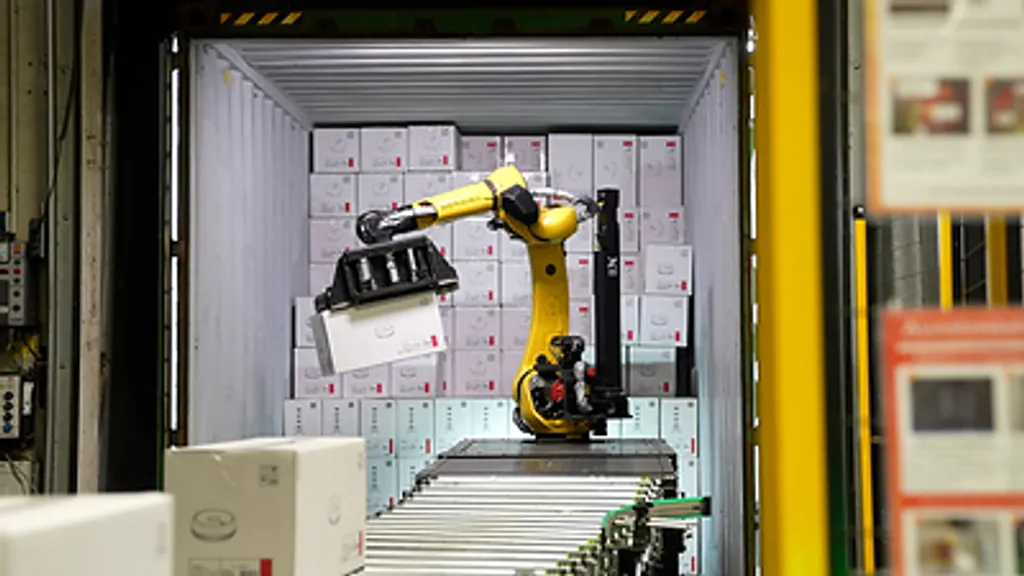
BAUHAUS, the European home-improvement retailer that runs more than 290 specialty centers across 19 countries, has automated the entire goods-receiving workflow at its central warehouse in Krefeld, Germany, using two mobile manipulation robots from XYZ Robotics: RockyOne, which unloads shipping containers, and RockyOne SE, which builds the resulting pallets [1][2]. The system is already live and running, according to the companies’ July 27 announcement, handling a facility that processes thousands of inbound shipments a day across more than 10,000 SKUs [1].
How the workflow actually splits across two robots
The Krefeld deployment isn’t a single robot doing everything — it’s a three-stage pipeline built around two distinct machines plus a scanning step in between [1]. RockyOne, described by XYZ Robotics as a mobile manipulation robot (MMR), autonomously enters the shipping container itself and unloads the loose cartons inside, which the release specifically notes vary widely in size, weight and stacking orientation — the kind of unstructured, non-palletized load that has historically been hard for fixed automation to handle at all [1][2]. As cartons come off the container, a barcode-scanning system identifies each one for real-time sorting [1]. Once sorted, a second robot, RockyOne SE, takes over and builds pallets according to patterns BAUHAUS itself defines, producing what the release calls “stable, storage-ready output” rather than a loosely stacked pallet that still needs human rework before it can go into storage [1].
That three-stage split matters for what BAUHAUS is actually claiming: not a single clever gripper, but full-container-to-shelf-ready-pallet coverage of the goods-receiving process, in a facility where the incoming freight is deliberately not standardized. XYZ Robotics’ own description of Krefeld’s cartons — “vary widely in shape, weight, and stacking, long beyond the reach of conventional automation” — is a real constraint at a home-improvement retailer’s central warehouse, where a single inbound shipment can range from small hardware boxes to bulky, irregular packaging, unlike a single-SKU e-commerce fulfillment center [1].
What BAUHAUS says changed
Torsten Winter, BAHAG/BAUHAUS AG’s vice president of operations for warehousing and transport, is the only named executive quoted in the release: “Since going live, the system has run reliably around the clock without manual intervention. Our team can now focus on higher-value work,” he said. “We are already exploring where else to apply this across our network. With XYZ Robotics, we have a reliable and forward-thinking partner by our side, closely supporting us on this journey” [1]. The release frames the underlying problem in familiar warehouse-ergonomics terms: manual container unloading involves repetitive lifting in confined spaces and harsh temperatures, which the companies say contributes to both high turnover and injury risk — the same category of problem driving a wave of similar deployments elsewhere in the industry this year [1]. With the robots in place, the release states that operators now shift from the physical unloading work itself to supervising the system through a tablet interface, and that daily operation “requires minimal training” [1].
XYZ Robotics, for its part, is treating Krefeld as a reference deployment rather than a one-off. Founded in 2018, the company already operates branches in Germany, the United States, China, Japan and South Korea, and its release states it is “expanding its European footprint to serve more warehouse and distribution operators, with local teams providing full lifecycle support” following the BAUHAUS installation [1]. That is a company describing its own expansion plans, not an independently confirmed pipeline of signed customers, and it is presented here as such.
For the application class RockyOne’s container-unloading work falls under, see IRH’s material-handling application page; for the palletizing step RockyOne SE performs, see the palletizing application page.
Sources
- BAUHAUS Partners with XYZ Robotics to Automate Its Entire Goods Receiving Process — PR Newswire, Jul 27, 2026
- BAUHAUS Partners with XYZ Robotics to Automate Its Entire Goods Receiving Process — The AI Journal, Jul 27, 2026
Frequently asked questions
What robots is BAUHAUS using at its Krefeld warehouse? +
Two models from XYZ Robotics: RockyOne, which autonomously enters shipping containers and unloads loose, irregularly sized cartons, and RockyOne SE, which builds pallets to customer-defined stacking patterns after the cartons are scanned and sorted.
How big is the Krefeld operation? +
BAUHAUS' Krefeld central warehouse handles thousands of inbound shipments daily across more than 10,000 SKUs, supplying a retail network of more than 290 specialty centers across 19 European countries.
Does BAUHAUS disclose a throughput or productivity number for the Krefeld deployment? +
No. The July 27, 2026 announcement and its own executive quote describe the system running reliably around the clock without manual intervention, but neither the press release nor its corroborating coverage states a cases-per-hour, cost-savings, or labor-reduction figure for Krefeld specifically.
Is there still a human role in the process? +
Yes. Workers now supervise the system through a tablet interface rather than manually unloading containers, and BAUHAUS' own executive says daily operation requires only minimal training.
More news