Techman's AI Cobots Run Automotive AOI at Quanta's Germany Plant
Techman's AI cobots now run optical inspection on ADAS/EV ECU lines at parent Quanta's German plant, though neither firm named the model deployed.
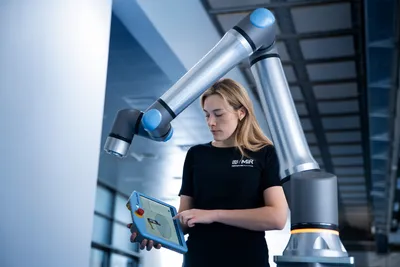
Techman Robot’s AI-vision collaborative robots are now running automated optical inspection on automotive electronic control unit (ECU) lines at parent company Quanta Computer’s automotive-electronics manufacturing plant in Germany, according to Techman’s own newsroom release published July 1, 2026, and independently confirmed by DIGITIMES the following day. The cobots inspect ECUs built for advanced driver-assistance systems (ADAS) and electric-vehicle electronics, checking assembly quality and traceability on boards Techman says can carry nearly 5,000 components each. Neither company names the specific TM cobot model deployed, a gap in the record worth flagging rather than papering over.
What Techman says was deployed, and where
Techman Robot (TWSE: 4585), the Taiwan-based collaborative-robot maker, and Quanta Computer (TWSE: 2382), the major Taiwanese electronics manufacturer that is Techman’s parent company, jointly announced the deployment at Quanta’s own automotive computer and automotive-electronics plant in Germany. That relationship matters: this is not a third-party integrator pitching Techman’s hardware to a new account, it is Quanta running its own subsidiary’s product on its own line and publicizing the result as a reference case.
Per the release, the cobots combine machine vision with precision motion control to perform AOI on ECU assembly lines, specifically for ADAS and EV-electronics boards. One example cited in the release: some of the automotive units being inspected use the Qualcomm Snapdragon Ride Flex SA8775P, a combined ADAS-plus-in-vehicle-infotainment chip platform. That detail is background on the electronics being inspected, not a Techman or Quanta product; it establishes the class of hardware dense and safety-relevant enough to justify AI-assisted inspection rather than a simpler fixed-rule optical check.
The specific inspection tasks named in Techman’s release are concrete rather than generic: production traceability through QR code scanning and OCR reading of PCBA labels, assembly verification covering connector seating and screw-fastening status, confirmation that water-cooling pipe rubber sleeves are correctly positioned, and real-time anomaly detection for foreign objects, missing components, and surface defects. That is a broader task list than a single-purpose inspection station; it reads as a cobot cell doing multiple checks across one line rather than one fixed AOI camera doing one job.
Why component density is the actual engineering story here
The number Techman leads with, nearly 5,000 components on a single ADAS-class ECU motherboard, is the reason this deployment is harder than routine AOI. Automotive ECU boards, especially ones combining ADAS sensor fusion with EV powertrain or infotainment functions, pack far more discrete components than a typical consumer-electronics assembly, and automotive-grade tolerances leave far less room for a missed defect: a failed connector or an unseated screw on a safety-critical ADAS board is a different category of failure than the same defect on a laptop motherboard. Fixed-rule optical inspection, the kind that checks pixels against a stored template, degrades as component count and board variability rise, because every new component placement or minor design revision requires re-teaching the inspection logic. AI-based vision, trained rather than hand-coded, is Techman’s pitch for handling that density without a full inspection-program rewrite every time a board revision ships. Techman frames this as validating that pitch at automotive-grade standards, not the more forgiving tolerances of general electronics assembly.
What’s disclosed and what isn’t
What’s concretely confirmed: an AI-vision cobot deployment is running today on Quanta’s German automotive ECU lines, doing the specific inspection tasks listed above, and Techman is treating the result as strong enough to publicize as a flagship case study. Both the manufacturer’s own release and DIGITIMES’ independent reporting, which explicitly describes Quanta as Techman’s parent company in this context, agree on those basics.
What isn’t disclosed: no cobot model number. Techman’s own TM-series cobot lineup in Industrial Robotics Hub’s robot database spans the compact TM5 and TM5S through the heavier-payload TM20S, TM25S, and TM30S, and any of them could plausibly perform camera-based AOI work depending on reach and payload needs at each station. Techman did not say. There’s also no defect-detection rate, throughput figure, or cycle-time number in either source; “enhances efficiency and inspection stability,” the phrase in Quanta’s own quote, is qualitative, not measured. And there’s no unit count: how many cobots are on the line, or how many stations they cover, is not stated.
The quotes
Terrisa Chung, VP and GM of Automotive Business at Quanta Computer, said in the release: “The introduction of Techman Robot’s AI vision and cobot solutions enhances the efficiency and stability of our inspection processes, reflecting Quanta Group’s ongoing commitment to excellence in smart manufacturing and automotive electronics.”
Scott Huang, COO of Techman Robot, framed the deployment as a proof point for the automotive market more broadly: “The successful application at the Germany plant not only proves that our solutions can satisfy the most demanding automotive-grade standards, but also demonstrates the collective capability of both companies to drive the future of automotive production automation.”
Why this matters beyond one plant
Cobots have spent years establishing themselves in general assembly, machine tending, and inspection applications in electronics and light-industrial settings, where tolerances are forgiving and the cost of a missed defect is low. Automotive electronics is a tougher market: ADAS and EV powertrain components carry functional-safety requirements consumer electronics do not, and automakers and their tier-one suppliers are conservative about qualifying new inspection methods on safety-relevant lines. A deployment at a parent-owned plant is a lower bar than an external customer win, since Techman doesn’t have to convince a skeptical outside buyer, but it is a real, running production line rather than a demo, and Quanta has every incentive to publicize it only if the numbers behind “enhances efficiency and stability” hold up internally.
Sources
- Quanta Computer Partners with Techman Robot at German Facility to Set New Benchmark for Smart Automotive Manufacturing — Techman Robot, Jul 1, 2026
- Techman Robot upgrades automotive production lines at Quanta Computer Germany plant with AI cobots — DIGITIMES, Jul 2, 2026
Frequently asked questions
Which Techman cobot model is running the inspection at Quanta's German plant? +
Neither Techman Robot's own press release nor DIGITIMES' independent coverage names a specific TM cobot model. That is a genuine disclosure gap in the reporting, not an oversight on our part: readers should treat this as "a Techman TM-series cobot," not a confirmed model number.
What exactly are the cobots inspecting? +
Per Techman's release, the cobots perform automated optical inspection (AOI) on automotive electronic control unit (ECU) production lines for ADAS and EV electronics: production traceability via QR code scanning and OCR label reading, assembly verification (connectors, screw-fastening status, water-cooling pipe rubber sleeve seating), and real-time detection of foreign objects, missing components, and surface defects.
Why is this deployment considered technically demanding? +
Techman's release states that a single automotive ECU motherboard for ADAS applications can carry nearly 5,000 components. Inspecting that density of components reliably, at production line speed, is a harder machine-vision problem than the sparser boards typical of consumer electronics, which is the stated rationale for using AI-based vision rather than fixed-rule optical inspection.
Is Quanta Computer a customer or is this an internal deployment? +
Both, in effect. Quanta Computer is Techman Robot's parent company, and DIGITIMES' independent reporting explicitly describes Quanta as Techman's "parent company" in this context. The deployment is at Quanta's own automotive-electronics manufacturing facility in Germany, making this an internal proof point Techman is now using as a public reference case.
More news