Humanoid Capital Surge and Japan's $6B AI Bet
Agility and AI² raise over $1.3B while Japan commits $6.1B to Noetra — industrial humanoids and sovereign physical AI reshape the mid-2026 capital stack.
Two humanoid-robot makers raised over $1.3 billion combined this week, and Japan’s government committed nearly five times that to a single national program. Agility’s SPAC merger and AI²’s state-backed mega-round both landed at $2.5B-$2.8B valuations within days of each other, both aimed at warehouses and factories rather than homes. Underneath that, Japan locked in a $2.4 billion first-year tranche of a $6.1 billion, five-year bet on shared physical-AI infrastructure, not a single product. A model release from Mistral and three mobile-robot launches from ABB, OMRON and Productive Robotics rounded out a week where the capital story and the hardware story moved on different, related tracks.
The humanoid capital-markets inflection has a state-scale counterweight
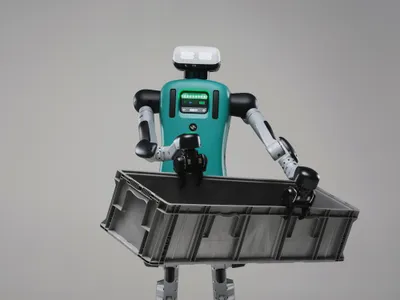
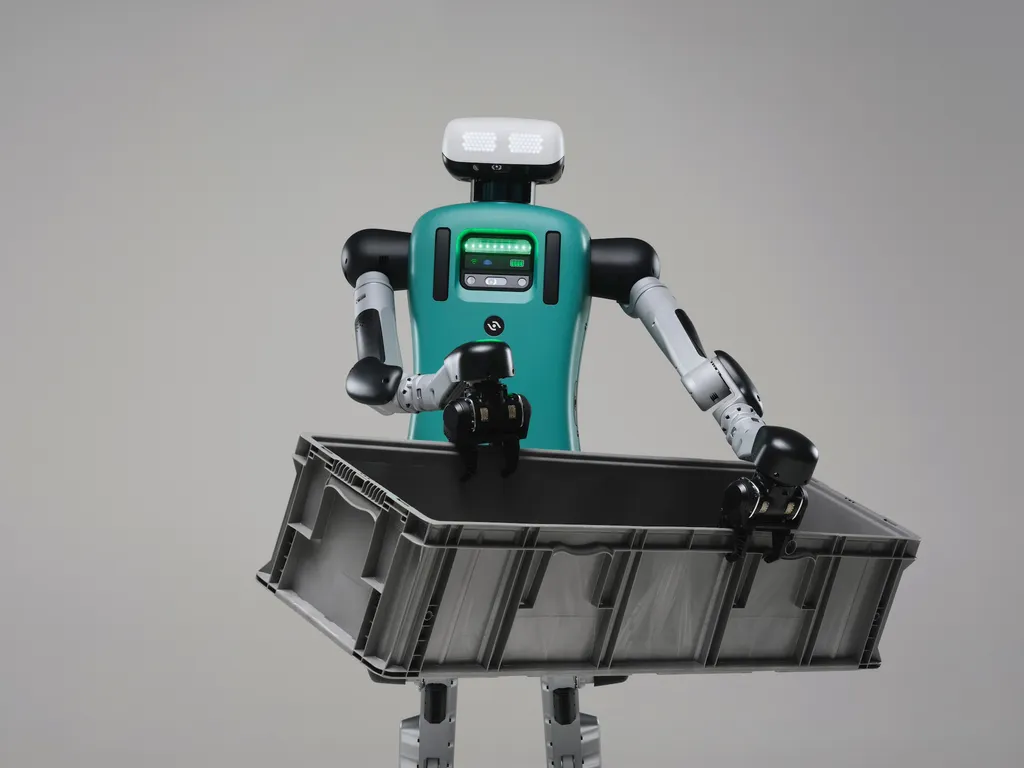
Agility Robotics agreed to go public through a merger with Churchill Capital Corp XI at a $2.5 billion pre-money valuation, expected to generate more than $620 million in gross proceeds, including roughly $200 million from a Foxconn-led PIPE round. Its Digit warehouse humanoid has more than $300 million in booked orders and, by Agility’s own count, has logged 65,000-plus operating hours across nine sites at customers including Schaeffler, GXO, Toyota and Mercado Libre. If the deal closes as planned, it becomes the first pure-play humanoid-robot listing on a North American exchange.
Within days, AI² Robotics raised roughly $735 million at a valuation near $2.8 billion for AlphaBot, a wheeled (not bipedal) humanoid for logistics, manufacturing and biotech, scaling from roughly 1,000 units in 2025 toward 10,000 in 2026. What stands out is the cap table: alongside financial investors CICC Capital and GSR Ventures sits China’s National SME Development Fund, a state-backed vehicle, plus corporate money from Sino Biopharmaceutical and the Moutai Group, a mix of state, pharmaceutical and consumer-goods capital rather than a conventional venture syndicate.
Crunchbase’s mid-2026 tally puts the two raises in a broader wave: global embodied-AI equity funding has reached $8.6 billion across 113 rounds, with 2026 year-to-date funding of $3.8 billion already ahead of all of 2025’s $3 billion total. Agility and AI² are two data points inside that surge, and their shared industrial focus, warehouses and factories over consumer robots, is the clearest signal yet of where near-term capital is landing.
Japan’s bet is infrastructure, not a product
Where Agility and AI² are company-level bets, Japan’s commitment is a shared platform. METI is backing the Noetra consortium with a ¥1 trillion ($6.1 billion) ceiling over five years, co-developing a multimodal physical-AI foundation model with AIST toward 10 million AI robots across roughly 18 sectors by 2040. The roadmap runs v1 by end of FY2026, reasoning in FY2027, omni-modal in FY2028. Only the FY2026 tranche, ¥387.3 billion (about $2.4 billion), is guaranteed; the rest is conditional on annual stage-gate reviews, so a missed milestone could slow or cut what comes next.
The same tranche also funds the compute side. NVIDIA and a coalition of Japanese manufacturers, FANUC, Yaskawa, Kawasaki and Fujitsu among them, are building on NVIDIA’s Cosmos physical-AI stack (Isaac, Omniverse, Jetson), backed by an order for 27,500 Rubin GPUs and 13,750 Vera CPUs and a 140-megawatt data center due online mid-2028 under Noetra Corp president Hironobu Tamba, a former SoftBank executive. Together the two stories describe one program with two faces: a shared model and compute layer Japan’s arm-makers will each build separate products on, not a single flagship robot. Worth naming plainly: this is a hedge, not full sovereignty. Japan is funding a homegrown model but renting the compute stack from a US chipmaker.
The software layer keeps thinning the hardware stack
A smaller but conceptually sharp story came from the model side rather than the hardware side. Mistral AI’s Robostral Navigate, an 8-billion-parameter vision-language-action model, navigates a robot indoors using nothing but a single ordinary RGB camera, no LiDAR, no depth sensor, no multi-camera rig. On the R2R-CE benchmark for unseen environments, Mistral reports a 76.6% success rate, a company spec, not independently verified, that it says beats the best single-camera approach by 9.7 points and the best sensor-heavy approach by 4.5. The model trained on 2.4 million simulated trajectories across 350,000 scenes, with a token-compression technique Mistral says cut training cost 22x, plus a further 3.2-point gain from online reinforcement learning. Its pointing-based navigation, predicting pixel coordinates rather than metric displacement, is pitched as less fragile to camera-calibration drift between training rig and deployed robot.
That fits the throughline this desk flagged last week: announcement versus delivery. A model that removes hardware cost from a mobile robot’s navigation stack is genuinely useful for integrators, but Robostral Navigate has no independent reproduction and no named factory-floor deployment yet. It is a benchmark result, not a floor-tested one.
Mobile autonomy gets heavier and more coordinated, and specs don’t scale linearly
Three separate mobile-robot launches this week shared a buyer-relevant pattern: capability doesn’t scale in a straight line with size. ABB’s Flexley Stack F712 forklift carries a 2,000 kg payload with an 8.5 m lift and ±10 mm positioning accuracy, a company spec, not independently verified, using visual SLAM instead of a warehouse retrofit. It completes ABB’s visual-SLAM AMR range alongside the Flexley Tug and Flexley Mover, all coordinated through AMR Studio.
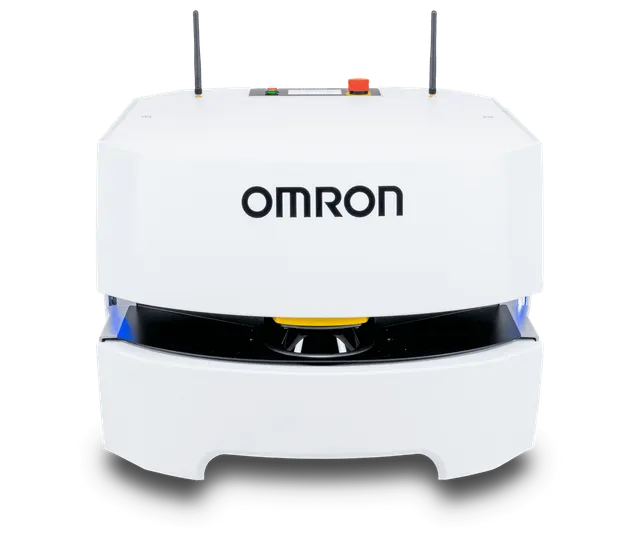
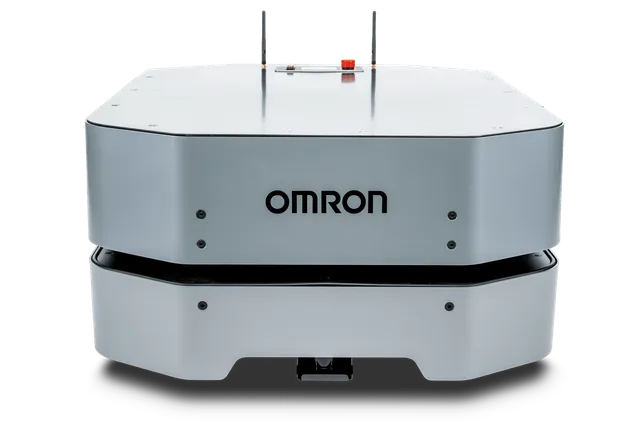
OMRON’s LD-150 and LD-300 show the same non-linear pattern at a smaller scale: the LD-300’s 300 kg payload is exactly double the LD-150’s 150 kg, but its 580 mm chassis is only 16% wider than the LD-150’s 500 mm. Both share 30-minute wireless inductive charging and ISO 3691-4:2023 compliance, and OMRON says FLOW Core will run the new units alongside its existing LD-90 and LD-250 in one mixed fleet, shipping targeted for Q4 2026.
Productive Robotics’ OB7 line, a five-model 7-axis cobot family debuting at IMTS 2026, shows the inverse mismatch: payload and reach move in opposite directions. The OB7 Max 8 has the longest reach at 1.7 m but only an 8 kg payload, while the Max 16 carries the most weight but has the shortest reach, tied with the base model at 1.0 m. The buyer lesson across all three launches: check payload, reach and footprint against the actual task rather than assume one scales with the others, and treat ISO 3691-4:2023 compliance plus fleet orchestration as table stakes for a 2026 mobile-robot purchase, not a differentiator.
Sources
- Agility Robotics to go public through $2.5 billion SPAC merger — Robotics & Automation News, Jul 7, 2026
- Agility Robotics to go public through merger with Churchill Capital Corp XI — Agility Robotics, Jun 24, 2026
- AI² Robotics raises $735M at $3B valuation for wheeled humanoid robots — The Robot Report, Jul 10, 2026
- Embodied AI fuels record funding, China IPO momentum builds — Crunchbase News
- Japan's Robotics and Manufacturing Leaders Build on NVIDIA Cosmos to Advance Physical AI Frontier — NVIDIA Newsroom, Jul 15, 2026
- Noetra launches development of Japan's multimodal AI foundation model for physical AI and robotics — Robotics & Automation News, Jul 17, 2026
- Robostral Navigate — Mistral AI
- ABB Robotics completes Visual SLAM AMR range with autonomous forklift launch — Robotics & Automation News, Jul 8, 2026
- OMRON Debuts LD-150 and LD-300 AMRs at Automate 2026, Targeting Higher-Throughput Material Flow — MarketScale, Jul 15, 2026
- Productive Robotics Equips Manufacturers with Zero Programming, End-to-End Automation at IMTS — RoboticsTomorrow, Jul 2, 2026
Robots mentioned
Tap a card to open the full spec sheet.
Frequently asked questions
What makes this week's humanoid funding different from past startup rounds? +
Timing and geography converge — Agility's SPAC (Western private capital plus a Foxconn-led PIPE) and AI²'s state-backed mega-round land within days at $2.5B-$2.8B valuations, while Japan commits $6.1B to a national program rather than a single company. Together they mark a mid-2026 capital-markets inflection for industrial humanoids.
Is Japan's ¥1 trillion ($6.1B) commitment guaranteed? +
No, it is a conditional ceiling. METI locks in ¥387.3B ($2.4B) for FY2026, but the remaining three-quarters runs through annual stage-gate reviews; a missed foundation-model milestone can pause or cut later funding. The v1 model due by end of FY2026 is the first real test.
Do Agility's Digit, AI²'s AlphaBot and Japan's Noetra compete for the same customers? +
Not directly. Agility and AI² sell their own humanoids, while Noetra is government-funded software and compute infrastructure that FANUC, Yaskawa, Kawasaki and Fujitsu will build their own separate products on. Noetra is the platform layer; the others are applications.
Why does OMRON's LD-300 carry double the LD-150's payload on only 16% more width? +
Different per-model engineering trade-offs: the LD-150 optimizes for narrow-aisle maneuverability, the LD-300 for capacity density. The lesson for buyers is that payload, reach and footprint rarely scale proportionally; check each spec against the actual task, not as a ratio.
More news