Cobot Selection by Payload and Reach: 118 Down to 8
We matched all 123 cobots in our database against 5 real buyer specs. Desktop-class jobs have 118 options. A 30 kg, 1,700 mm spec narrows the field to 8.
Every one of the 123 cobots in the Industrial Robotics Hub database publishes both a payload rating and a reach figure, so we ran the obvious buyer question against all of them: for a given part weight and a given reach, how many cobots actually qualify? At a desktop-class spec, 118 of 123 (95.9%) clear the bar. Push the spec to 30 kg at 1,700 mm, a real heavy-palletizing target, and the field collapses to 8 (6.5%). That is a 14.75x drop in choice, and it does not happen gradually.
How many cobots fit a light-duty spec?
At 3 kg payload and 500 mm reach, the entry point for small-parts assembly, 118 of 123 cobots in our database qualify. Almost any cobot on the market clears this bar; a buyer shopping this light rarely needs to compare more than price, IP rating, and programming method, because payload and reach are not the constraint. Step up to 5 kg at 800 mm, a typical bench-assembly spec, and the field is still wide open at 100 of 123 (81.3%). Choice at the low end of the cobot market is not the problem. The problem shows up two brackets later.
How fast does the field shrink as the spec gets real?
We ran five buyer-realistic targets, each requiring a single model to clear both the payload and the reach threshold at once, not either one alone.
| Target spec | Typical job | Qualifying cobots | Share of 123 |
|---|---|---|---|
| 3 kg @ 500 mm | Desktop / small-parts assembly | 118 | 95.9% |
| 5 kg @ 800 mm | Bench assembly | 100 | 81.3% |
| 10 kg @ 1,300 mm | Machine tending | 45 | 36.6% |
| 20 kg @ 1,500 mm | Palletizing-lite | 21 | 17.1% |
| 30 kg @ 1,700 mm | Heavy palletizing | 8 | 6.5% |
The steepest single drop sits between the second and third bracket: crossing from bench assembly (5 kg / 800 mm) into machine tending (10 kg / 1,300 mm) cuts the field from 100 cobots to 45, more than half the options gone in one step up in spec. By the time a job needs 20 kg and 1,500 mm of reach together, five out of six cobots in the database are already disqualified, not because they are bad robots, but because they were built for a different bracket entirely.
Why does Universal Robots disappear at the toughest tier?
Universal Robots is the volume leader in this market. It sold more cobots than any other brand in 2025, per our own order-share analysis, and its catalog includes both a 35 kg payload model and a 1,750 mm reach model. On a spec sheet, that reads like coverage. It is not.
UR30 is the brand’s payload champion at 35 kg, but its reach tops out at 1,300 mm. UR20 is the reach champion at 1,750 mm, but its payload caps at 20 kg. Neither model, nor any of Universal Robots’ other seven cobots, clears 30 kg and 1,700 mm at the same time. The brand has a 30 kg-class arm and a 1,700 mm-class arm. It does not have both in one machine. A buyer who reads “35 kg payload” on one spec sheet and “1,750 mm reach” on another and assumes the brand covers a 30 kg / 1,700 mm job is buying against a spec that does not exist in that catalog.
This is not a Universal Robots problem specifically. It is what happens across most of the market once a spec asks for two numbers at once instead of one.
Which brands actually have an SKU for the heavy tier?
At 30 kg and 1,700 mm, 8 cobots across 6 brands qualify, out of 16 brands that sell a cobot at all. Ten brands, including Universal Robots, ABB, Doosan, KUKA, Staubli, JAKA, Kawasaki, Mitsubishi, Han’s Robot, and Siasun, have zero model that clears both numbers simultaneously, even when some of them (Doosan tops out at 25 kg / 1,700 mm, JAKA at 30 kg / 1,780 mm on different models) come close on one axis alone.
| Model | Brand | Payload | Reach |
|---|---|---|---|
| FANUC CR-35iB | FANUC | 50 kg | 1,813 mm |
| ROKAE xMate CR35 | ROKAE | 35 kg | 2,100 mm |
| ROKAE xMate CR45 | ROKAE | 45 kg | 1,947 mm |
| AUBO iS35 | AUBO | 35 kg | 2,100 mm |
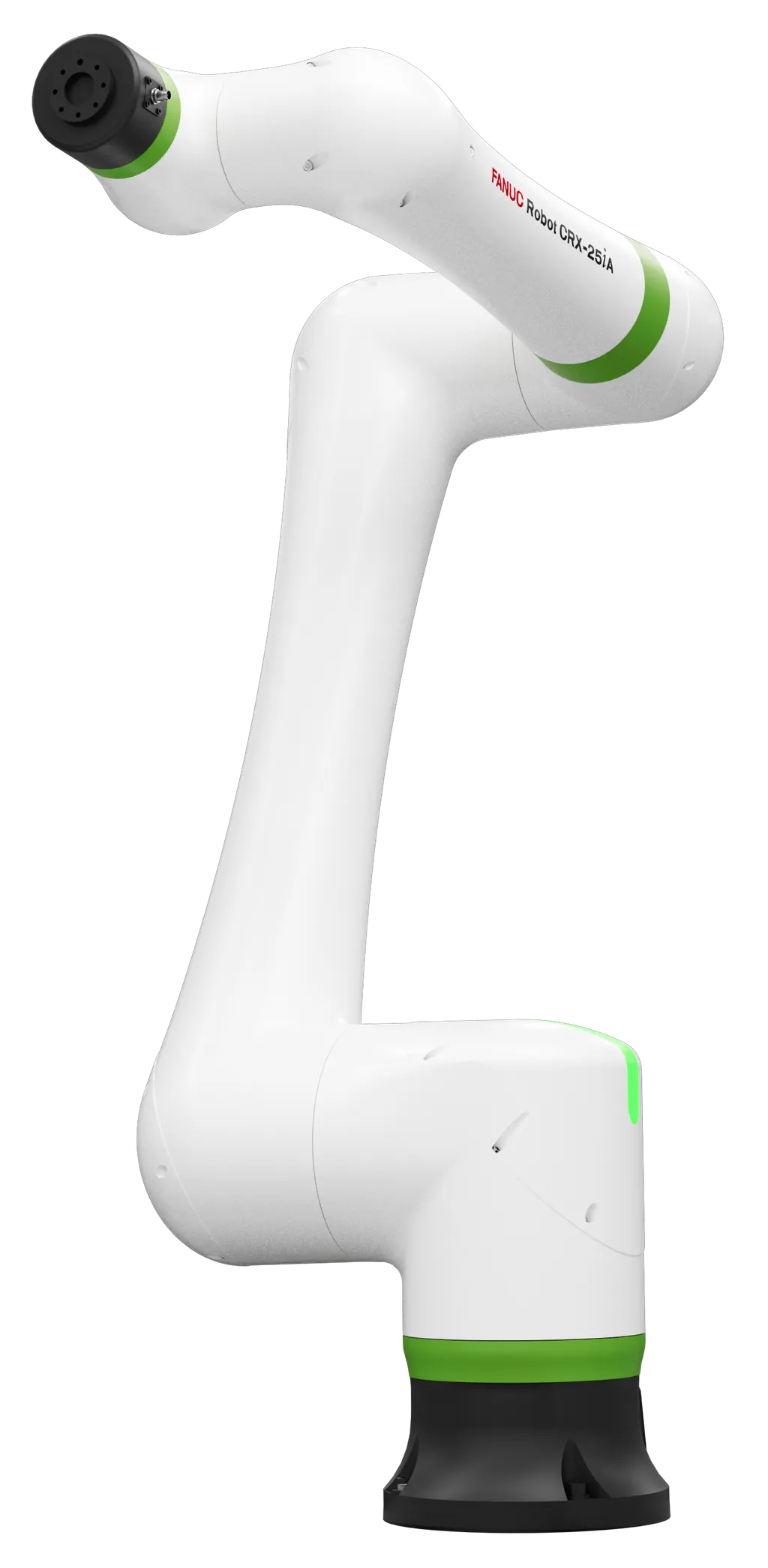
| FANUC CRX-25iA | FANUC | 30 kg | 1,889 mm |
| Dobot CR30H | Dobot | 30 kg | 1,800 mm |
| Techman TM30S | Techman | 30 kg | 1,702 mm |
| Yaskawa HC30PL | Yaskawa | 30 kg | 1,700 mm |
Two names are worth a second look. FANUC’s CRX-25iA is rated at 30 kg despite the “25” in its model name, a reminder that a model number is marketing, not a spec sheet. And FANUC’s own CR-35iB clears the bar with the most headroom in the set, rated at 50 kg, 20 kg above the threshold. Buyers scanning for a heavy-tier cobot who filter model names for “30” or skip past FANUC because its lighter CRX line looks capped would miss both.
What should this change about how you shop for a cobot?
Two separate spec-sheet numbers are not the same as one machine that hits both. Before shortlisting a brand off its published payload maximum or its published reach maximum, check whether a single model in that catalog clears your actual combined target, the way heavy cobots now overlap articulated arms on payload alone but not always on reach too. At the light end of the market, almost every cobot qualifies and the decision comes down to price, safety mechanism, and integration fit. Past 10 kg and 1,300 mm combined, the field thins fast enough that checking one model’s own two numbers, not the brand’s two best numbers, is the difference between a real shortlist and a wasted RFQ.
Compare these robots