Pharma Robots: Only 11 of 72 Are Washdown-Rated
72 of 400 robots in our database are tagged for pharma or medical work. Only 11 are washdown-rated, and 28 carry no real ingress protection at all.
Of the 72 robots in our 400-robot database tagged for pharma, medical-device, or life-sciences work, 28 (38.9%) carry no real ingress protection at all: no published IP rating, or a rating of IP20/IP30 that stops dust and stray fingers and nothing else. That is more robots than the 11 (15.3%) that are actually washdown-rated at IP67 or better. Only 18 (25.0%) publish an ISO cleanroom class. A “pharma-ready” tag on a spec sheet tells you a vendor is marketing into that vertical. It does not tell you whether the robot survives a wash-down, and it does not tell you whether it is certified for aseptic-grade air. Those are three different claims, and most robots in this slice of the catalog make at most one of them.
How many robots in our database are tagged for pharma or medical device work?
72 of 400 robots (18.0%) carry an industries or applications tag identifying them for pharma, medical-device, or life-sciences work, spanning 15 of our 20 brands. One data-hygiene note before anything else: that 72 is a merge of seven inconsistent tag spellings in our own data, pharma, pharmaceuticals, pharmaceutical, life-sciences, medical-devices, medical, and laboratory, all pointing at the same buyer intent. It is a minor gap, the same pattern our food-and-beverage washdown piece flagged for that tag family, but a naive single-string filter would undercount this segment badly. We merged all seven before running anything below.
The type mix skews toward precision hardware: 26 cobots, 23 SCARA robots, 13 articulated arms, 10 delta robots. Repeatability tells the same story. Among the 71 pharma-tagged robots that publish it, the median is 0.02mm, tighter than the 0.03mm median across the whole 400-robot catalog. Pharma and medical-device buyers are shopping for tight-tolerance assembly work, not raw throughput, and the spec sheets reflect it.
Does a pharma tag mean the robot is actually built for a pharma environment?
Not on its own, and this is the central finding. A pharma or medical-device line needs two separate things from a robot: an ISO 14644-1 cleanroom class, which governs airborne particle control, and an IP rating on the arm, which governs how much liquid and dust the housing itself can survive during a wash-down or sanitization cycle. They are not the same spec, and a robot can clear one without coming close to the other.
environment.ipRatingArm, or a value of IP20/IP30 (protects against solid objects, not water). Categories are not mutually exclusive; a robot can appear in more than one row or neither.The 28-robot “no real protection” group is bigger than the 11-robot washdown-rated group. Buyers filtering by the industries tag and stopping there are more likely to land on a robot with nothing documented for liquid ingress than on one actually cleared for a wash-down. The remaining 33 robots sit in between, carrying some protection (IP40, IP54, or IP65) that stops dust and low-pressure splashes but falls short of the temporary-immersion or high-pressure standard that IP67 and up implies.
What does the full IP-rating spread look like across the 72?
| IP Rating | Robots | Share of 72 |
|---|---|---|
| IP20 | 20 | 27.8% |
| IP54 | 16 | 22.2% |
| IP65 | 14 | 19.4% |
| IP67 | 6 | 8.3% |
| None published | 6 | 8.3% |
| IP40 | 3 | 4.2% |
| IP68 | 3 | 4.2% |
| IP30 | 2 | 2.8% |
| IP69K | 2 | 2.8% |
IP20, the tier that means “keeps out solid objects larger than a finger and nothing else,” is the single largest bucket at 27.8%, ahead of every washdown tier combined. Only IP68 and IP69K, the two ratings that mean sealed against sustained or high-pressure immersion, appear on just 5 robots between them (6.9%). For the catalog-wide baseline this pharma slice is measured against, our overall IP67+ prevalence analysis covers washdown-rating rates across every robot type, no application-tag filter applied; we won’t restate those numbers here.
Which brands sell a washdown-rated pharma robot, and which don’t?
The brand breakdown is where the gap turns from a data-hygiene footnote into a sourcing problem. 9 of the 15 brands selling into this vertical (60%) have zero washdown-rated model among their pharma-tagged lineup. Six of those nine, Dobot, Doosan, KUKA, Omron, ROKAE, and Universal Robots, have neither a cleanroom class nor a washdown rating on any pharma-tagged robot they sell. They are marketing into pharma and medical-device buyers with no documented environmental spec that buyers in this vertical actually need.
| Brand | Pharma/Medical-Tagged | Cleanroom Class | Washdown-Rated (IP67+) |
|---|---|---|---|
| Epson | 16 | 4 | 0 |
| Staubli | 9 | 4 | 0 |
| KUKA | 8 | 0 | 0 |
| ABB | 6 | 2 | 2 |
| Doosan | 5 | 0 | 0 |
| JAKA | 5 | 0 | 3 |
| Mitsubishi | 5 | 5 | 0 |
| AUBO | 3 | 0 | 2 |
| FANUC | 3 | 0 | 1 |
| Omron | 3 | 0 | 0 |
| Yaskawa | 3 | 2 | 2 |
| Kawasaki | 2 | 1 | 1 |
| ROKAE | 2 | 0 | 0 |
| Dobot | 1 | 0 | 0 |
| Universal Robots | 1 | 0 | 0 |
Can a robot be cleanroom-certified and still fail a hose test?
Yes, and the three biggest pharma-tagged catalogs in our database each prove it a different way.
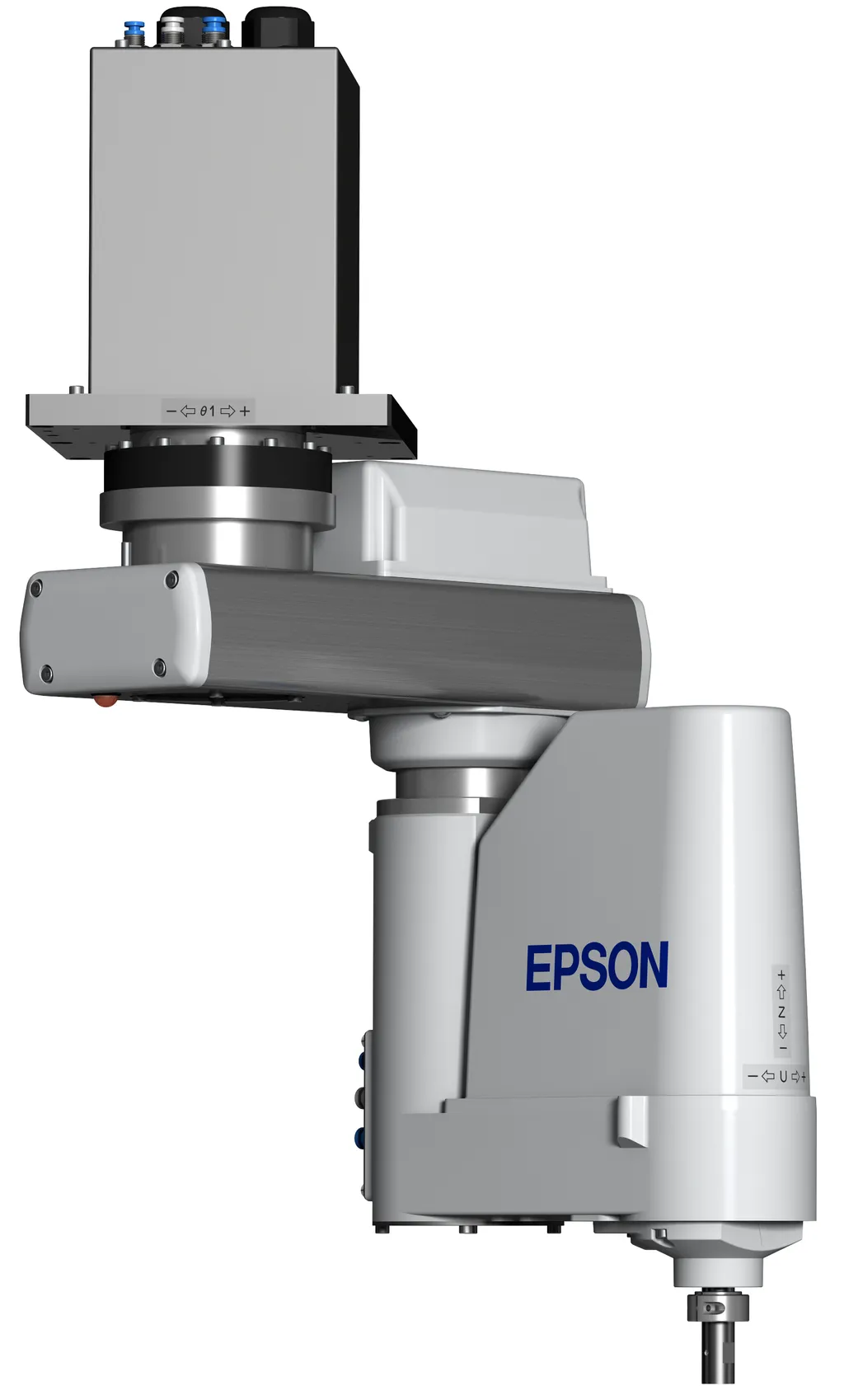
Epson has the largest pharma-tagged presence of any brand, 16 robots, all SCARA or 6-axis arms, with repeatability as tight as 0.008mm. Every one of them is IP20 or unrated. None is washdown-rated. Four of the 16 (the g1, gx4, rs3, and rs4) skip the IP rating entirely but do publish an ISO 3 cleanroom class, the tightest tier in our database. That is a real, different environmental-control strategy: particle control through cleanroom design rather than through a sealed housing. It is also not the same thing as surviving a caustic wash cycle.
Staubli’s entire pharma-tagged lineup, all 9 robots including the TX2-90, sits at IP65, one tier below washdown. IP65 stops dust and low-pressure jets. It does not survive the temporary immersion or high-pressure spray that IP67 and up implies, despite Staubli’s own explicit “pharma-clean” market positioning for this line. Only 4 of the 9 carry a cleanroom class at all.
Mitsubishi is the sharpest illustration of the underlying lesson. All 5 of its pharma-tagged robots, including the RH-12FRH, publish an ISO cleanroom class, and 4 of the 5 hit ISO 3, semiconductor-grade, the tightest tier that exists anywhere in our data. Not one of them is washdown-rated; they sit at IP20 or IP40. A robot can be certified for the cleanest air in the building and still not survive a hose-down, because cleanroom class and IP rating measure two unrelated things: airborne particle count in the room versus liquid and dust ingress into the housing.
This is why cleanroom class matters at all for a pharma line: the FDA’s own guidance on sterile drug products produced by aseptic processing states that aseptic processing of a sterile product requires an ISO 5 environment (with ISO 7 or 8 acceptable for surrounding, less-critical areas), and while 21 CFR 211 does not itself cite classification numbers, FDA guidance references the ISO 14644-1 classification system directly. ISO 5 is the real bar for the highest-risk work, and it is a specification for particle control, full stop. It says nothing about whether the robot survives cleaning between batches. We found no correlation between cleanroom class and repeatability in our earlier cleanroom-rated robots analysis; this pharma-specific slice shows the same pattern recurring on a different pairing, cleanroom class and washdown rating, and we won’t restate that post’s numbers here beyond noting it.
Which robots are actually washdown-rated for pharma work?
Eleven, across six brands.
| Robot | Brand | Type | IP Rating |
|---|---|---|---|
| ABB IRB 360-8/1130 | ABB | Delta | IP69K |
| FANUC M-3iA | FANUC | Delta | IP69K |
| ABB IRB 390 FlexPacker | ABB | Delta | IP67 |
| AUBO iS7 | AUBO | Cobot | IP67 |
| AUBO iS10 | AUBO | Cobot | IP67 |
| Kawasaki MC006V | Kawasaki | Articulated | IP67 |
| Yaskawa MPP3H | Yaskawa | Delta | IP67 |
| Yaskawa MPP3S | Yaskawa | Delta | IP67 |
| JAKA Pro5 | JAKA | Cobot | IP68 |
| JAKA Pro12 | JAKA | Cobot | IP68 |
| JAKA Pro16 | JAKA | Cobot | IP68 |
environment.ipRatingArm of IP67, IP68, or IP69K.The pattern is consistent: 5 deltas, 5 cobots, and one articulated arm, and nothing else. Every one of these classes built compact, sealed housings from the start, deltas and cobots especially carry a packaging and pick-and-place heritage where a wash-down variant is a natural catalog extension rather than a special-order part. Zero SCARA robots make this list, and zero models from KUKA, Doosan, Epson, or Staubli, despite all four being major pharma-market brands by tagged-robot count.
What should a pharma or medical-device buyer check before ordering?
Ask for cleanroom class and IP rating as two separate line items, not one. A vendor’s “pharma-ready” or “cleanroom” marketing language does not imply washdown capability, and a washdown-rated arm does not imply it is cleared for ISO 5 aseptic air. Epson and Mitsubishi both sell into this vertical with real cleanroom certification and zero washdown rating; Staubli sells an entire line one tier short of washdown under explicit pharma-clean branding; six brands, including household names like KUKA and Universal Robots, publish neither spec on any pharma-tagged model at all.
If your application genuinely needs wash-down or sanitization, not just particle control, 60% of the brands currently selling into pharma and medical-device work have nothing in their own documented catalog that qualifies. That doesn’t mean those brands can’t do the job; it means the buyer has to go find the one specific washdown SKU, most likely a delta or a cobot, or accept a documented protection gap and build the sealing into the cell instead of the robot. Either is a defensible engineering decision. Reading a “pharma” tag as proof of either spec is not.
Compare these robots