HII Signs Up to $900M Milestone-Gated Deal With Two Robotics Startups
HII will award Path Robotics and GrayMatter Robotics up to $900M in Navy shipbuilding work over seven years — but only as each clears staged technology and performance milestones.
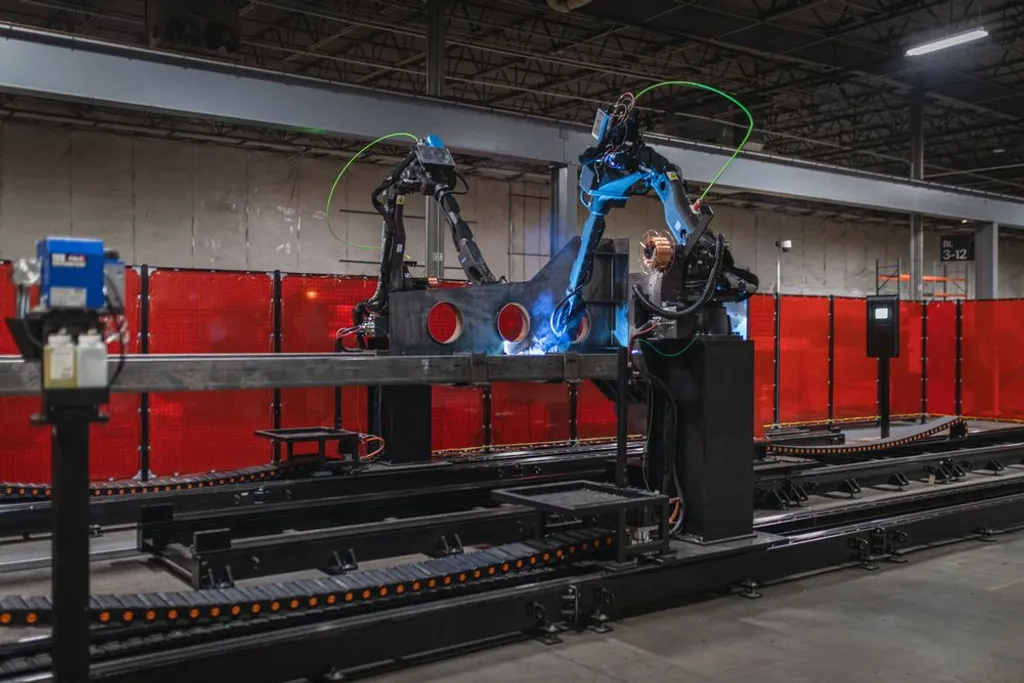
HII, America’s largest military shipbuilder, announced August 6 that it has signed long-term, performance-based production agreements with two robotics startups — Path Robotics and GrayMatter Robotics — worth up to $900 million in combined shipbuilding work across seven years. The number is the headline, but it isn’t the story. HII’s own release is explicit that the money is not guaranteed: it is “contingent on the two companies meeting clearly defined technology and manufacturing readiness, and performance milestones outlined in the agreements.” What HII actually signed is a structured, two-stage bet — a demand signal big enough to justify two venture-backed startups pouring capital into Navy-grade automation, with the payout gated throughout.
The mechanism, not just the number
The agreements fall under HII’s HYPR program — High-Yield Production Robotics — which HII launched in April 2026 to accelerate adaptive automation across fabrication of both crewed and uncrewed naval platforms. Per HII’s release, HYPR runs in two stages. The first is a Navy-grade development stage: HII partners directly with Path Robotics and GrayMatter Robotics to develop, validate and qualify high-precision production techniques spanning autonomous welding, grinding, blasting, painting, assembly and inspection, and to integrate those techniques into an autonomous production line. Only after that line clears qualification does the second stage begin — HII actually starts sourcing shipbuilding work through it, contingent on what the release calls “favorable cost, schedule, and quality performance.”
Neither HII’s release nor The Robot Report’s independent coverage publishes a dollar split between the two companies — this piece does not repeat an unconfirmed per-company figure that has circulated elsewhere, because neither primary source states one. What both agree on, in The Robot Report’s own summary, is the division of labor: “Path Robotics provides robotic welding technology, while GrayMatter offers robotic sanding systems.” The scope spans HII’s core Navy programs — aircraft carriers, submarines, destroyers, amphibious ships, future frigates, and unmanned surface vessels — though HII does not name a specific shipyard as the deployment site, and neither Newport News Shipbuilding nor Ingalls Shipbuilding is cited by name in connection with it.
Who’s building what
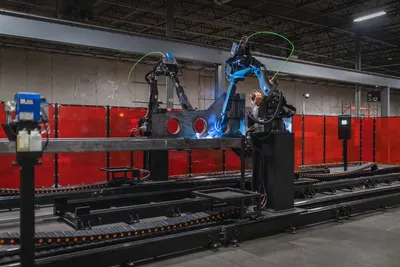
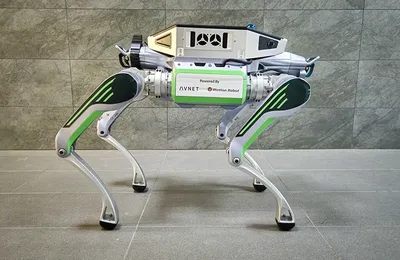
Path Robotics, founded in 2018, has raised more than $370 million to build what it calls physical AI for manufacturing, starting with a welding model named Obsidian. HII describes Path’s “intelligent welding cells” as capable of the complex, variable welds traditional fixed automation cannot handle — a real distinction in shipbuilding, where hull sections rarely present the same joint geometry twice. Path has also launched Rove, a mobile system pairing Obsidian with a quadruped robot, moving welding to large or immovable structures in the field rather than a fixed cell — described in HII’s own related video content as, in effect, a robotic welding dog.
GrayMatter Robotics, headquartered in Carson, California and founded in 2020, builds what it calls “Factory SuperIntelligence” — autonomous systems for complex, high-mix tool-manipulation work such as surface preparation, coating and inspection. Per HII’s release, GrayMatter says its systems deliver “up to 12x the throughput of skilled manual labor” and “a 95% reduction in rework,” and has processed more than 30 million square feet of surface area across 20-plus industries. Its “air-gapped, edge-deployed architecture” is pitched for data sovereignty — relevant inside Navy shipbuilding.
Why now
HII frames the deal as an extension of its distributed-shipbuilding strategy — work that starts with small steel structures and grows to units and modules fabricated outside the shipyards before final assembly. HII plans to outsource more than 2.5 million hours of shipbuilding work in 2026, a 30% increase from 2025, while expanding its assembly-partner network. That push, plus a persistent U.S. skilled-welder shortage, is the backdrop for a milestone-gated contract that suits both sides: HII gets a scalable automation pipeline without a blank check, and Path and GrayMatter get a demand signal concrete enough to justify building Navy-grade capability before a dollar of the $900 million ceiling is sourced. The timing fits a broader push HII made public the same week — its newsroom lists “HII Expands Welding Automation at Ingalls Shipbuilding Through Partnership with HD HHI” and “Marking 140 Years of HII’s Newport News Shipbuilding in Virginia,” both dated August 4, 2026, as adjacent stories, though this piece asserts no unverified specifics of the HD HHI deal beyond its headline.
Eric Chewning, HII’s executive vice president of maritime systems and corporate strategy, framed it as more than a vendor contract: “We are committed to making generational investments to develop new shipbuilding capability and to expand capacity. Together, we are defining a new approach to robotics in shipbuilding: automation that can adapt to extreme levels of complexity, mix, and size.” Path Robotics CEO Andy Lonsberry called it validation of a founding thesis: “For years, we’ve believed physical AI could fundamentally change manufacturing. HYPR is a powerful validation of our vision — that physical AI can scale shipbuilding capacity in one of the world’s most demanding production environments.” GrayMatter CEO Ariyan Kabir: “This agreement represents an important milestone in bringing Factory SuperIntelligence to America’s leading shipbuilding company.”
HII, for context, is a 140-plus-year-old shipbuilder headquartered in Virginia with roughly 45,000 employees, running primarily through its Newport News Shipbuilding and Ingalls Shipbuilding yards. It is the largest producer of unmanned underwater vehicles for the U.S. Navy and also runs a Mission Technologies segment covering C6ISR, AI/ML, electronic warfare and synthetic training — a fabrication-automation story inside a much larger prime contractor, not a startup pivot.
Sources
- HII Signs Performance-based Production Agreements with Path Robotics and GrayMatter Robotics — HII Newsroom, Aug 6, 2026
- HII signs up to $900M agreement with Path Robotics, GrayMatter Robotics — The Robot Report, Aug 6, 2026
Frequently asked questions
Is the $900 million guaranteed money for Path Robotics and GrayMatter Robotics? +
No. HII's own release describes the amount as work it "intends to award... contingent on the two companies meeting clearly defined technology and manufacturing readiness, and performance milestones outlined in the agreements." It is a ceiling tied to a two-stage, milestone-gated structure, not a signed check.
How is the $900 million split between the two companies? +
HII's release and The Robot Report's coverage both state the combined $900 million figure across Path Robotics and GrayMatter Robotics together; neither source publishes a per-company dollar breakdown, so none is reported here.
What does each company actually build? +
Path Robotics builds robotic welding systems around a physical-AI model it calls Obsidian, plus Rove, a mobile welding system pairing Obsidian with a quadruped robot for in-field work on large structures. GrayMatter Robotics builds autonomous systems for surface preparation, coating and inspection tasks such as sanding and grinding, which it markets under the term "Factory SuperIntelligence."
Why is HII doing this now? +
HII says it plans to outsource more than 2.5 million hours of shipbuilding work in 2026, a 30% increase from 2025, as part of a broader distributed-shipbuilding strategy moving fabrication of small steel structures, units and modules outside its shipyards. The agreements sit inside HII's HYPR (High-Yield Production Robotics) program, launched in April 2026 to accelerate automation across both crewed and uncrewed naval shipbuilding.
More news