AMD Launches Open Robotics Partner Network, Ryzen AI X100 Chips
AMD unveiled an open Robotics Partner Network and Ryzen AI Embedded X100 processors — up to 16 Zen 5 cores, 40 GPU CUs, 50 TOPS — aimed at physical AI.
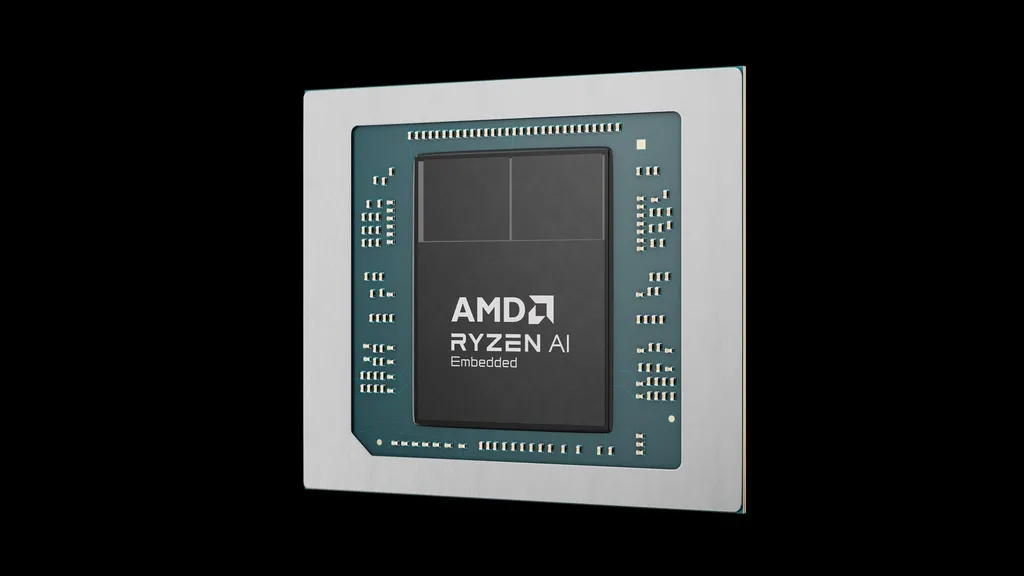
AMD used its “Advancing AI 2026” event at Moscone Center in San Francisco on July 23 to open a free Robotics Partner Network and launch the Ryzen AI Embedded X100 processor family, its first dedicated push into the compute that runs on a robot rather than in a data center backing it. The X100 lineup tops out at 16 Zen 5 CPU cores, a 40-compute-unit RDNA 3.5 integrated GPU, and up to 50 TOPS of NPU performance inside a 55-watt envelope, paired with a Kria AI Robotics Developer Platform meant to get that silicon into robot builders’ hands. Mass production is targeted for the fourth quarter of 2026; no named robot brand has committed to using it yet.
The Robotics Partner Network
The Robotics Partner Network (RPN) is AMD’s attempt to do for robotics what its existing developer ecosystems do for PCs and servers: give hardware ODMs, software vendors, simulation-tool makers, sensor/perception companies, safety and benchmarking firms, and systems integrators a shared, tiered structure to build around AMD platforms. The stack underneath is familiar to robotics developers already: ROS 2 for middleware, AMD’s ROCm compute framework, Ryzen AI software, Vitis AI for inference tooling, and ONNX for model interchange. AMD opened enrollment in July 2026, and the entry-level Registered tier costs nothing — no licensing fee, no membership dues — a deliberate move to lower the bar for smaller robotics shops that might otherwise default to a rival’s ecosystem.
The most concrete signal of traction so far is the Digital Twin Consortium (DTC), which joined the network the same day the RPN launched. DTC’s mission is advancing digital twin interoperability and adoption across industries, and its general manager and CTO, Dan Isaacs, framed the fit directly: “Physical AI is where the digital twin proves its value — a robot that perceives, reasons, and acts in the real world is only as capable as the twin it trains and validates against.” That’s a software-ecosystem partnership, not a hardware commitment from a robot maker — an important distinction for anyone reading this as evidence that arms or AMRs are about to ship on AMD silicon.
What the X100 actually is
The Ryzen AI Embedded X100 family spans three tiers, each with a standard and an “i”-suffixed industrial-grade variant: the 8-core X168/X168i, the 12-core X188/X188i, and the 16-core flagship X199/X199i. The 8- and 12-core parts carry a 32-compute-unit RDNA 3.5 GPU; the 16-core X199 steps up to 40 compute units and the family’s full 50 TOPS of NPU throughput. Clock speeds top out at 5.1 GHz on the X199 series and 5.0 GHz on the X188/X168 series. Memory is LPDDR5x-8533 across up to eight channels with Link-ECC, packaged into a compact 45mm by 37.5mm footprint, all inside the same 55-watt thermal budget across the lineup. AMD says sampling began in June 2026, with mass production scheduled for the fourth quarter.
Those specs matter because they describe a different design target than a conventional PC or server chip: enough CPU headroom for deterministic real-time control loops, a capable GPU for vision and simulation workloads, and a dedicated NPU for on-device inference, all sharing a unified memory architecture so data doesn’t have to be copied between separate CPU, GPU, and NPU memory pools. That unified-memory approach is the centerpiece of the second half of AMD’s announcement.
The Kria AI Robotics Developer Platform
Rather than sell the X100 as bare silicon, AMD is bundling it. The Kria AI Robotics Developer Platform pairs a Kria AI system-on-module — built on the 16-core X199 with a choice of 64GB or 128GB of LPDDR5x — with a robotics carrier card, an evaluation kit, the AMD Robotics Software Suite, and a set of validated reference designs. The pitch is a shorter path from evaluation board to shipped product, with software support for PyTorch, ONNX, ROS 2, and MoveIt running on top of AMD’s ROCm stack.
AMD’s own benchmark claims here should be read as company-reported until third parties independently reproduce them. AMD says the platform sustains over 8,000 control decisions per second with deterministic real-time control and sub-100-millisecond vision-language-action (VLA) reasoning. Against Nvidia’s Jetson T5000, AMD claims up to 3.4 times better real-time reliability, 1.6 times more free CPU cores, and support for 2.3 times more concurrent agents. AMD also claims migrating existing CUDA code to ROCm preserves roughly 75% of it unchanged — meaningful if true, since CUDA lock-in has been one of the biggest practical barriers to switching AI accelerator vendors in robotics. None of these figures come with a published, independently audited methodology; general availability targets Q4 2026, currently in early-access sampling with unnamed customers, and pricing hasn’t been disclosed.
Why this matters, and what it isn’t
This is an infrastructure and ecosystem bet, not a robot launch. No individual robot model is announced as running on X100 silicon, and AMD names no industrial robot brand as a design partner — the sole named partner, the Digital Twin Consortium, is a standards body, not a hardware maker. That matters because it puts AMD’s move in context against a compute race already underway. Industrial Robotics Hub covered Nvidia’s equivalent push on July 17, when FANUC, Yaskawa, Kawasaki Heavy Industries, and Fujitsu committed to building on Nvidia’s Cosmos physical-AI stack — Isaac simulation, Omniverse digital twins, Jetson edge hardware — backed by a ¥387.3 billion Japanese government investment tranche. AMD has no equivalent named coalition of industrial robot makers yet; it has an open, no-cost partner network and one software-ecosystem partner. Qualcomm and Intel also compete for embedded robotics compute, though neither made a comparably sized announcement at AAI 2026.
Sources
- AAI 2026: New AMD Open Robotics Partner Network for Physical AI Development — AMD Newsroom, Jul 23, 2026
- DTC Joins the AMD Robotics Partner Network to Accelerate Development of Next-Generation Physical AI Solutions — GlobeNewswire, Jul 23, 2026
- AMD Launches Ryzen AI Embedded X100 Processors, Kria AI SOM, and Physical AI Robotics Developer Platform — CNX Software, Jul 24, 2026
- AAI 2026: AMD Kria AI Robotics Developer Platform — AMD Newsroom, Jul 23, 2026
Frequently asked questions
What is the AMD Robotics Partner Network? +
A free, tiered ecosystem AMD opened in July 2026 for robotics hardware makers, software vendors, simulation-tool providers, sensor makers, safety/benchmarking firms, and system integrators to build around AMD's robotics compute and software stack, including ROS 2, ROCm, Ryzen AI software, Vitis AI, and ONNX. Registered-tier entry carries no licensing or membership fee.
What's new in the Ryzen AI Embedded X100 chips? +
A family of embedded processors spanning 8 to 16 Zen 5 CPU cores, an RDNA 3.5 integrated GPU with up to 40 compute units, and up to 50 TOPS of NPU performance, all inside a 55-watt power envelope. The goal is to run perception, reasoning, and real-time control directly on a robot rather than offloading to the cloud.
When can robot makers actually buy and use this? +
Sampling began in June 2026. AMD is targeting mass production of the X100 silicon and general availability of the bundled Kria AI Robotics Developer Platform in the fourth quarter of 2026. Pricing has not been disclosed.
Has any major robot maker committed to using AMD's platform? +
Not publicly, beyond software and ecosystem partner the Digital Twin Consortium. As of this story, no industrial robot brand such as FANUC, ABB, KUKA, or Yaskawa has announced adoption of the X100 or Kria platform.
More news