CJ Logistics Puts Humanoid Robots on a Live Packing Line
CJ Logistics has deployed two humanoid robots to pack boxes at an Olive Young warehouse near Seoul, a company-claimed first for live Korean logistics.
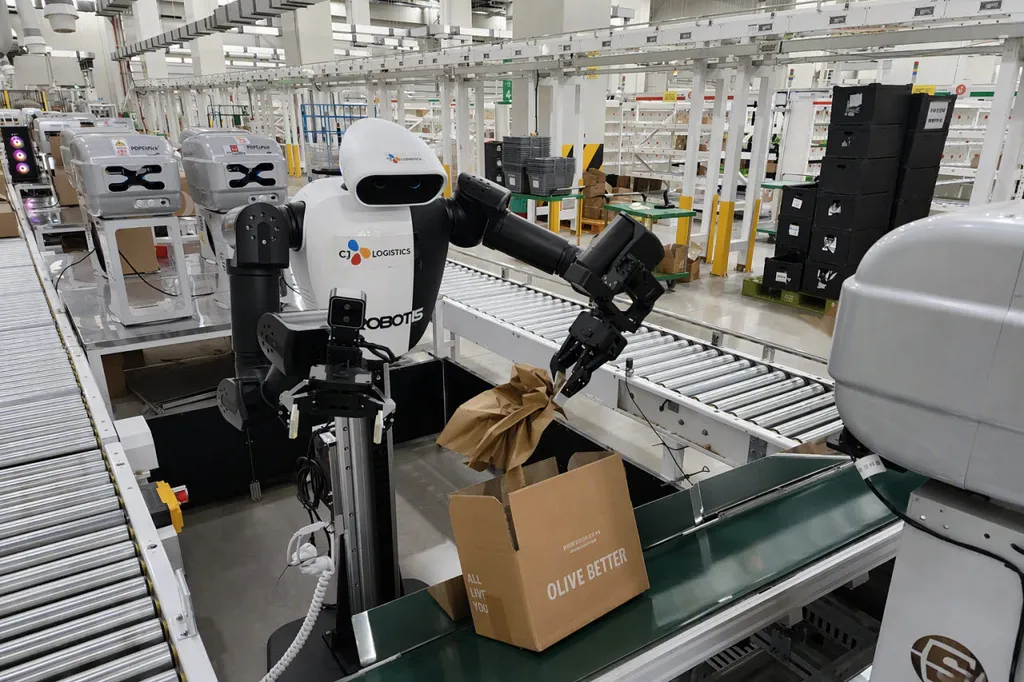
CJ Logistics, South Korea’s largest logistics company, has put two dual-arm humanoid robots to work on a live packaging line at an Olive Young fulfillment center in Yangji, Yongin, Gyeonggi Province — inserting cushioning material into shipping boxes as they move through the pack-out process. The company announced the deployment September 3 (Korea time) and describes it, in language echoed across Korean trade press covering the same announcement, as the first time humanoid robots have been applied to an actual, ongoing logistics operation in the country. That’s CJ Logistics’ own framing, not an independently audited record, and worth reading the rest of the story with that distinction in mind.
The task itself is narrow, and deliberately so. Each robot handles one step: taking cushioning material — protective paper or filler — and placing it inside a box before the box moves on to sealing and labeling. Not picking, not box-building, not sortation. That narrowness is the point. Cushioning insertion is forgiving: the material is soft and deformable, placement tolerance is loose, and a misjudged fill doesn’t stop a line or damage a product the way a fumbled precision pick would. It’s a sensible first foothold toward a far more ambitious goal — a general-purpose logistics humanoid — without betting an operation’s throughput on unproven hardware on day one.
CJ Logistics runs this work through its TES (Technology-Enhanced Service) Logistics Technology Research Institute, and the deployment follows an earlier field trial at the company’s Gunpo fulfillment center in 2025. Sources describe Gunpo as a genuine on-site test rather than a lab demo, but none specify whether that trial ran against live customer orders the way the Olive Young line now does — a detail CJ Logistics hasn’t clarified and this story won’t guess at.
Three named technology partners sit behind the hardware. Robotis, the Seoul-based maker of the robot platform, is best known for its DYNAMIXEL smart-actuator line and has more recently built out a humanoid product family — including a platform called AI Sapiens and a semi-humanoid industrial worker unit — aimed at what it calls “Physical AI” applications. Aidin Robotics supplies the dexterous hands: force- and torque-sensing grippers built around “force-aware robotics,” letting a hand sense contact pressure rather than simply open and close on command — useful for tucking cushioning into a box without crushing it or missing the opening. The third partner, RealWorld AI, commercially branded RLWRLD, supplies what CJ Logistics calls the robot’s “brain”: a robot foundation model, or RFM, combining vision, sensor data, and simulation so the robot can recognize its surroundings and respond to products or box configurations it hasn’t seen before, rather than running a hand-coded script for one fixed scenario.
That RFM approach is the real technical bet, and it matters more than the specific task on display. Traditional industrial robots are programmed for a fixed motion against a fixed target; a foundation-model approach instead trains a robot to generalize across variation — box sizes, product shapes, fill patterns — the way a language model generalizes across text it wasn’t explicitly trained on. If that generalization holds up under real warehouse variability rather than staged demos, cushioning insertion becomes the first rung on a ladder CJ Logistics has already described publicly: expanding to picking, sorting, inspection, and packaging, with a single robot eventually handling multiple sequential processes rather than one narrow task apiece. CJ Logistics has also been reported among RLWRLD’s corporate investors in prior funding rounds, alongside LG Electronics and SK Telecom — making this less a vendor sale than a portfolio company putting its own backer’s technology to work on its own floor.
Kim Jung-hee, head of CJ Logistics’ TES Logistics Technology Research Institute, framed the ambition in a quote carried by Seoul Economic Daily: “By combining logistics data gathered in the field with AI technology, we will refine humanoids so they can judge and carry out a range of tasks on their own.” Korean-language coverage of the same announcement attributes a related but differently worded quote to Kim, describing the deployment as moving beyond demonstration into a robot actually performing a role in a live operation — consistent in substance, though not a verbatim match, which reads as different outlets pulling different lines from the same briefing rather than a discrepancy in the underlying facts.
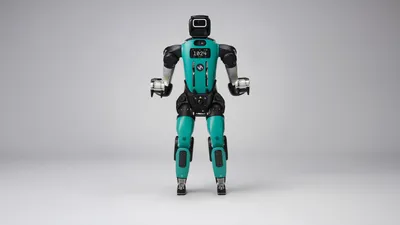
What’s genuinely new is narrower than the “first in Korea” framing suggests. Humanoids on logistics floors are now a live global category, not a one-company breakthrough — Agility Robotics’ Digit has been doing tote-handling work in U.S. warehouses, and Hyundai and Boston Dynamics have their own humanoid timeline running through Hyundai’s Metaplant America. Closer to home, LG and NVIDIA have their own factory-floor humanoid pilot targeting 2027. What distinguishes CJ Logistics’ move is less the robot and more the stack underneath it — a homegrown Korean foundation-model bet, from a company CJ itself helped fund, going to work on CJ’s own floor before it’s proven anywhere else.
For comparison, this desk has covered Agility Robotics’ Digit handling logistics work under a new NVIDIA safety certification and Brightpick’s mobile-robot fleet expansion inside Dr. Max’s pharmacy distribution network — different hardware, same underlying question of whether a robot proven in a pilot holds up once it’s handling live orders at scale. CJ Logistics’ own robots have no entry in this site’s database, so no related-robot links accompany this story. Cushioning insertion falls under this site’s packaging applications coverage.
Sources
- CJ Logistics deploys humanoid robots at warehouse in Korean first — Seoul Economic Daily, Sep 3, 2026
- Humanoids Join CJ's Packing Line — The Korea Herald, Sep 3, 2026
- CJ Logistics deploys humanoid robots at warehouses in Korea — The Korea Times, Sep 3, 2026
- CJ대한통운, 양지 올리브영 물류센터에 협동로봇 투입 — Edaily, Sep 3, 2026
- CJ대한통운, 양지 올리브영 물류센터에 휴머노이드 로봇 투입 — Money Today, Sep 3, 2026
Frequently asked questions
What are the robots actually doing? +
On the packaging line at an Olive Young distribution center, each robot uses its arms to insert cushioning material — protective paper or filler — into shipping boxes before they move on to sealing and labeling. It is one narrow step in the pack-out process, not full box assembly, picking, or sealing.
Who supplies the robots and their software? +
Three named partners: Robotis (Seoul-based maker of the robot hardware/actuator platform), Aidin Robotics (maker of the dexterous robotic hands and their force/torque sensing), and RealWorld AI, commercially known as RLWRLD (developer of the robot foundation model, or RFM, that handles perception and task decisions). CJ Logistics has also been reported as a corporate investor in RLWRLD's funding rounds, not solely a customer.
Is this really the first humanoid robot used in Korean logistics? +
That is CJ Logistics' own characterization, repeated across Korean trade press covering the same announcement — not a claim this desk can independently audit. It follows an on-site field trial at CJ Logistics' Gunpo fulfillment center in 2025; sources describe that as a real-world test rather than the live production deployment now running at the Olive Young site, though none of the available sources spell out whether the Gunpo trial handled live customer orders.
Did CJ Logistics disclose cost or performance numbers? +
No. Every source reviewed for this story is silent on throughput, accuracy, unit cost, or return on investment for the two robots. The company's own statements describe only the task and its stated plans to expand it — this piece does not estimate or infer figures the company has not published.
More news