Delta's Dual-Arm Cobot Takes Voice Commands, Not Code
Delta Electronics debuted an Embodied AI Dual-Arm Robot Platform at Automation Taipei 2026 that plans and self-corrects from voice commands using an NVIDIA Jetson AGX Orin stack, aimed at high-mix assembly work like AI servers.
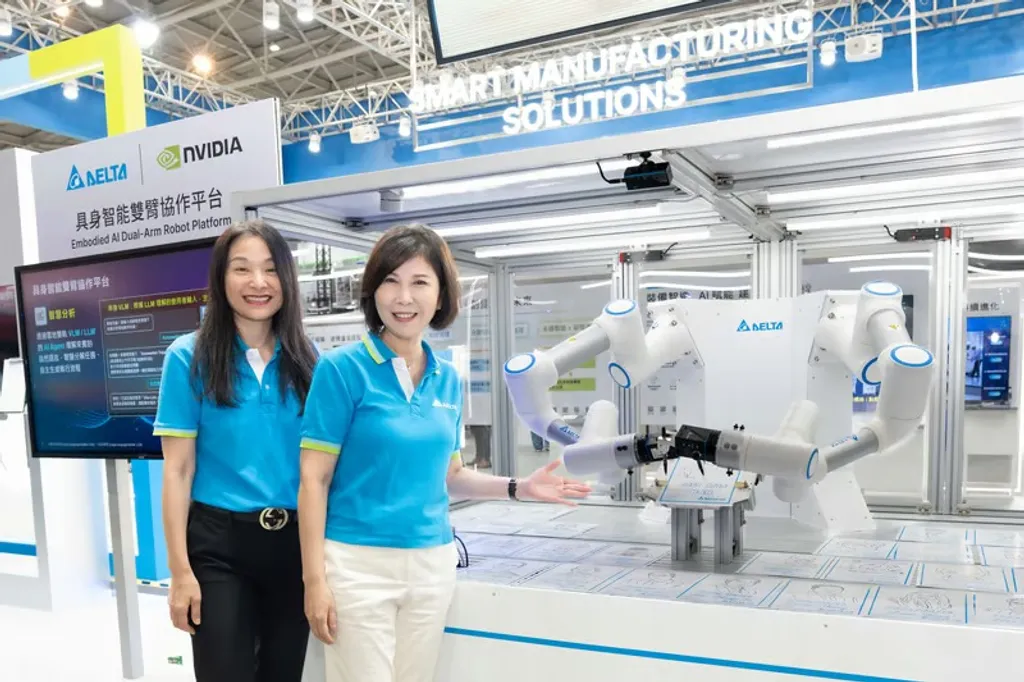
Delta Electronics used its 55th-anniversary appearance at Automation Taipei 2026 to unveil a dual-arm robot that takes spoken instructions instead of pre-written motion code, folding an onboard AI model directly into the robot’s control system rather than bolting AI on top of a conventionally programmed arm.
What Delta showed
Delta (Taiwan Stock Exchange: 2308), the Taiwan-based power-electronics, thermal-management, and industrial-automation company founded in 1971, unveiled its Embodied AI Dual-Arm Robot Platform at Booth M420 in Hall 1, 4F of the Taipei Nangang Exhibition Center, part of Automation Taipei 2026 (August 19-22), a show themed around the transition from automation to autonomy. The platform runs on an NVIDIA Jetson AGX Orin compute module, rated for up to 275 TOPS of onboard AI processing, layered with NVIDIA Isaac ROS Nvblox for real-time 3D environment mapping and dynamic obstacle avoidance, and NVIDIA cuMotion for GPU-accelerated motion planning [1][2].
The pitch is direct: a conventional industrial robot needs an engineer to pre-program every movement, and any change to the task means re-programming. Delta says its platform instead lets the robot autonomously interpret a spoken task, analyze the workflow, plan and execute the motion sequence, and self-correct using multimodal sensor data as conditions change, without a human writing new code for each variation [1][2]. At the booth, Delta demonstrated this by having the dual-arm robot draw portraits in different styles on voice direction, a deliberately visual way to show real-time task interpretation rather than a fixed script [1][2][3].
Delta’s target application is narrower and more concrete than the demo suggests: high-mix, low-volume, multi-process assembly work, with AI server assembly named specifically as the use case where fast changeover between product variants matters most [1][2][3].
Two named executives, two different angles
Lisa Kao, General Manager of Delta’s Industrial Automation Business Group, framed the launch around a structural shift in manufacturing rather than the robot itself: “Glocalization is driving cross-region smart manufacturing. Along with labor shortage, factories will need to transit from automation to autonomy, where AI, smart robotics, and digital twins play pivotal roles” [4].
Nat Huang, general manager of Delta’s industrial motion solutions business, spoke to the mechanics on the show floor, describing the dual-arm cobot as able to “autonomously understand, plan and execute tasks for complex, multi-step assembly work such as AI server production,” and framing the direct benefit as reduced changeover downtime, the time a line sits idle while it is reconfigured for a different product [3]. That changeover-time framing lines up with Delta’s own stated target market: assembly lines that switch products often enough that re-programming overhead becomes a real cost, not an occasional inconvenience.
The other half of the announcement: a digital twin trained to see defects
Alongside the dual-arm platform, Delta introduced an AI-Enhanced Production Line Digital Twin built around NVIDIA’s “Defect Image Generation” skill, which sits on top of NVIDIA’s Cosmos open-world foundation model. Instead of manufacturers photographing thousands of real defective parts to train an inspection model, and waiting for enough defect examples to accumulate, the tool auto-generates synthetic defect patterns and surface-texture variations that an automated optical inspection (AOI) model can train against [1][2].
Delta reports it has already deployed this on an AI-server power-supply line at its own Thailand facility, and claims two results from that deployment: defect-detection model development time for a new product cut from roughly three months to two weeks, and AOI detection rates improved by 17% [1][2]. Both figures come from Delta’s own release and have not been independently audited; treat them as a vendor’s report of its own internal deployment; useful directional evidence, not a verified benchmark. Worth noting, too, that these are Delta’s own manufacturing lines, not a third-party customer site, so the results describe Delta validating its own tool on its own hardware before offering it more broadly.
A component detail worth more than the headline
Beyond the two headline systems, Delta also unveiled a next-generation joint module for humanoid and dual-arm robots, combining drive, motor, reducer, encoder, and force sensor into a single integrated unit. Delta says it designs all five of those components in-house, though some reducers are still externally sourced [3]. That detail matters more than it might look on a show floor crowded with robot demos: it is the clearest evidence yet of the strategy Kao described separately to Taipei Times, that rather than building complete humanoid robots to compete with the likes of Unitree or Tesla’s Optimus program, Delta intends to supply the core components and subsystems that other robot makers assemble into finished machines, describing the goal as building “the brain, cerebellum and nervous system” of robots rather than the body [3]. Kao put the strategic framing plainly: Delta is aiming to be “the brain, not the skeleton.”
That is a meaningfully different bet than the one most humanoid and dual-arm robot makers are placing. It positions Delta closer to a Tier 1 automotive-style supplier of critical subsystems than a robot brand competing head-on for end-customer deployments, a lower-risk, lower-glamour position, but one that could put Delta components inside a wider range of other companies’ robots than any single robot line of its own could reach.
Delta was not the only company using Automation Taipei 2026 to show off dual-arm hardware this week: Aurotek Corp, a Taiwan-based automation integrator for whom robotics makes up roughly 10% of first-half revenue, separately demonstrated a “personnel-less factory” concept integrating multiple robot types on the same show floor [3], a reminder that Delta’s autonomy pitch is landing in a crowded week for Taiwanese manufacturing-automation announcements, not a vacuum.
For readers tracking the broader cobot category this platform sits in, see IRH’s collaborative robot type overview and its assembly application page for the class of work Delta is targeting.
Sources
- Delta Showcases Embodied AI Dual-Arm Robot Platform and AI-Enhanced Production Line Digital Twin at Automation Taipei 2026 — PR Newswire (Delta Electronics official release), Aug 19, 2026
- Delta Showcases Embodied AI Dual-Arm Robot Platform and AI-Enhanced Production Line Digital Twin at Automation Taipei 2026 — RoboticsTomorrow, Aug 19, 2026
- Delta unveils embodied AI dual-arm robot platform, joint module at Automation Taipei — Taipei Times, Aug 21, 2026
- Delta's Dual-Arm AI Robot Signals Push From Automation to Autonomy in Taiwan, APAC Factories — eWeek, Aug 20, 2026
Frequently asked questions
What makes this an 'embodied AI' robot platform instead of a normal programmable cobot? +
A conventional industrial robot executes a fixed motion sequence that an engineer pre-programs, and any change to the task requires re-programming. Delta's platform instead pairs an onboard AI model directly with the robot's motion controller, so the robot interprets a spoken task description, plans the sequence of moves itself, and adjusts in real time using camera and sensor data as conditions change. Delta demonstrated this live at its Automation Taipei 2026 booth by having the dual-arm robot draw portraits in different styles based on voice direction.
What does the NVIDIA Jetson AGX Orin and Isaac ROS stack actually do in this system? +
The Jetson AGX Orin is the onboard compute module, rated for up to 275 TOPS of AI processing, that runs the robot's perception and planning workloads locally rather than in the cloud. On top of it, Delta uses NVIDIA Isaac ROS Nvblox for real-time 3D mapping of the robot's surroundings and dynamic obstacle avoidance, and NVIDIA cuMotion for GPU-accelerated motion planning. Together they are what let the robot re-plan a movement on the fly instead of halting when something in its workspace changes.
What is Delta's 'brain, not skeleton' strategy for humanoid and dual-arm robots? +
Rather than building and selling complete humanoid robots itself, Delta's stated strategy, described by Industrial Automation Business Group General Manager Lisa Kao, is to supply the core components and subsystems, what she called 'the brain, cerebellum and nervous system', to other robot makers who build the physical bodies. The newly unveiled joint module, which combines drive, motor, reducer, encoder, and force sensor into a single unit for humanoid and dual-arm robots, is a concrete example of that components-first approach.
Can you buy the Embodied AI Dual-Arm Robot Platform yet? +
No. As of this show, Delta has disclosed no price and no firm commercial-availability date for the platform. It was presented as a booth demonstration and technology showcase at Automation Taipei 2026, targeted at high-mix, low-volume assembly work such as AI server production, not as a shipping SKU.
More news