Zoomlion's Z01, Z03 Humanoids Handle Wire Harnesses, Mirrors
Zoomlion showed Z01 and Z03 humanoids running wire-harness and mirror-preassembly tasks at WRC 2026, with no independent productivity figures disclosed.
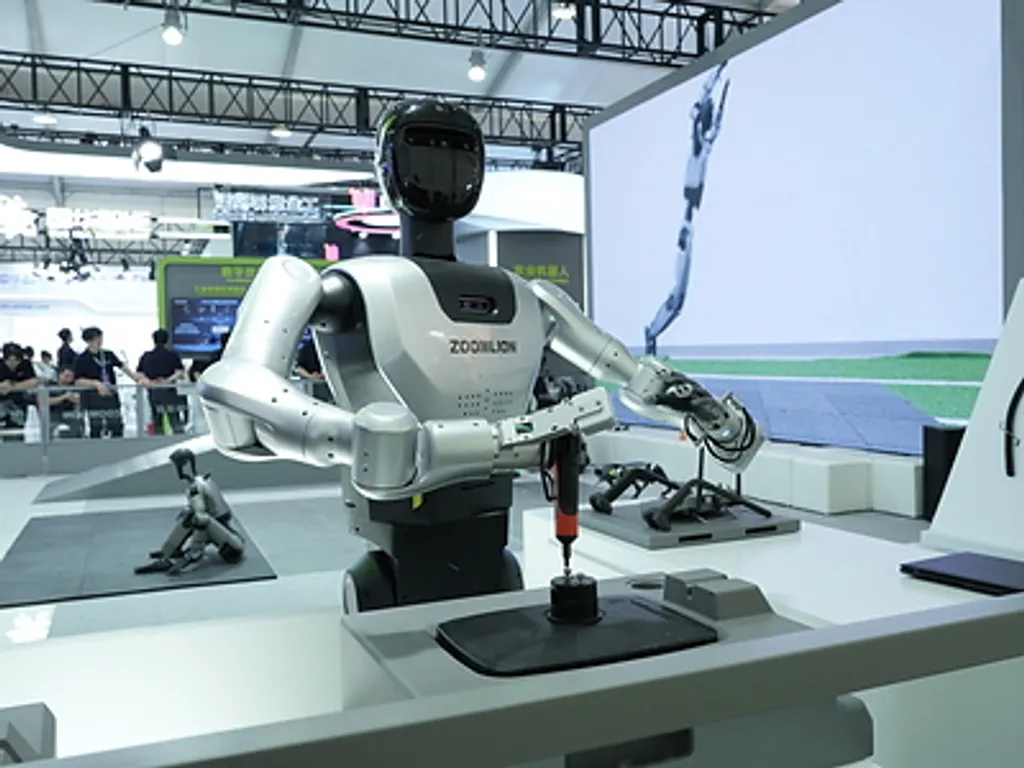
Zoomlion, the Chinese construction-machinery giant better known for cranes and excavators than robotics, used the 2026 World Robot Conference (WRC 2026) in Beijing to show two humanoid robots, designated Z01 and Z03, running specific factory tasks: wire-harness handling and mirror preassembly. The company disclosed no independent productivity, throughput, or ROI figures for either machine, and did not announce commercial availability [1][2].
What Zoomlion showed
Z01 is a bipedal humanoid that Zoomlion demonstrated handling and organizing wire harnesses, the bundled cable assemblies that route power and signal wiring through a vehicle or machine, a task that requires precise, repeatable dexterity because harness routing errors are hard to catch downstream [1][2][3]. Z03 is a wheeled humanoid, built for stability and payload rather than bipedal mobility, shown performing three distinct tasks: material picking, sorting irregularly shaped items, and completing preassembly of rearview mirrors [1][2][3]. Both machines were presented together under a platform Zoomlion calls “Robot Ops,” which the company describes as “a professional development platform for embodied intelligence in the Software 3.0 era” [1][2].
Robot Ops is structured around four modules, per Zoomlion’s own description: basic tools, imitation learning, reinforcement learning, and task orchestration [1][2]. That structure matters more than it might look on a show floor crowded with robot demos, because it signals Zoomlion is positioning Robot Ops as infrastructure for training and coordinating robot behavior, not just a name for the two robots it happened to bring to Beijing. Imitation learning and reinforcement learning are the two dominant methods the wider industry uses to teach a robot a task without hand-coding every motion: imitation learning has the robot copy demonstrated human movements, while reinforcement learning has it improve through repeated trial against a reward signal. Pairing both inside one platform, alongside a task-orchestration layer to sequence multi-step jobs, is a fairly standard architecture among embodied-AI developers in 2026, not a novel one, but it is a concrete description of what Zoomlion is building rather than marketing language alone.
What’s confirmed, and what isn’t
Zoomlion’s release states the robots have been “validated across nearly 20 manufacturing scenarios at Zoomlion Smart City, where they have been deployed in active manufacturing environments” [1][2]. Zoomlion Smart City is Zoomlion’s own facility, so this is a company reporting results from its own site, not an independently audited customer deployment. No throughput numbers, cycle times, uptime figures, defect rates, or cost/labor comparisons accompany that claim in any of the three sources reviewed for this story. That absence is worth stating plainly rather than glossing over: a reader coming away from Zoomlion’s release with an impression of measured productivity gains would be reading in figures that were not actually published.
Commercial availability is similarly undisclosed. Nothing in the release states a price, a shipping date, or whether Z01 and Z03 will be sold to outside manufacturers at all, as opposed to remaining internal tools Zoomlion uses on its own lines and shows off at conferences. Read plainly, WRC 2026 was a capability and roadmap showcase for Zoomlion’s own embodied-intelligence ambitions, not a product launch.
Why a crane maker is building humanoids
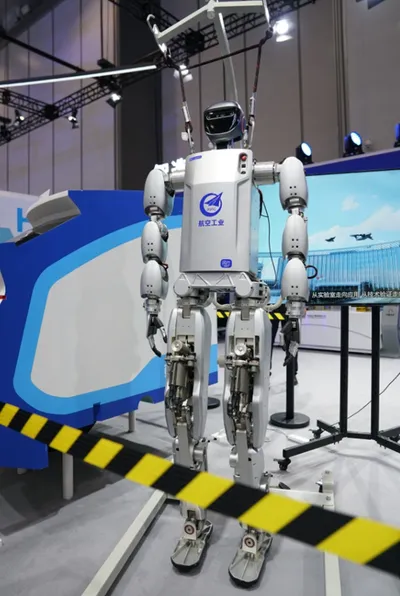
Zoomlion’s move fits a broader pattern among large Chinese industrial-equipment manufacturers this year: companies whose core business is heavy machinery, not robotics, using WRC 2026 and adjacent shows to demonstrate embodied-AI capability, often built on the same imitation-learning and reinforcement-learning foundations. AVIC, the state aerospace group, separately unveiled its own humanoid at the same conference (see below). Delta Electronics, a power-electronics and automation supplier, showed a voice-directed dual-arm platform at Automation Taipei 2026 the week prior, explicitly pitching a “brain, not skeleton” components strategy rather than competing as a robot brand outright. Zoomlion’s Z01 and Z03 sit closer to the “brain and body together” end of that spectrum: a heavy-equipment maker building its own humanoids and its own training platform in-house, aimed initially at its own factory floor.
For the application classes these tasks fall into, see IRH’s pick-and-place application page and assembly application page. For a look at another WRC 2026 humanoid reveal from the same week, with a real deployment and independently corroborated (though still company-reported) figures, see IRH’s coverage of AGIBOT’s four-robot unveiling and Longcheer Technology deployment.
Sources
- 2026 World Robot Conference: Zoomlion Showcases Industrial Embodied Intelligence — PR Newswire, Aug 21, 2026
- 2026 World Robot Conference: Zoomlion Showcases Industrial Embodied Intelligence — RoboticsTomorrow, Aug 21, 2026
- 2026 World Robot Conference: Zoomlion Showcases Industrial Embodied Intelligence — Zoomlion (official newsroom)
Frequently asked questions
What do Zoomlion's Z01 and Z03 robots actually do? +
Z01 is a bipedal humanoid that Zoomlion showed handling and organizing wire harnesses, a fiddly, cable-routing task common on electrical and mechanical assembly lines. Z03 is a wheeled humanoid that performs material picking, sorts irregularly shaped items, and completes preassembly of rearview mirrors. Both were demonstrated live at WRC 2026 under Zoomlion's own 'Robot Ops' platform.
What is 'Robot Ops'? +
Robot Ops is Zoomlion's own embodied-intelligence development platform, which the company describes as built for what it calls the 'Software 3.0 era.' It has four core modules: basic tools, imitation learning, reinforcement learning, and task orchestration, meant to let Zoomlion (and eventually, implicitly, other users) train and coordinate robot behaviors rather than hand-code them.
Has Zoomlion published independent productivity numbers for these robots? +
No. Zoomlion's own release states the robots have been 'validated across nearly 20 manufacturing scenarios' at Zoomlion Smart City, its own facility, and deployed there in active manufacturing environments. No throughput, cycle-time, uptime, or ROI figures accompany that claim, and no third party has audited it.
Is Zoomlion selling Z01 and Z03 commercially? +
That is not disclosed in the release. What Zoomlion showed at WRC 2026 reads as a capability and roadmap showcase, demonstrating what the robots and the Robot Ops platform can do, rather than a product-availability or pricing announcement.
More news