Elite Robots Backs Generalist AI's GEN-1 With Cobot Validation
Chinese cobot maker Elite Robots says its arms ran 1,800+ zero-intervention block stackings for Generalist AI's GEN-1 foundation model, largely repackaging figures from Generalist's own April model launch rather than new independent results.
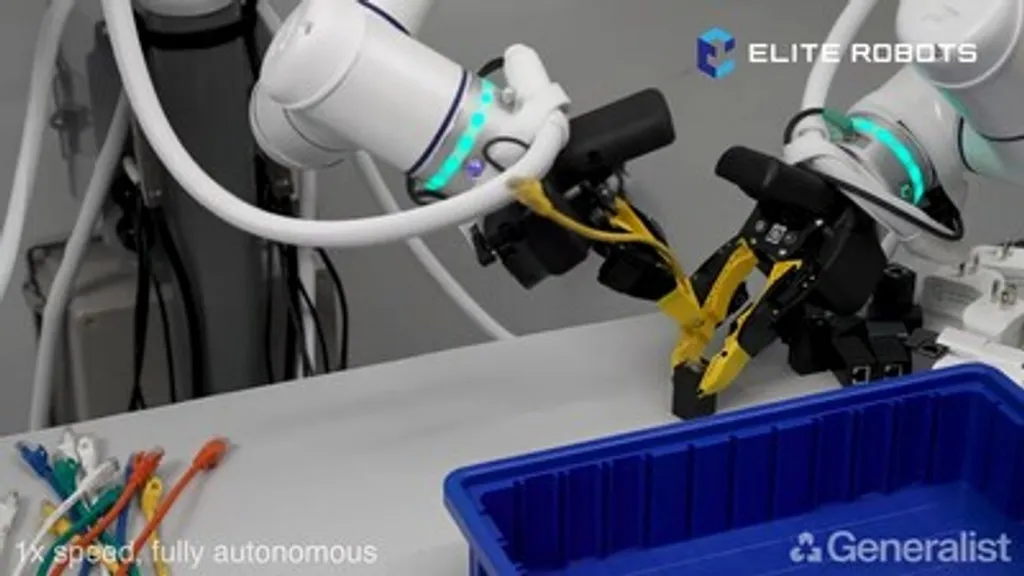
Elite Robots, the Shanghai-headquartered collaborative-robot maker, announced on July 21, 2026 that its cobot arms served as the hardware behind a validation run for Generalist AI’s GEN-1 embodied foundation model: more than 1,800 block-stacking cycles and 200-plus box-folding cycles with, per the release, zero mechanical intervention. The figures are real and attributed to Elite’s own hardware. What is less clear from the announcement itself is how much of this is new July data versus a repackaging of Generalist AI’s April model launch, since the release explicitly credits its “picture and data” to that earlier post.
What the release actually says
The joint announcement, distributed via PR Newswire out of Shanghai, opens by crediting Generalist AI, a US startup founded by former Google DeepMind researchers and backed by NVIDIA NVentures, with unveiling GEN-1, “its latest embodied foundation model achieving a 99% task success rate and a 3x speed increase.” It then states that “Elite Robots collaborated with Generalist AI to support real-world data collection and algorithm validation on its cobot platform.”
Three specific claims follow under a “Key Highlights” section: “Industrial-Grade Reliability,” meaning flawless, zero-intervention performance across 1,800-plus block stackings and 200-plus box foldings, “backed by 100,000-hour MTBF and ±0.02mm repeatability”; “3x Trajectory Acceleration,” describing smooth, jitter-free servo control; and “Real-Time Adaptability,” a 360-degree motion range with force feedback that lets GEN-1 “instantly correct unexpected execution errors.” Reading the release’s own fine print matters here: the MTBF and repeatability figures are attached to the reliability of Elite’s cobot hardware, the arm did not physically fail across 2,000 repetitions, not to any measured property of the AI model itself. That distinction gets lost when the two numbers are quoted alongside the 99% success rate as if they describe the same thing.
Just as important is a line at the bottom of the release, easy to miss: “(Picture and data referenced from: Generalist AI Team, ‘GEN-1: Scaling Embodied Foundation Models to Mastery,’ Generalist AI Blog, Apr 2026).” That is Elite Robots’ own citation, and it confirms the core performance figures in this July announcement trace back to Generalist’s original model launch three and a half months earlier, not to a fresh July validation event.
What the April source actually claims
Generalist AI’s April 2, 2026 blog post is more specific than the July release lets on. It reports GEN-1 achieving a 99% average success rate across demonstrated tasks, against 64% for Generalist’s own prior model, GEN-0, and 19% for a model trained from scratch with no pretraining, broken out per task: servicing robot vacuums (99% vs. 50% vs. 2%), folding boxes (99% vs. 81% vs. 13%), and packing phones (99% vs. 62% vs. 42%). On training data, Generalist says GEN-1 is pretrained on over 500,000 hours of human physical-interaction data, captured via low-cost wearable sensing devices worn by people performing everyday activities, not by robots, and then fine-tuned per task using roughly one hour of robot-specific demonstration data. That 500,000-hour pretraining figure, and the wearable-device data-collection method, is Generalist’s own claim about its foundation model’s training pipeline; it has not been independently audited.
None of that April benchmark data is specific to Elite Robots’ hardware. The 1,800+ block stackings and 200+ box foldings in the July release appear to be the new, Elite-specific contribution, run on Elite’s cobot platform, layered on top of the April model’s already-published success-rate claims.
The skepticism worth noting
Unite.AI’s July 21 analysis, published the same day as the release, raises a specific and verifiable point: “Generalist’s own GEN-1 write-up and its June funding announcement never mention Elite Robots.” In other words, Generalist AI has publicly described GEN-1’s capabilities without naming Elite Robots as a hardware partner, while Elite Robots is now publicly claiming that role. Unite.AI frames this as Elite “asserting that its arms were the hardware underneath some of those runs, a plausible role… but not one Generalist has confirmed publicly,” and characterizes the release’s “ChatGPT moment” framing for robotics as marketing language rather than a demonstrated milestone. Elite Robots, founded in 2016 by researchers from Beihang University’s Robotics Institute and headquartered in Shanghai’s Zhangjiang AI Robot Valley with manufacturing in Suzhou, makes the EC and CS series cobots (3-25 kg payload); it is not currently in Industrial Robotics Hub’s robot database, and neither is Generalist AI’s GEN-1, which is a software model rather than hardware.
Sources
- Elite Robots Collaborates with Generalist AI on Next-Gen Embodied AI — PR Newswire (Elite Robots), Jul 21, 2026
- GEN-1: Scaling Embodied Foundation Models to Mastery — Generalist AI (official blog), Apr 2, 2026
- Elite Robots Pitches Its Cobots for Generalist AI's GEN-1 — Unite.AI, Jul 21, 2026
Frequently asked questions
What is GEN-1? +
GEN-1 is Generalist AI's embodied foundation model, first detailed in the company's own April 2, 2026 blog post. Per that post, GEN-1 is pretrained on over 500,000 hours of human physical-interaction data captured via low-cost wearable devices, not robot data, and then fine-tuned per task using roughly one hour of robot demonstration data, which Generalist says lets one model drive different robot bodies and end-effectors without robot-specific retraining.
Is the '99% success rate' compared to any baseline in the July announcement? +
Not in the July 21 press release itself, which states the 99% figure without a comparison point. The baseline comparison, GEN-1's 99% average success rate versus 64% for Generalist's prior model GEN-0 and 19% for a from-scratch model with no pretraining, appears only in Generalist's own April blog post about the original model launch, months before the Elite Robots announcement.
What did Elite Robots actually contribute? +
Per the joint release, Elite Robots supplied cobot hardware for real-world data collection and algorithm validation, and its arms performed the 1,800+ block-stacking and 200+ box-folding runs cited in the announcement. However, the release itself states its data and imagery are 'referenced from' Generalist AI's April blog post, and an independent trade write-up from Unite.AI noted that Generalist's own GEN-1 materials and June funding announcement do not mention Elite Robots by name, so Generalist has not publicly confirmed Elite's specific role.
Are the 100,000-hour MTBF and ±0.02mm repeatability figures GEN-1 performance metrics? +
No. Reading the release closely, those two figures describe the reliability and precision of the Elite Robots cobot hardware itself ('backed by 100,000-hour MTBF and ±0.02mm repeatability'), not a measured property of the GEN-1 model's software performance. They are standard hardware-datasheet-style specs attached to explain why the arm could run 1,800+ repetitions without a mechanical fault, not evidence about the AI model's accuracy.
More news