Regal Rexnord's Thomson CTU Wins FANUC Approval for CRX Cobots
Thomson's Movotrak Cobot Transfer Unit is now FANUC-approved for CRX cobots, extending horizontal reach up to 10 meters with built-in collision detection.
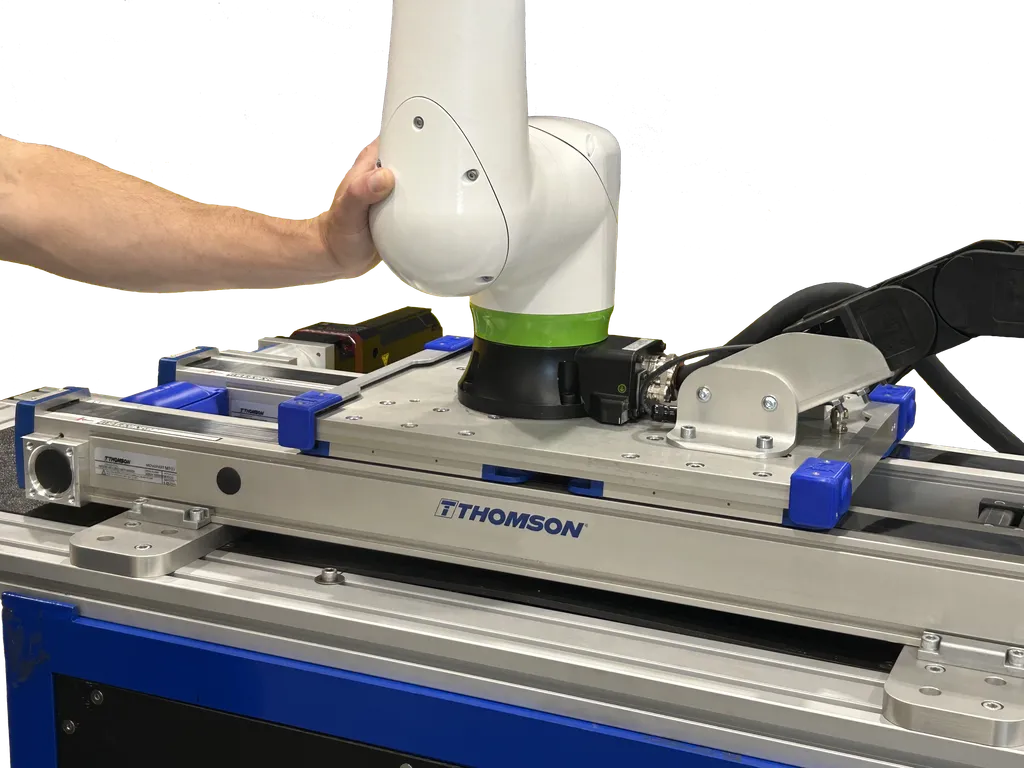
Regal Rexnord’s Thomson division announced August 4 that its Movotrak Cobot Transfer Unit (CTU) — an external 7th-axis linear rail — is now approved for integration with FANUC’s CRX-series collaborative robots, extending a cobot’s horizontal operating range up to 10 meters. The unit plugs into FANUC’s Cobot Device network and configures from the robot’s own teach pendant, and Thomson markets it as the first external linear axis of its kind with built-in collision detection — aimed at manufacturers who want one cobot working a full line of machines instead of standing bolted to one spot.
What the CTU actually does
A 7th axis is not new in industrial robotics — linear rails that carry a robot base back and forth have been used with large, non-collaborative arms for decades, typically requiring custom motion-control programming to integrate the rail’s motor and the robot’s controller into one coordinated system. What Regal Rexnord and FANUC are announcing is a pre-engineered version of that idea built for the CRX collaborative line: per Thomson’s product page and the press release, the Movotrak CTU was added to FANUC’s Cobot Device network through a co-developed plug-in interface, so certified FANUC integrators can access Thomson’s configuration tools directly on the teach pendant rather than writing separate motion code for the rail.
The unit combines several Regal Rexnord product lines into one engineered package: Thomson dual linear units for the rail motion, a Kollmorgen servo motor and software, Boston Gear gearheads, and Huco couplings, according to the companies. Thomson’s spec sheet lists the included hardware as dual linear units, the Kollmorgen motor, a precision gearhead, a carriage mounting plate sized for the robot, Freedrive paddles for hand-guided programming, end-of-stroke limit switches, cable management, and a control box with the unit’s 7th-axis collision-detection software. The rail mounts to a floor, wall, or ceiling, and Thomson states it is compatible with “even the largest sized cobots on the market.”
On collision detection specifically, Thomson describes it as a layer independent of the robot’s own force-limiting: large surface areas on the linear carriage act as paddles, triggering a safeguard stop when contacted, with sensitivity adjustable at installation and monitoring handled by the Movotrak’s own motor drive and digital I/O rather than routed entirely through the cobot’s controller. Safety I/O for stopping scenarios is supplied by the cobot and any third-party safeguarding devices connected to the cell, per Thomson’s description — meaning the rail’s own hardware is doing part of the safety work, not just extending the arm’s reach.
Two named executives, two frames on the same announcement
Regal Rexnord quoted two executives on the launch. Emily Kern, President of Regal Rexnord’s Linear Motion Division, called it a capability play: “Adding an external axis transport layer to a 6-axis cobot opens new avenues for productivity, innovation and profitability” for customers, according to the press release. Kevin Long, EVP and President of Regal Rexnord’s Automation & Motion Control segment, framed it from FANUC’s side: “FANUC is a highly regarded leader in industrial robotic technology… We’re proud that the Thomson CTU is now approved for integration with their cobot platform.” Regal Rexnord’s release states the Movotrak CTU is compatible with FANUC’s largest CRX cobots, specifically naming the CRX-30iA.
Thomson traces its own linear-motion technology to 1945, when it invented the linear ball bushing bearing, and now operates as one brand under Regal Rexnord (NYSE: RRX), a roughly 32,000-employee motion-control manufacturer, per the company’s own public filings. This is also not Regal Rexnord’s first cobot-maker partnership for the Movotrak CTU: the company’s own newsroom shows it announced the same product as the first cobot 7th-axis technology certified by ABB Robotics for ABB’s GoFa cobot line in August 2025, a year before the FANUC approval.
Why the reach problem is real for cobots specifically
FANUC’s CRX line is popular precisely because it is a compact, easy-to-deploy six-axis cobot — but that compactness comes with a short native reach. Industrial Robotics Hub’s own robot database lists arm-only reach across the six current CRX models between roughly 692 mm (CRX-3iA) and 1,889 mm (CRX-25iA), with the workhorse CRX-10iA topping out at 1,249 mm. None of that reaches two machines set several meters apart — a routine layout in machine-tending and material-handling cells. Upgrading to a larger arm solves the reach problem but usually means giving up collaborative status, and the fencing and floor space that comes with it. A 7th-axis rail is the established alternative: keep the cobot’s safety profile, multiply its work envelope instead.
The barrier has traditionally been integration effort. Bolting a linear rail under a cobot and getting the controller to treat it as a coordinated additional axis has historically meant custom controls programming — a cost and skill requirement out of reach for smaller manufacturers without dedicated robotics-integration staff, even when the rail hardware itself is straightforward. That is the gap Regal Rexnord is targeting by building the Movotrak CTU as, in its own words, plug-and-play and configurable from the existing FANUC teach pendant rather than a separate programming environment. Readers comparing FANUC’s CRX line against Universal Robots’ cobots can also see FANUC’s full collaborative and industrial catalog on Industrial Robotics Hub.
Sources
- Regal Rexnord Leading Motion Control Brands Power New Collaborative Robotics Solution with FANUC — RoboticsTomorrow, Aug 4, 2026
- Regal Rexnord Announces New Collaborative Robotics Solution with FANUC — Quality Magazine, Aug 5, 2026
- Movotrak Cobot Transfer Unit product page — Thomson Linear (a Regal Rexnord brand)
- Regal Rexnord and ABB Robotics Collaborate for Seamless Integration of Cobot 7th Axes — Regal Rexnord, Aug 5, 2025
Frequently asked questions
How much extra reach does the Movotrak CTU actually add? +
Thomson states the Movotrak CTU adds a horizontal operating range up to 10 meters when mounted as an external 7th axis under a FANUC CRX cobot. That figure comes from Thomson's own product page and Regal Rexnord's press release — it is a manufacturer-stated maximum rail travel, not an independently tested figure, and actual usable range in a given cell depends on how the rail is installed and what payload the cobot carries while moving along it.
Which FANUC cobots work with the Movotrak CTU? +
Regal Rexnord's announcement states the unit is compatible with FANUC's CRX line and specifically names the CRX-30iA as one of the largest cobots it supports. FANUC's CRX-30iA is not currently listed in Industrial Robotics Hub's own robot database, which as of this story's publication covers the CRX-3iA, CRX-5iA, CRX-10iA, CRX-10iA/L, CRX-20iA/L, and CRX-25iA — so that specific model's specs are sourced entirely from the manufacturer's own announcement, not independently cross-checked against a FANUC datasheet in our database.
What does 'collision detection' mean on an external axis like this, versus on the robot itself? +
It's a separate safety layer built into the rail, not the cobot's own joint-torque sensing. Thomson describes user-adjustable collision detection performed by the Movotrak's own motor drive and digital I/O, with large surface areas on the linear carriage acting as paddles that trigger a safeguard stop when contacted — monitoring that happens on the rail hardware, with safety I/O tied back to the cobot and any third-party safeguard devices, rather than relying on the robot arm's built-in force limiting to catch a collision involving the rail itself.
Why does a 7th-axis rail matter for a collaborative robot specifically? +
Six-axis cobots like FANUC's CRX series have a fixed, relatively short native reach — Industrial Robotics Hub's own database puts the CRX line's arm-only reach between roughly 0.7 and 1.9 meters across its six current models. A linear rail multiplies that into a genuine work envelope spanning multiple machines or stations without swapping to a larger, non-collaborative arm. The traditional obstacle has been that wiring a 7th axis into a robot's motion control took custom integration work; a pre-engineered, teach-pendant-configurable unit like the Movotrak CTU is aimed squarely at removing that barrier for shops without in-house robotics-integration staff.
More news