Tate Deploys 58 Hirebotics Cobot Welders, Lifts Output 12x
Tate Inc. has fielded 58 Hirebotics Cobot Welders across three US plants, citing 12x per-welder throughput gains — and more welders hired, not fewer.
Tate Inc., a 120-year-old maker of structural ceilings, containment systems, and raised access flooring for data centers, has deployed 58 Hirebotics Cobot Welder systems across three US plants — Arkansas, St. Paul, Virginia, and Kentucky — and says the shift has lifted per-welder throughput on critical structural assemblies by a factor of 12, according to a case study Hirebotics published and multiple trade outlets covered in the first week of August 2026. Tate, part of Ireland’s Kingspan Group, began moving from manual hand-welding to cobot-assisted welding in 2024.
The headline figure comes from Hirebotics’ own account of the change on the shop floor: a welder working by hand produced roughly one-third of a “hack” — Tate’s internal term for a production batch unit — per shift. With a cobot assisting, that same welder now turns out four full hacks per shift. Hirebotics and Tate both describe this as a company-reported result from a case study, not an independently audited engineering benchmark, and Industrial Robotics Hub is flagging it as such below.
What’s actually running on the floor
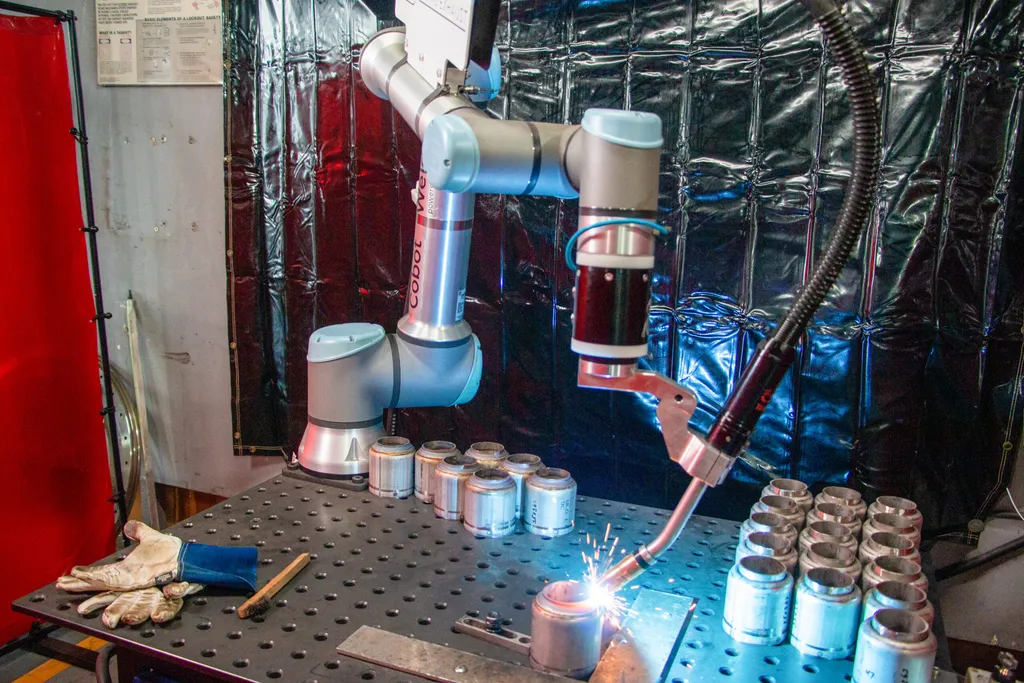
The Cobot Welder is not a robot Hirebotics builds from scratch. The Nashville, Tennessee-based company is a Universal Robots-certified OEM integrator — a repeat winner of UR’s Global OEM of the Year award — and a FANUC Authorized Solution Integrator, not a robot manufacturer in its own right. Per Hirebotics’ own product page, the Cobot Welder pairs a Universal Robots UR8 Long collaborative arm, rated for a 68.9-inch reach, with a Miller Auto Deltaweld 350 MIG power source and an air-cooled Tregaskiss Tough Gun torch as standard equipment. Notably, the UR8 Long does not appear in Industrial Robotics Hub’s own robot database, which currently covers the UR3e, UR5e, UR7e, UR10e, UR12e, UR15, UR16e, UR20, and UR30 — so its specs here rest on the manufacturer’s own listing rather than a cross-checked database entry.
The more distinctive piece is the control layer. Instead of a traditional robot teach pendant, operators program a weld path by physically hand-guiding the torch — a “tap-to-teach” method Hirebotics calls its Smart Puck — and then run, monitor, and adjust the job from a smartphone or tablet through its cloud-based Beacon and Beacon Pro software. That no-code approach is central to the training-time claim in Tate’s case study: Hirebotics says new operators, including welders with zero robotics background, are up and running on a cobot in 10 to 20 minutes.
Because Beacon is cloud-based, weld programs and parameters set at one Tate plant can be pushed live to the other two. Curtis Ward, Tate’s fabrication production manager, is quoted in the case study describing the effect directly: through the Beacon app he can “share weld parameters to different sites in real time,” setting minimum and maximum values that operators can’t exceed — turning what would otherwise be plant-by-plant variation into what Tate calls a single internal welding standard. Shahram Totonchian, the plant manager at Tate’s St. Paul, Virginia facility, framed the consistency payoff in terms of rework: in his account, a cobot weld and a properly executed hand weld should look identical, and “when you stay with that consistency and follow the program, there is no rework.”
A hybrid floor, not a robot swap
Tate did not simply replace industrial robots or welders with cobots. Brad Kampbell, Tate’s VP of Engineering, said the company weighed large industrial welding units against cobots when planning its new manufacturing facilities and “settled on a hybrid of both.” In the Arkansas plant specifically, the 58-unit fleet includes cobots doing precision tacking and pre-assembly work that then feeds parts downstream to Tate’s existing traditional industrial robots for finish welding — the cobots handling the flexible, frequently-changing setup work that’s expensive to program on a big fenced-off arm, while the larger robots handle repetitive finish passes at higher raw speed.
Perhaps the more unusual data point is workforce-related. Tate says it has hired more certified welders since starting the cobot rollout in 2024, not fewer — a direct rebuttal, at least at this one manufacturer, to the general assumption that welding automation shrinks headcount. Totonchian ties this partly to working conditions: cobot-assisted welding, in his account, is also a recruiting pitch, because it means fewer hours “under the hood” in a 120-degree environment. Lead welder Chuck Goodson put it more bluntly in the case study: “I’d never seen one till two years ago. And now I’m a firm believer.” Tate’s next step, per the case study, is adopting Hirebotics’ Cobot Painter system on the same Beacon platform, on the theory that operators already trained on welding cobots won’t need retraining to run painting cobots.
Sources
- Tate Inc. Case Study — Hirebotics
- Cobot Welder product page — Hirebotics
- Data center infrastructure company Tate boosts welding productivity 12-fold with fleet of 58 Hirebotics cobots — Robotics & Automation News, Aug 7, 2026
- Hirebotics Cobots Help Tate Deliver 12x Output Per Welder — RoboticsTomorrow, Aug 6, 2026
- Hirebotics Cobots Help Tate Deliver 12x Output Per Welder — ManufacturingTomorrow, Aug 6, 2026
Frequently asked questions
What exactly is a Hirebotics Cobot Welder? +
It pairs a Universal Robots UR8 Long collaborative arm (68.9-inch reach) with a Miller Auto Deltaweld 350 MIG power source and an air-cooled Tregaskiss Tough Gun torch. There's no traditional teach pendant — operators hand-guide the torch through a weld path using a tap-to-teach 'Smart Puck,' then run and monitor the job from a phone or tablet via Hirebotics' Beacon software.
How did Tate get to a 12x throughput increase? +
Per Hirebotics' case study, a Tate welder went from roughly one-third of a 'hack' (Tate's internal production-batch unit) per shift by hand to four full hacks per shift with a cobot. The company attributes the jump to fast no-code programming, spec-consistent welds that eliminate rework, and weld parameters shared in real time across all three plants through Beacon Pro.
Did the automation cut jobs at Tate? +
No — Tate says it has hired more certified welders since starting the rollout in 2024, not fewer. That's the company's own reported outcome from a single manufacturer, not an independently audited industry-wide trend, but it runs counter to the usual automation-and-layoffs narrative.
What's next for Tate's automation rollout? +
Tate plans to add Hirebotics' Cobot Painter system next, which runs on the same Beacon platform — the idea being that operators already trained on the welding cobots won't need to be retrained to run the painting cobots.
More news