LG's CLOiD Robot Graduates From CES Demo to Factory Pilot
LG will pilot its CLOiD robot on a real Tennessee factory line in 2026 and previewed a bipedal humanoid built on NVIDIA chips for a 2027 reveal.

LG’s CLOiD robot spent its first seven months of public life folding towels in a CES demo living room. On August 13, 2026, LG committed to putting it on an actual factory floor: the wheeled robot will be deployed within 2026 to LG Electronics’ washing-machine manufacturing line in Tennessee for real-world production-environment validation. That is the concrete, verifiable news out of a meeting between LG Chairman and CEO Kwang Mo Koo and NVIDIA founder and CEO Jensen Huang at NVIDIA’s Santa Clara headquarters — a session both companies describe as shifting their robotics partnership from “strategic planning” to “active execution.”
Alongside the CLOiD news, LG previewed a future bipedal humanoid and disclosed a multi-year AI-infrastructure buildout. This story leads with the industrial pilot because it is the item an automation buyer can actually track against a calendar; the humanoid and the compute buildout are real, but they are roadmap commitments, not shipped hardware.
From living room to laundry-room production line
CLOiD debuted at CES 2026 in January as part of LG’s “Zero Labor Home” pitch — a wheel-based robot with articulated arms, shown folding towels and doing other light household chores in a staged home environment. It was, at the time, a consumer-facing demo, not an industrial product. The August 13 announcement is the first time LG has named a real deployment site and a real timeline for testing CLOiD outside that demo setting: LG Electronics’ own washing-machine plant in Tennessee, within calendar 2026.
That distinction matters to anyone evaluating this as an industrial-automation story rather than a consumer-tech one. A home-robot demo reel is choreographed; a production line is not. LG’s own framing treats the Tennessee deployment explicitly as a validation exercise — the company says that, based on results there, it plans to refine CLOiD’s performance and then consider expanding it to global production facilities, homes, and commercial spaces. In other words, Tennessee is the gate CLOiD has to pass before LG scales it anywhere else.
What is missing from every source reviewed for this story is any specification of what CLOiD will actually do on that line. There is no disclosed payload capacity, no cycle time, no task list — nothing indicating whether CLOiD will handle parts, packaging, quality inspection, or something else entirely. For a plant engineer trying to gauge whether this technology is relevant to their own operation, that is the single biggest open question, and it is one none of the three sources for this piece — LG’s own press release and two independent trade-press writeups — answer. That gap is worth stating plainly rather than papering over with the more exciting humanoid news that came alongside it.
The humanoid preview: components, not a product yet
The second piece of the announcement is a next-generation bipedal humanoid robot, still unnamed, that LG plans to unveil publicly in the first quarter of 2027. It is built on three pieces of NVIDIA technology: Jetson Thor for onboard compute, Isaac GR00T — NVIDIA’s open humanoid foundation model — for the underlying AI, and NVIDIA’s Halos for Robotics safety architecture. LG says the humanoid will draw on component capabilities from across the LG group: actuators and sensors from LG Innotek, batteries from LG Energy Solution, and the core robotics and AI work from LG Electronics.
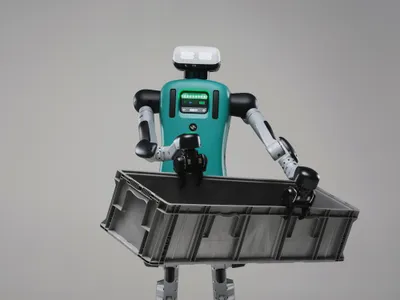
Halos for Robotics is the same safety stack NVIDIA built into Agility Robotics’ Digit v5, where it centers on an IGX Thor compute module carrying a Functional Safety Island independently certified to IEC 61508 SIL 3. That certification is what let Digit v5’s “cooperatively safe” marketing claim be checked against a real, third-party-audited standard rather than taken on faith. None of the sources for this LG story state that LG’s humanoid carries that same SIL 3 certification — only that it uses the broader Halos for Robotics framework. Readers should not assume parity with Agility’s specific certification until LG or NVIDIA states it directly, which would likely happen closer to the Q1 2027 unveiling.
The compute buildout behind both robots
LG also disclosed an AI-infrastructure commitment sized to support this robotics push: an 80 MW-scale LG AI Factory in Cheonan, Chungcheongnam-do, South Korea, targeted for completion in the first half of 2028, preceded by a smaller “AI Factory reference site” using NVIDIA’s Vera Rubin platform in the first half of 2027. Kwang Mo Koo framed the pace of the underlying partnership directly: “As our discussions have moved fast, our tasks and goals in AI Factory and Physical AI have become clear. We will accelerate the spread of AI by building industry-leading references.” Jensen Huang’s framing was broader: “The defining opportunity of physical AI is to give every machine the ability to understand the real world, reason and act safely alongside people—reshaping everyday life from the home and factory floor to the road.”
Two named robots and a big compute number make this announcement easy to read as a product launch. It is not one yet. CLOiD is an unproven wheeled robot about to face its first real industrial test; the humanoid is components and a target date; the AI Factory is a construction commitment for 2028. What is real today is a partnership that has moved from planning documents to a named plant, a named city, and a named quarter.
Sources
- LG to Unveil Its Next-Gen Humanoid Robot, Built on NVIDIA Isaac GR00T — PR Newswire, Aug 13, 2026
- LG to Unveil Its Next-Gen Humanoid Robot, Built on NVIDIA Isaac GR00T — RoboticsTomorrow, Aug 14, 2026
- LG, NVIDIA Expand Robotics Collaboration With New Humanoid, Factory Robot Plans — The AI Insider, Aug 14, 2026
Frequently asked questions
What is LG CLOiD, and has it actually worked in a factory before? +
No. CLOiD is a wheel-based home robot LG first showed publicly at CES 2026 in January, demonstrating chores like folding towels as part of a 'Zero Labor Home' concept. The August 13, 2026 announcement is the first time LG has committed to testing CLOiD in an industrial setting — its own washing-machine manufacturing line in Tennessee — and that pilot has not yet started as of this story's publication.
What can CLOiD actually do on a factory line — payload, speed, task scope? +
Undisclosed. Neither LG's announcement nor the trade press covering it states a payload capacity, cycle speed, or specific task list for the Tennessee pilot. LG says only that the deployment is meant to validate performance in a real production environment before deciding whether to expand the robot to other plants, homes, and commercial spaces. That is a real gap worth tracking, not a detail this story can fill in.
Is LG's new humanoid robot the same thing as CLOiD? +
No, they are two separate machines. CLOiD is the existing wheeled robot going to the Tennessee pilot. The humanoid LG previewed alongside it is a new, unnamed bipedal robot still in development, targeted for public unveiling in the first quarter of 2027, built on NVIDIA Jetson Thor compute, the Isaac GR00T foundation model, and NVIDIA's Halos for Robotics safety architecture.
Does LG's humanoid carry the same safety certification as Agility Robotics' Digit v5? +
Not stated. LG's humanoid will use NVIDIA Halos for Robotics, the same safety architecture NVIDIA built into Agility Robotics' Digit v5 via an IEC 61508 SIL 3-certified Functional Safety Island on the IGX Thor module. None of the sources for this story state that LG's device carries that specific SIL 3 certification, and this story does not assume it does — that detail should surface closer to the robot's Q1 2027 unveiling.
More news