FANUC Previews IMTS 2026: Battery-Ready CRX, New CNC Line
FANUC says it will show a DC controller letting CRX cobots run off battery power on mobile robots, plus new machining, paint and CNC hardware at IMTS 2026.
FANUC America says it will use IMTS 2026 to showcase a new controller purpose-built to let its CRX collaborative robots run off battery power when mounted on autonomous mobile robots — eliminating the separate inverter that mobile-cobot builders have had to engineer around until now. The September 3 announcement, previewing FANUC’s booth 338900 (McCormick Place, Chicago, September 14-19), bundles that hardware unlock with a new machining robot variant, a paint robot demo built around a moving target, upgrades to FANUC’s flagship heavy-industrial arm, three new CNC machining centers, and an AI-partnership push with Google Cloud, NVIDIA, Amazon Web Services and Inbolt under FANUC’s “Physical AI” framing. IMTS itself is still more than a week away as of publication, so everything below is FANUC’s own statement of what it intends to demonstrate, not a report from the show floor.
The controller that’s the real hardware story
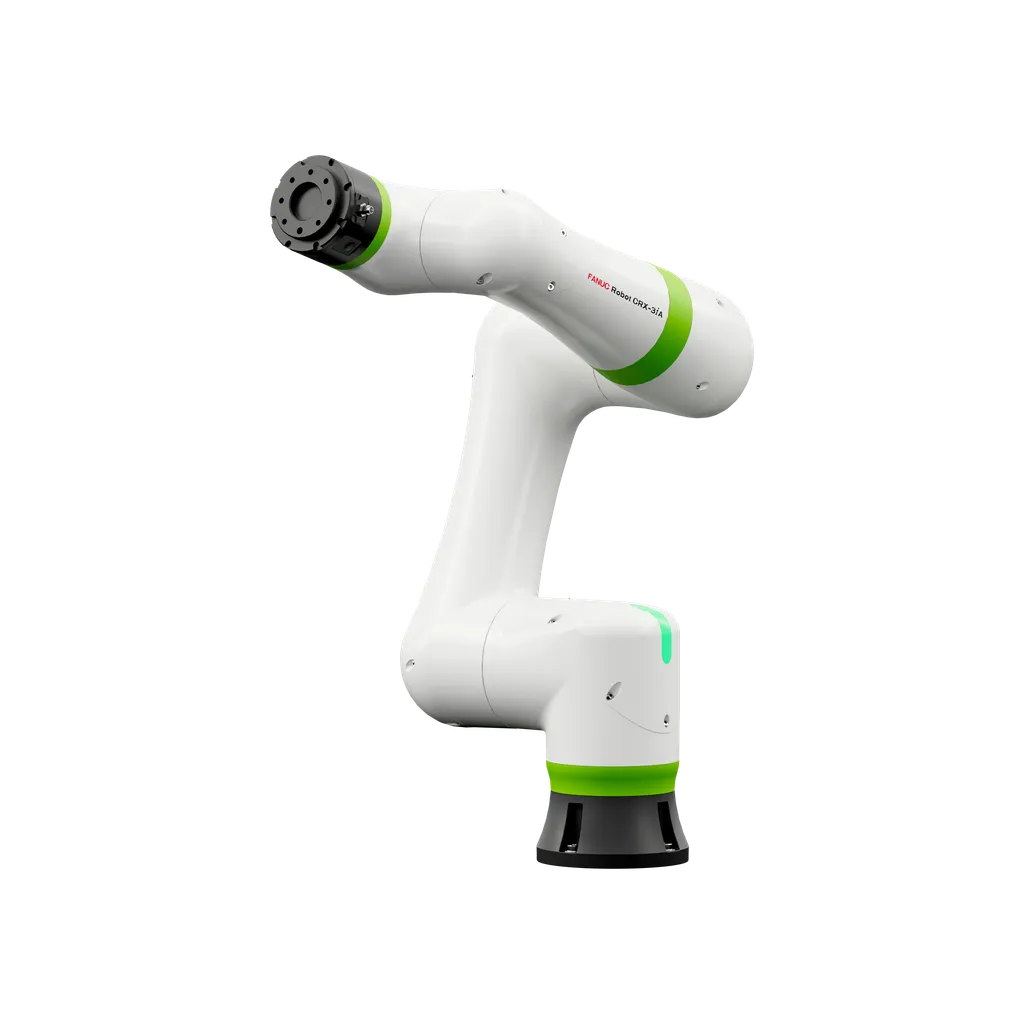
The most concrete new product is the R-50iA Compact DC Controller. Per FANUC’s release, it runs directly off 24V-48V DC battery power and “eliminates the need for a separate inverter, reducing system complexity and simplifying mobile robot integration” for CRX cobots mounted on AMRs — a specific, testable engineering claim, not a marketing refresh. Pairing a cobot with a mobile base has historically meant carrying a separate AC power/inverter subsystem just to run a controller built for a fixed wall outlet. FANUC says the R-50iA also adds cybersecurity certification, advanced vision support, Ethernet connectivity and Python support; a demo will show CRX robots on the platform doing assembly, machine tending, part transport, inspection and washing. A related R-50iA Mate Controller, for fixed installations, appears in CRX-30iA transmission-assembly and bolt-tightening demos that consolidate functions into a single cabinet.
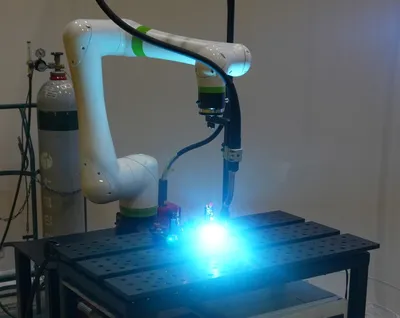
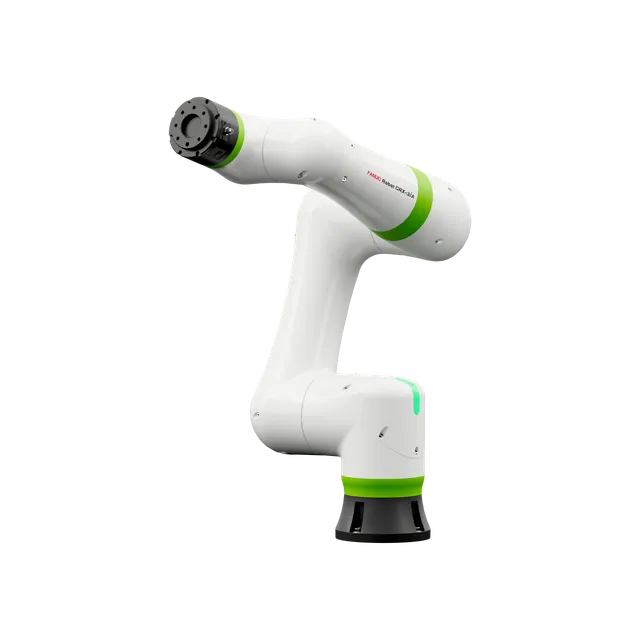
FANUC is also bringing a new CRX-3iA to IMTS, calling it “portable” — notable since Industrial Robotics Hub’s own database entry for the CRX-3iA already lists this exact 3 kg-payload, 11 kg-weight, 692 mm-reach cobot as FANUC’s lightest CRX model, one a person can carry with one hand. The demo will show it vertical-up welding on structural steel, a use case FANUC pitches for shipbuilding, where a welder needs to move a cobot between awkward positions rather than bolt it down.
Machining, paint and the heavy-arm line
Three other product threads round out the announcement, each tied to a named demo:
- M-810/190-20B: demonstrated performing “wet machining” — rough milling, drilling, grinding and tool changing, per FANUC’s event page. FANUC Japan introduced the broader M-810 series for material removal in August 2025; the 190-20B configuration appears to be the specific news at IMTS, though FANUC’s current public materials don’t say whether it’s a distinct new model or an existing variant in a new application — a distinction this desk flags rather than guesses at.
- P-55/15-21A paint robot: paired with the new R-50iA’s single-cabinet design, this robot tracks a moving overhead conveyor line and paints football helmets while they sway, holding consistent coating quality on a target that isn’t standing still — proof, FANUC argues, that the system adapts to dynamic lines rather than the fixed parts robotic painting has traditionally required.
- R-2000 E Series: FANUC’s event page (spelled “R-2000/E Series”) describes a maintenance-free update to its large industrial-arm line — faster axis speeds, higher wrist load capacity, digital-twin capability. Two units run a coordinated automotive spot-welding demo, simulated via NVIDIA Isaac Sim. This desk’s own catalog separately lists two prior-generation R-2000iC arms, R-2000iC/165F and R-2000iC/270F — FANUC hasn’t published anything confirming the E Series as a successor to that line, so no relationship is implied beyond a shared name.
On the CNC side, FANUC will debut its next-generation 500i-A CNC control platform, adding CAD-based automatic programming, reduced cycle times and advanced tool management. Alongside it, three new ROBODRILL DC Series machining centers round out the lineup: the D54CS (10,000-rpm high-torque spindle with Smart Spindle Load Control, for heavy/high-speed drilling and tapping), the D74CS (a new 12,000-rpm high-acceleration spindle for faster cutting), and the D116CS (expanded travel — 1,100 mm X-axis, 600 mm Y-axis — sized for large electric-vehicle instrument panels).
The AI layer
FANUC frames the showcase under “Physical AI” — a term it shares with NVIDIA for systems where robots use AI to perceive, reason and act in real-world environments rather than follow fixed paths. Four partnerships anchor the pitch:
- Google Cloud — a joint demo shows AI agents interpreting handwritten instructions to direct robots to identify, locate and kit parts. Praveen Rao, Google Cloud’s Global Head of Manufacturing Industry, said: “AI agents and multimodal reasoning are transforming manufacturing operations from rigid automation into intelligent collaboration.”
- NVIDIA — Isaac Sim is being integrated as “an open framework” inside FANUC’s ROBOGUIDE digital-twin software, driving live digital twins for the R-2000 E Series demo and a separate CRX-5iA hard-drive-handling demo. NVIDIA’s head of robotics partnerships, Amit Goel, said the integration “is giving developers a faster path to build, test and deploy AI-driven manufacturing solutions.”
- Amazon Web Services — FANUC will show “Zero Down Time,” AWS’s predictive-maintenance offering, among its connected-manufacturing exhibits.
- Inbolt — a bolt-tightening demo on a CRX-20iA/L pairs Inbolt’s physical-AI part-tracking with NVIDIA-powered processing to tighten bolts to spec on parts still in motion.
Mike Cicco, FANUC America’s President and CEO, framed the shift: “Manufacturing is entering a new era where Physical AI enables robots to see, reason and act in real-world production environments, allowing manufacturers to automate increasingly complex tasks with greater intelligence and adaptability.” FANUC also lists a digital-twin software suite — CNC Reflection Studio, CNC Guide 2, Surface Estimation, Tool Path Optimizer and Smart Digital Twin Manager — meant to validate CNC programs and machining processes in simulation before committing floor time to them.
FANUC isn’t the only company previewing new cobot hardware for the show — Industrial Robotics Hub covered Productive Robotics’ 7-axis OB7 family back in July — and the “Physical AI” framing continues a push this desk covered in the NVIDIA-Japan Cosmos coalition story, which named FANUC among the robotics makers building on NVIDIA’s simulation stack.
Sources
- FANUC America Brings Robotics, Automation, Physical AI and CNC Innovation to IMTS 2026 — PR Newswire / FANUC America Corporation, Sep 3, 2026
- FANUC America Brings Robotics, Automation, Physical AI and CNC Innovation to IMTS 2026 — RoboticsTomorrow, Sep 4, 2026
- IMTS 2026 | FANUC America — FANUC America
Robots mentioned
Tap a card to open the full spec sheet.
Frequently asked questions
What exactly is the R-50iA Compact DC Controller, and why does it matter? +
It's a new controller for FANUC's CRX collaborative-robot line that runs directly off 24V-48V DC battery power instead of the standard AC-fed inverter setup most robot controllers need. FANUC's own release states this removes the requirement for a separate inverter when a CRX cobot is mounted on an autonomous mobile robot (AMR) — a real hardware-integration simplification for anyone building a mobile cobot platform, not just a spec bump. A related variant, the R-50iA Mate Controller, is also being introduced across the CRX lineup for fixed installations, consolidating functions into a single cabinet.
Has IMTS 2026 already happened? +
No. IMTS 2026 runs September 14-19, 2026 at McCormick Place in Chicago, confirmed directly on FANUC America's own event page. FANUC's September 3 announcement is a pre-show preview of what it plans to demonstrate at booth 338900 — everything described here is a company statement about a future showcase, not a report from the show floor.
Are the M-810/190-20B machining robot and P-55/15-21A paint robot brand-new products? +
FANUC's parent company in Japan introduced the broader M-810 series for material removal in August 2025. What's new at IMTS 2026 specifically is the 190-20B variant being demonstrated doing wet machining (milling, drilling, grinding and tool changing) — this desk could not independently confirm from FANUC's current materials whether 190-20B is an entirely new configuration or an existing M-810 variant being shown in a new application. The P-55/15-21A paint robot's specific IMTS demonstration, tracking swaying football helmets on a moving conveyor line, is new; FANUC's release does not describe the P-55/15-21A itself as a newly launched robot model versus an existing one in a new demo.
Is the new R-2000 E Series the same robot as the R-2000iC models already on the market? +
Not confirmed either way. FANUC's own event page calls it the 'R-2000/E Series' and describes it as a maintenance-free update with faster axis speeds, higher wrist load capacity and digital-twin capability, powered by NVIDIA Isaac Sim. Industrial Robotics Hub's own robot database separately lists two prior-generation R-2000iC models (R-2000iC/165F and R-2000iC/270F). FANUC has not published anything this desk could find directly confirming the E Series as a renamed or updated version of the iC line, so no relationship between them is claimed here.
More news