Brightpick Cuts Pharmacy Picking Staff From 15 to 0.5 a Shift
Brightpick is adding 44 Autopicker robots for Dr. Max Group, bringing its pharmacy-network fleet to 74 as Prague reports a 95% cut in picking labor.
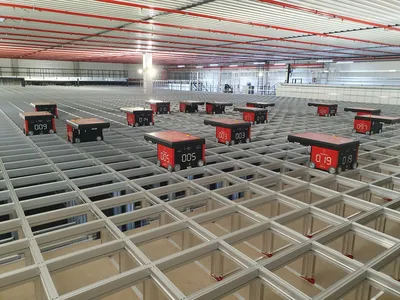
Brightpick, the Austin, Texas-headquartered warehouse-robotics maker, said on August 18 that it is expanding its multi-year deployment with Dr. Max Group, Europe’s largest pharmacy chain, by 44 additional Autopicker autonomous mobile manipulator robots. Once installed, the fleet across the Dr. Max group will reach 74 robots, up from the 30 currently running at the partnership’s original site in Prague. This is a scale-up of an already-running deployment, not a pilot announcement or a funding round.
The deployment, robot by robot
The relationship started small. Viapharma, Dr. Max’s logistics sister company that handles pharmacy and hospital distribution, installed 9 Autopicker units at its Prague facility in late 2023. Over the course of 2025 and into 2026, that fleet grew to 30 robots as Viapharma expanded the site’s SKU range and volume.
The new expansion, set for the second half of 2026, splits 44 robots across two additional facilities: 22 to Viapharma’s Ostrava, Czech Republic site, which handles pharmacy and hospital replenishment, and 22 to a Dr. Max facility in Bratislava, Slovakia, which handles e-commerce distribution. Add those to the 30 already running in Prague and the group’s Autopicker fleet totals 74 robots across three distribution centers in two countries, once both new sites are complete. Downstream, that logistics network supplies more than 3,000 Dr. Max pharmacies across six countries.
Brightpick CEO and co-founder Jan Zizka framed the expansion as validation of the technology at scale: “Expanding our partnership with Dr. Max Group across three major distribution centers is a tremendous validation for us of the reliability and added value of our technology.” Rudolf Zurek, Viapharma’s logistics director, gave the more operational read on why the company kept adding robots: “Deploying Brightpick technology enabled us to fundamentally increase picking accuracy and optimize warehouse processes.”
What an Autopicker actually is
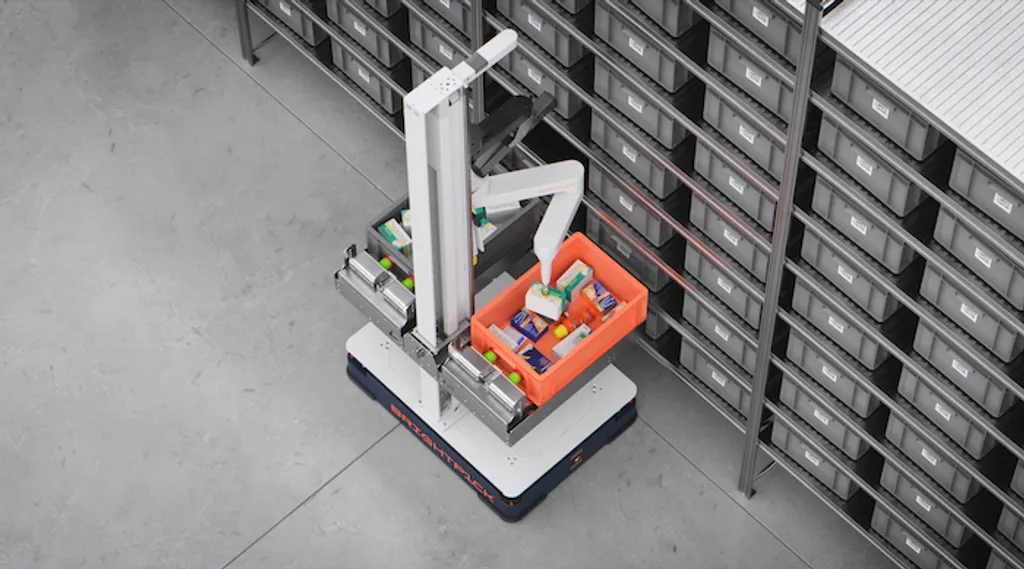
The Autopicker is not a conventional shelf-carrying AMR. It pairs a mobile robot base with an articulated picking arm and 3D vision, using what Brightpick calls “Physical AI” to identify, grasp, and consolidate items directly in the warehouse aisle rather than ferrying a rack back to a stationary human picker. Brightpick says the robot navigates using LiDAR and AI-based vision rather than QR codes, floor markers, or a pre-mapped route, and that installing it requires no structural changes to the facility, part of why Dr. Max has kept adding units to an already-running site instead of re-engineering the layout each time. A fixed Goods-to-Person station backs up the mobile fleet for items the robot can’t cleanly pick, such as damaged packaging or unusually high-volume single-order lines.
Brightpick’s software layer, called Intuition, handles inventory tracking, batch management, and expiration-date-aware picking logic, sequencing picks so the earliest-expiring stock moves first. That matters specifically for this deployment: pharmaceutical distribution carries lot-tracking and expiration-handling requirements that a general e-commerce picking system doesn’t need to solve. Brightpick launched the original Autopicker commercially in February 2023; the company has also released a next-generation “Autopicker 2.0” hardware and software update, though this desk did not independently verify throughput specs for that newer version and is omitting unconfirmed per-hour pick-rate figures rather than repeating them second-hand.
Brightpick describes itself as a 250-plus-employee company with robots deployed across the U.S. and Europe; named customers beyond Dr. Max/Viapharma include The Feed, a Colorado-based cycling nutrition and apparel retailer. Earlier, 2024-era coverage of Brightpick listed Cincinnati as its headquarters; the company’s own current site states Austin, Texas, which is the figure used here.
The numbers, and what’s actually confirmed
Brightpick and Dr. Max report specific operational results from the Prague site: up to 20,000 items picked per day across roughly 8,000 SKUs, a 95% reduction in manual picking labor (picking staff per shift reportedly went from about 15 to roughly 0.5 full-time-equivalent, with displaced staff reallocated to quality control), a 40% increase in warehouse throughput and storage capacity within the same footprint, and what the companies describe as the practical elimination of picking errors. Brightpick’s resource page also claims 100% uptime, attributed to the fleet’s design, where one robot going down doesn’t halt the rest of the line.
Every one of those figures is company-reported, not independently audited. Neither company has published raw throughput data or a measurement methodology that would let an outside party recompute the 95% or 40% figures. That doesn’t mean they’re wrong, they’re consistent across Brightpick’s press release, its separate Dr. Max case-study page, and Dr. Max Deputy Director of Logistics Tomáš Seget’s own quote about scalability driving the decision to keep adding robots, but readers should treat them as the vendor’s account of its own deployment rather than a verified benchmark.
Why this deployment is worth tracking
Pharmaceutical warehouse automation carries a narrower margin for error than general e-commerce fulfillment: wrong-item picks, expired stock, or a lot-tracking failure carry regulatory consequences a mispicked t-shirt doesn’t. Dr. Max scaling a single vendor’s fleet from 9 units to a planned 74 across three sites and two countries, rather than distributing the expansion across competing suppliers, is a more concrete signal of confidence than a press-release quote alone. It’s also a useful counterpoint to the current wave of humanoid-robot capital-markets stories: this is a purpose-built AMR-plus-arm system solving one narrow, high-stakes task, and the customer is buying more of it because the existing deployment is being expanded, not because a prototype demo went well.
For more on how AMRs compare against fixed-arm systems on raw payload, see this desk’s AMR payload comparison of the Pudu MP2000 against fixed arms, and for a different angle on pharma-grade robotics, this desk’s coverage of hygiene and IP-rating gaps in pharma and medical robot arms looks at fixed-arm washdown requirements rather than mobile picking. For general background on the AMR category Autopicker belongs to, see the AMR robot-type hub.
Sources
- Brightpick Expands Partnership with Dr. Max Group — Brightpick, Aug 18, 2026
- Dr. Max Group case study — Brightpick
- Warehouse robotics company Brightpick expands partnership with Dr. Max Group — Robotics and Automation News, Aug 18, 2026
Frequently asked questions
How many Autopicker robots will Brightpick have running for Dr. Max Group once the expansion is complete? +
74. The original Prague, Czech Republic site (operated by Viapharma, Dr. Max's logistics sister company) has scaled from 9 robots in late 2023 to 30 today. The new expansion adds 22 robots to Viapharma's Ostrava, Czech Republic facility and 22 to a Dr. Max facility in Bratislava, Slovakia, bringing the group total to 74 once both sites are live.
What does an Autopicker actually do, and how is it different from a standard warehouse AMR? +
It combines a mobile robot base with a robotic picking arm and 3D vision, so it can navigate to a storage location and physically pick and consolidate items itself, rather than just carrying a shelf or tote to a human picker. Brightpick says it navigates by LiDAR and AI vision without needing QR codes, floor markers, or pre-mapped routes, and that it requires no structural changes to the warehouse. A fixed Goods-to-Person station handles exception items the robot can't pick cleanly, like damaged packaging.
Are Brightpick's efficiency numbers independently verified? +
No. The 95% labor reduction, 40% throughput increase, and 100% uptime figures come from Brightpick and Dr. Max's own public materials, not from an independent audit or third-party benchmark. They are treated in this story as company-reported claims, not verified facts, and are labeled as such.
More news