Unichem Buys Tactile E-Skin Maker Loomia for $6M
South Korean automotive-leather maker Unichem is acquiring Brooklyn's Loomia Technologies for ~$6M, betting flexible pressure-and-shear sensors — already proven on a 2018 Festo gripper — become standard on robot hands.
Unichem, a 50-year-old South Korean automotive-leather manufacturer, has signed to acquire 100% of Loomia Technologies Inc., a Brooklyn, New York-based maker of flexible tactile sensors, for roughly 8.6 billion Korean won — about $6 million USD, equal to 6.5% of Unichem’s capital. The deal is structured as $4 million in cash, $1 million in Unichem common stock, and $1 million in earn-out claw-backs, targeting an October 15, 2026 close through a reverse triangular merger. Loomia announced the agreement on its own company blog August 4; The Robot Report reported the fuller deal structure August 18.
It’s a small transaction for a components supplier, not a robot maker, and shouldn’t be read as a breakthrough. What makes it worth tracking is not the price tag but the technology’s track record: Loomia’s flexible sensing layer has already been built into a real industrial gripper, for a real industrial-automation company, years before “robot skin” became a humanoid buzzword.
What Loomia actually builds
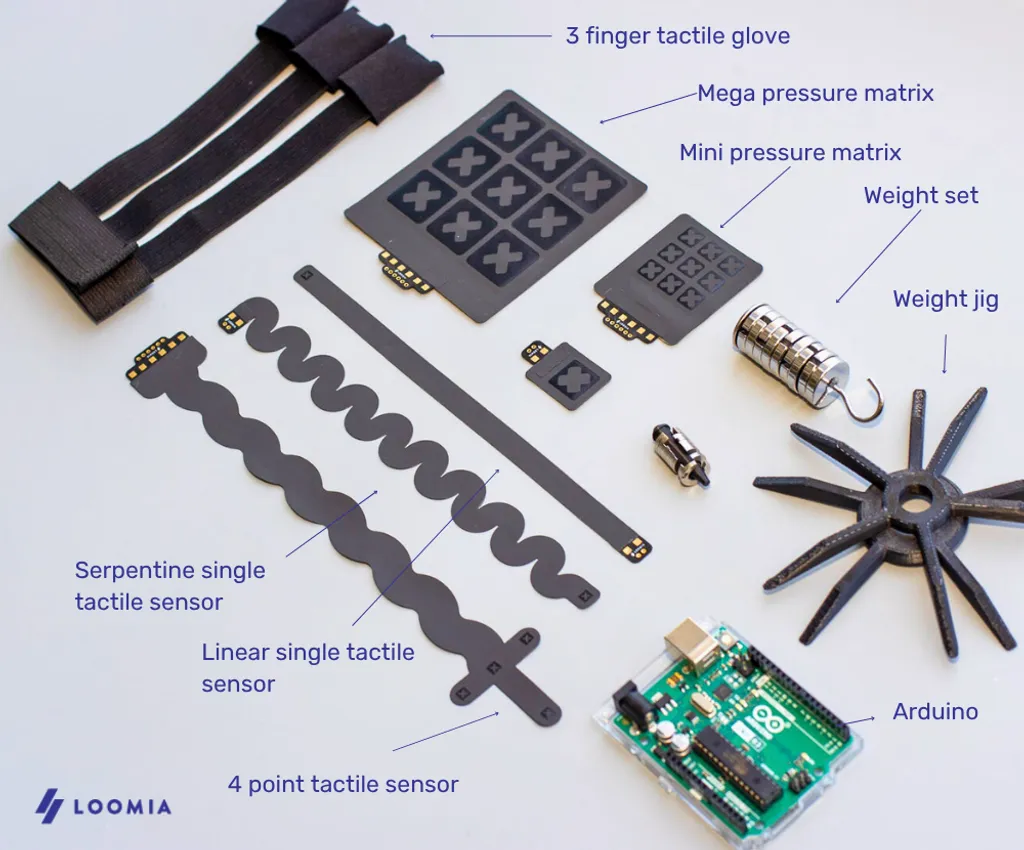
Loomia’s core product is the Loomia Electronic Layer (LEL), an ultra-thin flexible circuit that bonds directly into leather or fabric rather than sitting on a rigid printed-circuit board — the same category of embedded-electronics manufacturing Unichem already does for automotive seat-heating systems, just applied to sensing instead of heating. Founded in 2014 by Stanford engineering graduate Madison Maxey, Loomia turned that approach into the Smart Skin Tactile Sensing Dev Kit, a $9,800 kit (currently sold out, waitlist only) pairing two sensor types: capacitive sensors for the light end (0.01N-1.0N, 1mm thick, 100Hz sample rate, suited to detecting first contact), and force-sensitive-resistor sensors for higher loads (0.1N-5N, 0.5mm thick, 10Hz, suited to grip force once an object is held).
Loomia states — a company claim worth flagging as such, not an independently benchmarked figure — that the LEL detects both vertical pressure and shear force, the sideways slip that signals an object is starting to move in the gripper, a distinction rigid printed sensors typically don’t make well. For a robot hand deciding whether to tighten its grip or whether an object is sliding, shear detection is arguably the more useful signal.
The precedent this desk cares about: Festo, 2018
The detail that separates this from a purely humanoid story is buried a few paragraphs into Loomia’s own product page: in 2018, Loomia built a glove-based pressure matrix for Festo, the German pneumatics and industrial-automation maker, to let a robotic hand handle soft, easily damaged items — apples and fabric are the examples given — without crushing them. That’s a genuine gripper-level deployment predating the current wave of humanoid “electronic skin” announcements by roughly six years, and it frames what tactile sensing is for on a factory floor. A rigid two-jaw gripper handling metal stampings doesn’t need shear detection; one handling soft, variable, or fragile goods — food, textiles, packaged consumer items — does, because the alternative is crushing or dropping the object. That’s the one concrete data point here that isn’t a forward-looking claim about humanoid robots that don’t yet exist commercially.
Who’s buying, and why
Unichem, founded in 1976 and based in Ansan, South Korea, makes natural leather goods for automotive interiors, supplying seat-heating systems for Volkswagen Group vehicles through seat-parts supplier Sabelt. In its own blog statement, carried on Loomia’s site, Unichem framed the deal in language worth treating as aspiration rather than settled fact: “The acquisition of Loomia is the starting point for Unichem to transition beyond a simple automotive interior materials manufacturer into an intelligent smart materials company that combines materials and electronic technology.” Unichem’s stated ambition extends into humanoid robot hands and electronic skins, medical devices, wearables, and AI data-center thermal management — a broad diversification pitch from a company whose proven business today is automotive leather.
Loomia is also a member of the HAND ERC, a National Science Foundation-backed consortium — Human AugmentatioN via Dexterity Engineering Research Center — whose members include Meta and Amazon Robotics. That’s consortium membership, stated by Unichem, not confirmation either company uses Loomia’s sensors in a shipping product; it signals proximity to well-funded robotics programs, nothing more specific.
An unnamed Unichem executive, described in The Robot Report’s account as “in charge of strategy,” said: “Loomia’s core technology will become the core hardware of the tactile revolution, going beyond just vision to drive innovation in robotics.” That “beyond just vision” framing is a real, if company-articulated, point: industrial robots with built-in vision have become common for locating and identifying parts, but vision alone can’t tell a gripper how hard it’s squeezing.
Leadership, and where tactile sensing lands first
Post-close, Madison Maxey and Kim Han-joo, Unichem’s chief science officer, will serve as co-CEOs. Both companies say they intend to retain Loomia’s engineering team, folding it into a new North American R&D and U.S. market-entry hub for Unichem — a structure that reads as an acquihire-plus-technology deal as much as a straightforward buyout, given the deal’s size.
Separately, The Robot Report notes Loomia has an existing manufacturing partnership with R&Y Corp., a Tier 1 automotive technology firm founded in 2022, which plans to deliver a first engineering sample in January 2027 targeting Tesla, OpenAI, Boston Dynamics, 1X Technologies, and Meta as prospective customers. That’s R&Y’s own timeline, not a Unichem-Loomia product commitment — worth keeping distinct from the acquisition itself.
If tactile e-skin does move from dev kits into production robots, the more plausible near-term entry point for an industrial-automation reader isn’t a humanoid at all — it’s the collaborative robot segment, where machines already work near people and soft or variable-geometry parts handling is common. A cobot arm fitted with shear-sensitive gripper skin could adjust grip force in real time on parts that vary slightly in shape or fragility, the same problem the 2018 Festo pilot solved for apples and fabric, at industrial scale rather than dev-kit scale.
Sources
- Unichem acquires Loomia to accelerate entry into the humanoid 'skin' market — The Robot Report, Aug 18, 2026
- Loomia's Next Chapter as Part of Unichem — Loomia Technologies Inc. (company blog), Aug 4, 2026
- Smart Skin Tactile Sensing Dev Kit — Loomia Technologies Inc. (product page), Aug 4, 2026
Frequently asked questions
What does Loomia actually make? +
The Loomia Electronic Layer (LEL), an ultra-thin flexible circuit that bonds into leather or fabric rather than sitting on a rigid printed-circuit board. Its commercial product, the Smart Skin Tactile Sensing Dev Kit ($9,800, currently sold out), combines capacitive sensors (0.01N-1.0N range, 1mm thick, 100Hz sample rate) with force-sensitive-resistor sensors (0.1N-5N range, 0.5mm thick, 10Hz), so a single kit covers both light-touch precision and higher-force grip.
What are the actual deal terms? +
Unichem is acquiring 100% of Loomia's shares for about 8.6 billion Korean won (~$6 million USD), equal to 6.5% of Unichem's capital, paid as $4 million cash, $1 million in Unichem common stock, and $1 million in earn-out claw-backs. Unichem expects to close the acquisition October 15, 2026, through a reverse triangular merger with a newly formed subsidiary.
Has this technology actually been used on an industrial robot before, or is this just humanoid hype? +
Yes, on a real industrial gripper. In 2018, Loomia built a glove-based pressure matrix for Festo, a major pneumatics and industrial-automation maker, to let a robotic hand handle soft items like apples and fabric without crushing them. That's a genuine, if small-scale, precedent for gripper-level tactile sensing predating the current humanoid-skin wave by several years.
Who runs the combined company, and what happens to Loomia's team? +
Madison Maxey, Loomia's founder, and Kim Han-joo, Unichem's chief science officer, will serve as co-CEOs post-close. Both companies have said they plan to retain Loomia's engineers as part of a new North American R&D and U.S. market-entry hub for Unichem.
More news