Which Industrial Robots Ship With Built-In Vision (And Which Don't)
Only 18 of the 339 robots in our database ship with a factory-integrated vision system. Twelve of those are Techman. Here is exactly who builds a camera into the arm, and why the other 321 rely on a bolt-on system instead.
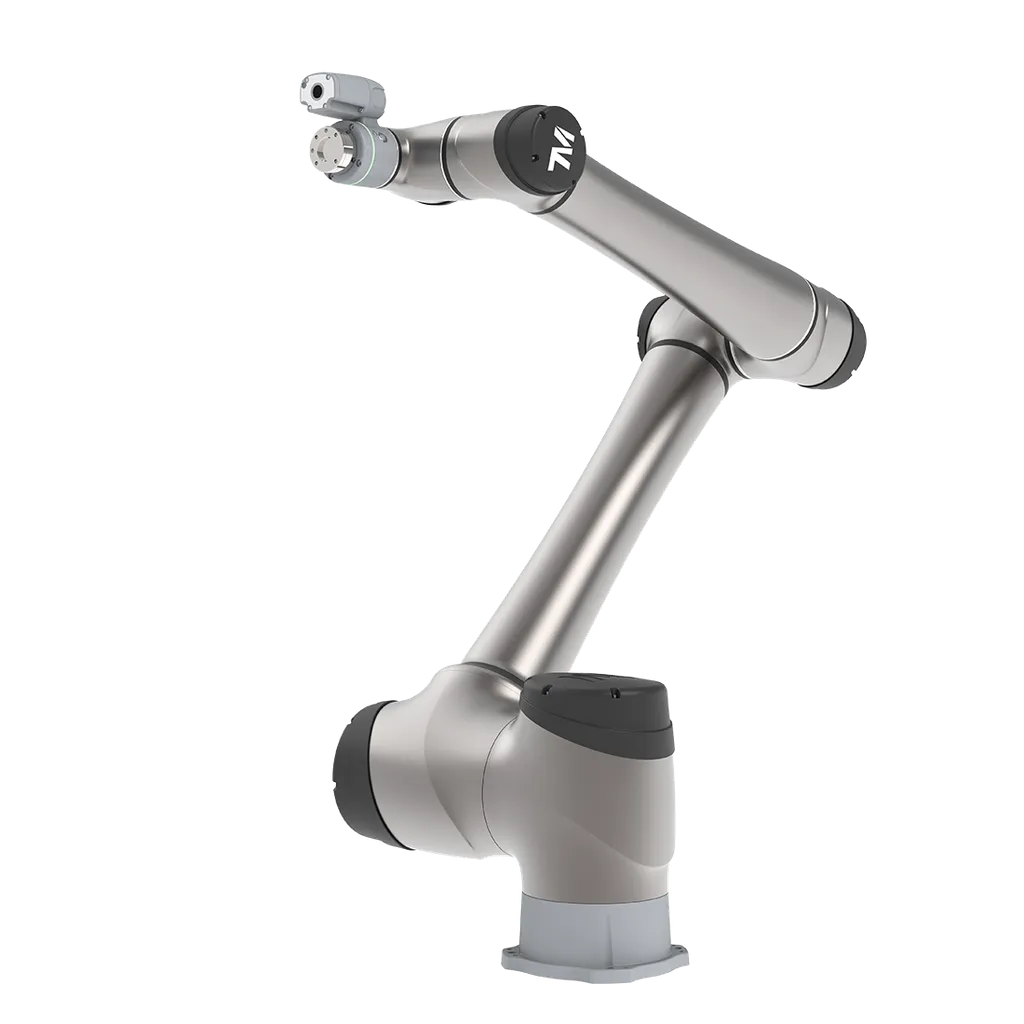
Ask a robot manufacturer whether their arm “does vision” and almost every one of them will say yes. Ask whether the camera is actually built into the robot you are buying, standard, no separate line item, and the honest answer from most of them is no. We checked our own 339-robot database to find out how rare a genuinely integrated system is: 18 robots, 5.3% of the catalog, ship with vision built in. Twelve of those eighteen are made by one brand.
That is not a knock on the other 321. Vision-guided robotics is a mainstream, well-supported application across nearly every brand we track, FANUC’s iRVision and ABB’s RobotStudio vision tools are both mature, widely deployed systems. But in the vast majority of cases, the camera itself is a separate purchase and a separate integration step, bolted onto the wrist or mounted over the cell, not something that arrives already fitted to the arm. This piece is about that specific, narrower fact: who builds the camera in, and who leaves it to you.
The full list: 18 robots, 4 brands
We filtered the database for connectivity.integratedVision === true and hand-checked every result against its own product page before publishing this list.
| Robot | Brand | Type | Payload | Reach |
|---|---|---|---|---|
| TM5-700 | Techman | Cobot | 4 kg | 700 mm |
| TM5-900 | Techman | Cobot | 4 kg | 900 mm |
| TM5S | Techman | Cobot | 5 kg | 900 mm |
| TM6S | Techman | Cobot | 6 kg | 1,800 mm |
| TM7 | Techman | Cobot | 7 kg | 900 mm |
| TM7S | Techman | Cobot | 7 kg | 900 mm |
| TM14 | Techman | Cobot | 14 kg | 1,100 mm |
| TM16 | Techman | Cobot | 16 kg | 900 mm |
| TM20 | Techman | Cobot | 20 kg | 1,900 mm |
| TM20S | Techman | Cobot | 20 kg | 1,300 mm |
| TM25S | Techman | Cobot | 25 kg | 1,300 mm |
| TM30S | Techman | Cobot | 30 kg | 1,702 mm |
| YuMi IRB 14000 | ABB | Cobot (dual-arm) | 0.5 kg/arm | 559 mm |
| YuMi IRB 14050 | ABB | Cobot (single-arm) | 0.5 kg | 559 mm |
| IRB 390 FlexPacker | ABB | Delta | 15 kg | 1,500 mm |
| Elfin E05-Pro | Hans Robot | Cobot | 5 kg | 800 mm |
| Elfin E10L-Pro | Hans Robot | Cobot | 8 kg | 1,300 mm |
| M-3iA/6S | FANUC | Delta | 6 kg | 1,350 mm |
By brand: Techman 12, ABB 3, Hans Robot 2, FANUC 1. Sixteen of the eighteen, 89%, are collaborative robots. The other two, the ABB FlexPacker and the FANUC M-3iA, are delta robots built for exactly the task where built-in vision earns its keep fastest: tracking randomly-oriented parts on a moving conveyor belt.
Techman built its whole brand around this one decision
Twelve of the eighteen robots on this list, two-thirds of every integrated-vision robot we track, come from a single manufacturer. That is a consistent product decision, not a coincidence of one or two models: every Techman cobot in our database, from the 4 kg TM5-700 up through the 30 kg TM30S added this year, pairs the same wrist-mounted stereo camera with the same TMflow vision software as a standard part of the robot. There is no Techman cobot in the catalog without it, and no version of any Techman model sold without the camera as a cost option you can decline.
That is a genuinely different design philosophy from every other cobot brand we track. Universal Robots, the volume leader in collaborative robots, sells zero robots with a factory-fitted camera, plenty of UR cells run vision-guided, but every one of them added a camera (typically a third-party model from Zivid, Photoneo, or a similar vision-systems vendor) as a separate integration line item. The same is true of AUBO, JAKA, Doosan, and every other cobot brand in the database except Techman and Hans Robot. If vision-guided bin picking or flexible part inspection is central to your application, that difference is worth pricing into a comparison directly, not discovering after you have already selected a robot on payload and reach alone.
Why the other 321 robots aren’t at a disadvantage
It would be easy to read an 18-robot list and conclude that 94.7% of the industry is behind on vision. That is not what this data shows. Vision-guided robotics is one of the most common applications across the whole catalog, our own pick-and-place robots guide and inspection robots guide both lean heavily on vision-guided models from brands that build nothing into the arm itself.
FANUC’s iRVision, ABB’s RobotStudio vision tools, and comparable software from KUKA, Yaskawa, and Mitsubishi are mature, widely deployed vision stacks used on thousands of production lines. What none of those brands do, outside the two FANUC and three ABB models above, is bundle the physical camera into the robot’s base configuration. You buy the arm, then you buy and mount a camera, then you integrate the two, usually with the manufacturer’s own recommended hardware and software, but as a distinct project phase with its own cost and its own commissioning time. That is the industry default. Techman’s all-in-one approach is the exception, not the norm the other 321 robots are failing to meet.
What this actually changes for a shortlist
The practical question is not “does this robot support vision,” almost every serious brand will say yes. It is whether the camera ships with the robot or gets added afterward, and that changes three things on a real quote:
- Upfront cost structure. A Techman or Hans Robot quote already includes the vision hardware. A quote for a UR, FANUC, or ABB arm (outside the FlexPacker/M-3iA) for the same vision-guided task will carry a separate camera and integration line, often from a third-party vendor, that is easy to underestimate if you are comparing sticker prices for the arm alone.
- Calibration and support ownership. When the camera is factory-integrated, the robot manufacturer owns the whole stack, and one support call covers both the arm and the vision system. When it is bolted on, you are managing two vendors and two support paths if something in the vision pipeline stops working.
- Time to first vision-guided motion. A pre-integrated system is running vision-guided picks close to out-of-the-box. A bolt-on system needs mounting, lighting, calibration, and software integration before it does the same job, real project time that a payload-and-reach comparison alone won’t surface.
None of that makes a bolt-on system the wrong choice. If your application only occasionally needs vision, or you already have a preferred vision vendor and integrator relationship, paying for an integrated camera on every robot you buy is money spent on a capability you would rather source and configure yourself. The point is not integrated-versus-bolt-on as better-or-worse, it is that this is a real design difference between eighteen robots and everything else in the catalog, and it deserves the same explicit line on your shortlist that payload and IP rating already get.
For a wider look at how Techman’s approach compares against the rest of the collaborative-robot field, see our Techman robots guide and best cobots for machine tending roundup, both of which cover the vision question in the context of a full buying decision rather than this narrow cross-brand cut.
Frequently asked questions
How many industrial robots come with built-in vision? +
18 of the 339 robots in our database, 5.3%, ship with a factory-integrated vision system as a standard feature of the robot or its controller. The rest can still run vision-guided applications, but only by adding a third-party camera and vision software as a separate integration step.
Which brand builds vision into every robot it sells? +
Techman. All 12 of its cobots, from the entry-level TM5-700 up to the 30 kg TM30S, ship with the same wrist-mounted stereo camera and TMflow vision software as a standard, non-optional part of the robot. It is the brand's core design decision, not an add-on tier.
Does 'no integrated vision' mean a robot can't do vision-guided work? +
No. Vision-guided picking, inspection, and bin picking are common applications for robots that have no camera built in. Brands like FANUC, ABB, and UR sell into those applications constantly, using their own vision software (iRVision, RobotStudio, and similar) paired with a third-party or robot-manufacturer camera bolted to the wrist or mounted overhead. The difference is who pays for and integrates the camera: the manufacturer at the factory, or you at commissioning.
What kinds of robots have integrated vision besides cobots? +
Two delta robots in our database ship with built-in vision as standard: the ABB IRB 390 FlexPacker and the FANUC M-3iA/6S. Both are high-speed pick-and-place robots designed to track parts moving on a conveyor, a task that depends on vision so directly that both manufacturers build the camera into the base package rather than treat it as optional.
Compare these robots