FANUC's New 2,300 kg Robot Is 1,500 kg Lighter
FANUC's new M-2000iA/2300 is now the heaviest robot in our 425-robot database at 2,300 kg, yet it weighs 1,500 kg less than the record it broke.
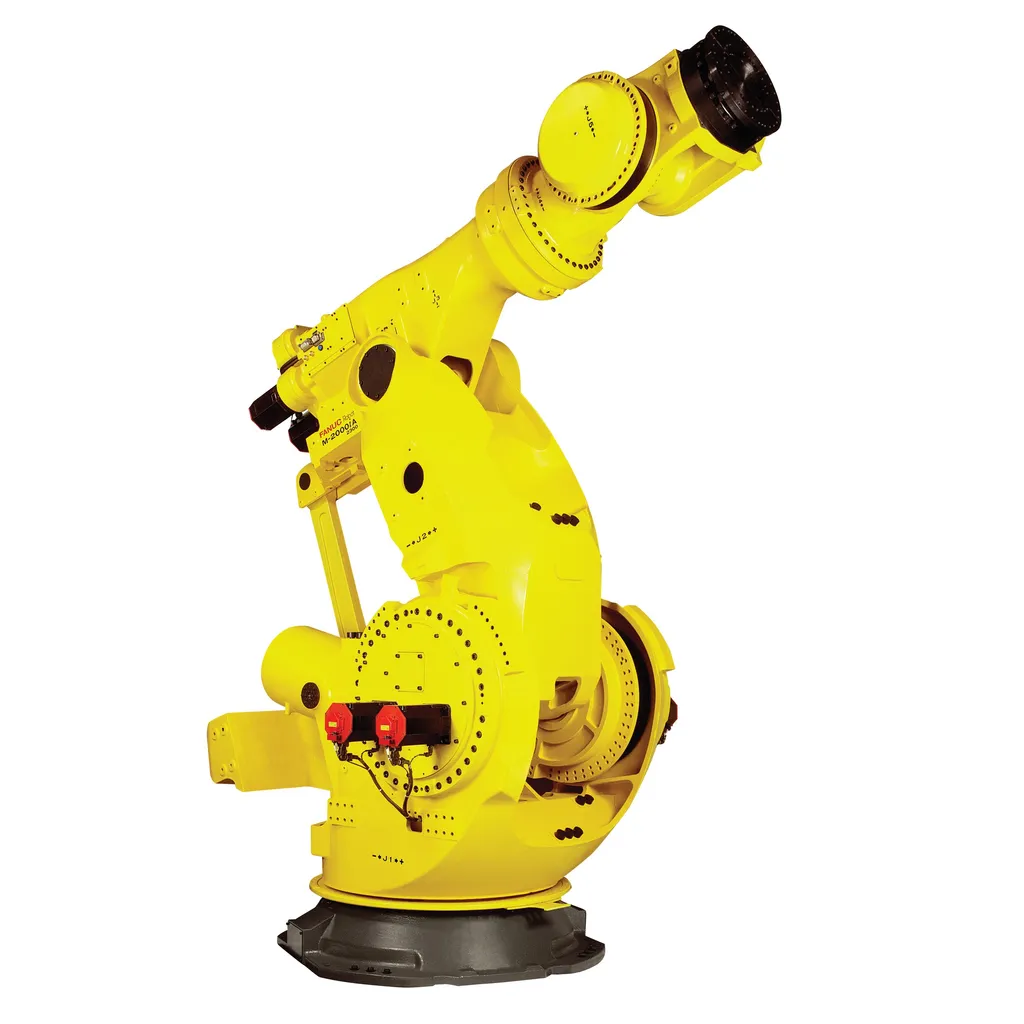
FANUC just added the heaviest robot in our 425-robot database. The M-2000iA/2300 is rated for 2,300 kg of payload, 600 kg more than the previous record holder, FANUC’s own M-2000iA/1700L. Here’s the part that should not be true on paper: the new record-setter weighs 11,000 kg, which is 1,500 kg lighter than the 12,500 kg machine it just replaced at the top of the list. More payload, less iron. That is not how heavy industrial robots usually get heavier.
What’s the heaviest robot in our database now?
We recompute this ranking every time it matters, because the answer moves. As of today, sorted by performance.payloadKg across all 425 robots (424 of which publish the field), the top of the table looks like this:
| Rank | Robot | Brand | Type | Payload | Reach |
|---|---|---|---|---|---|
| 1 | M-2000iA/2300 | FANUC | Articulated | 2,300 kg | 3,734 mm |
| 2 | M-2000iA/1700L | FANUC | Articulated | 1,700 kg | 4,683 mm |
| 3 | HD-1500 | Omron | AMR | 1,500 kg | n/a (wheeled) |
| 4 | M-1000iA | FANUC | Articulated | 1,000 kg | 3,253 mm |
| 4 | KR 1000 TITAN | KUKA | Articulated | 1,000 kg | 3,202 mm |
| 6 | MD-900 | Omron | AMR | 900 kg | n/a |
| 7 | ER700-2800 | Estun | Articulated | 700 kg | 2,800 mm |
| 7 | M-410iB/700 | FANUC | Palletizer | 700 kg | 3,143 mm |
| 9 | MD-650 | Omron | AMR | 650 kg | n/a |
| 10 | IRB 7720-620/2.9 | ABB | Articulated | 620 kg | 2,900 mm |
Source: our analysis of 425 robots in the Industrial Robotics Hub database.
FANUC now holds the top two spots outright, and by a wide margin. Rank 3 belongs to Omron’s HD-1500, a wheeled AMR, not a fixed arm, and rank 4 is a 1,300 kg drop from the new leader. The gap between #1 and #2 alone, 600 kg, is bigger than the entire payload of the #4 robot on this list. More on that AMR entry, and another wheeled contender that’s been chasing this number lately, further down.
How does FANUC fit more payload into a lighter robot?
Payload and mechanical weight both matter to a buyer, but they matter for different reasons: payload tells you what the robot can lift, weight tells you what your foundation, crane, and floor loading plan need to handle. FANUC’s two M-2000iA flagships split those two numbers in an unusual direction.
| Spec | M-2000iA/2300 | M-2000iA/1700L |
|---|---|---|
| Payload | 2,300 kg | 1,700 kg |
| Reach | 3,734 mm | 4,683 mm |
| Mechanical weight | 11,000 kg | 12,500 kg |
| Repeatability | ±0.18 mm | ±0.27 mm |
| Axes | 6 | 6 |
| Payload-to-weight ratio | 20.9% | 13.6% |
The “L” in 1700L stands for long-reach, and it earns that name: 4,683 mm of reach against the 2300’s 3,734 mm, nearly a meter more. That’s the real tradeoff here, not a flaw. FANUC built two different tools for two different jobs, one that reaches further with less payload and one that lifts more within a tighter envelope. They are not the same machine with a different sticker.
Run the ratio anyway, because it’s the number that tells you how efficiently each machine turns mass into capacity. The 2300 moves 2,300 kg from 11,000 kg of steel, a 20.9% payload-to-weight ratio. The 1700L moves 1,700 kg from 12,500 kg, 13.6%. That’s a 1.54x gap, the 2300 is 54% more efficient by this measure, despite carrying 600 kg more.
Zoom out to the whole database and the number gets more interesting. The median payload-to-weight ratio across all 175 articulated arms that publish both figures is 14.0% (full breakdown in payload-to-weight ratio by type). The M-2000iA/2300, the single heaviest arm in the class, beats that median by about 49%. Heavier does not mean less efficient here. If anything, FANUC’s newest flagship is proof that a bigger number on the payload spec sheet doesn’t have to come with a proportionally bigger number on the crane rental invoice.
Spec sheets lie, even the manufacturer’s own
Here’s an honest complication. Our own database’s stored record for the 1700L, scraped 2026-07-16, currently holds 3,734 mm reach and 11,200 kg weight, different from what FANUC’s own live product page shows today: 4,683 mm and 12,500 kg. That’s not a typo on our end. It’s a real discrepancy between what FANUC published then and what FANUC publishes now, and it’s exactly the kind of thing a spec-sheet skeptic should flag rather than quietly average away.
I pulled both FANUC pages myself today, raw HTML, not an AI summary of a summary, specifically to avoid that trap: FANUC’s current M-2000iA/2300 product page and its current M-2000iA/1700L product page. The numbers used throughout this article are the live ones. Our stored 1700L record needs a refresh, and that’s now flagged for the data-enrichment side of this operation rather than fixed here. Every “heaviest robot” claim in this database, including the one in this article’s headline, is only as good as its last verification against the manufacturer, not its last scrape date.
Does this beat the rising AMR payload claims?
Fixed arms have had company at the top of the payload leaderboard lately. On 2026-08-23 we covered Pudu Robotics’ MP2000, an AI-native autonomous mobile robot claiming 2,000 kg of payload, a vendor spec that would have ranked #2 in our whole database at the time, behind only the 1700L. The M-2000iA/2300, at a verified 2,300 kg, now decisively beats that AMR claim too, by 15%, and reasserts the fixed arm’s lead by a wider margin than before Pudu ever made the claim.
The decision this actually informs
A payload record on a spec sheet, ours or the manufacturer’s, is only as fresh as its last verification. If you’re specing a foundation, a crane, or a rigging plan around a “heaviest robot we carry” claim, pull the number from the live manufacturer page the same day you plan around it. Don’t trust a cached database, including this one, and don’t assume “heavier” and “less efficient” travel together. For the M-2000iA/2300, they don’t. For a full breakdown of how payload trades against reach across the articulated class, see our articulated robot selection guide by payload and reach.
Compare these robots