Three Ways to Scale a Robotics Business, One Week Apart
Hyundai, NEURA and Corvus chose three different ways to scale robotics this week, while a patent fight escalated and humanoids went live in Korea.
Eight stories crossed this desk between August 30 and September 5, and the throughline isn’t any single deal, it’s how differently robotics companies are choosing to grow. A car company committed factory capacity to build robots domestically; a German startup used a record raise to keep buying finished companies; a small drone maker raised a modest round priced on real usage; two cobot rivals turned a patent fight into a dispute over what they’re allowed to say about each other; a Korean logistics giant put humanoids on a live line; and AI showed up in two forms, rugged silicon for factory infrastructure and cloud reasoning bolted onto existing arms. Read together, it’s a snapshot of an industry that hasn’t settled on one playbook.
Three theories of how to scale
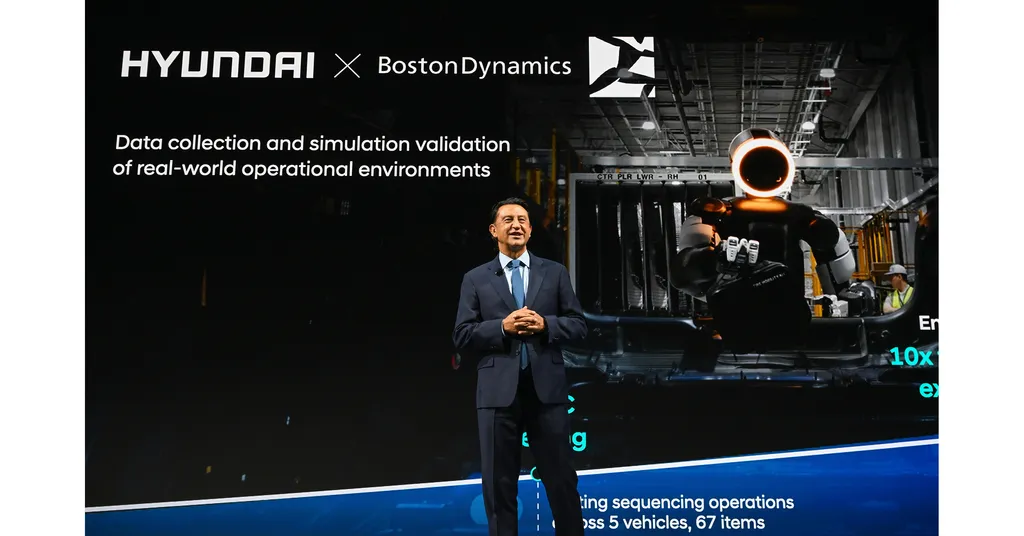
Hyundai is betting on owned capacity. At its August 26 investor day, it said US robot production begins in 2028 at 30,000 units of annual capacity, and its Robot Metaplant Application Center (RMAC) in Savannah, Georgia will expand more than tenfold by year’s end. That sits on a July move few noticed: Hyundai bought out SoftBank’s remaining Boston Dynamics stake for roughly $325 million, making the humanoid maker wholly owned five years after Hyundai’s original $1.1 billion stake. It’s automotive-scale capital funding a slow buildout, with Atlas not reaching the factory floor for parts-sequencing until that same 2028 target.
NEURA Robotics is betting on assembly by acquisition. Its purchase of German cleaning-robot maker Adlatus, announced August 24, is NEURA’s fifth acquisition in 16 months, per independent PitchBook reporting, following a controls integrator, a mobile-robotics business, an automotive engineering division, and Bosch Rexroth’s AGV unit. Each deal alone looks like a bolt-on; together they read as a company using its $1.4 billion June Series C to buy platform coverage across “boring” robot categories, unified under one software layer, the Neuraverse. NEURA says the platform will stay open to other manufacturers’ hardware; so far, none is named as connected.
Corvus Robotics is the outlier, and the more telling contrast. Its $20 million raise, alongside a CEO transition to co-founder Mohammed Kabir, brings total funding to just $38 million since 2017, a rounding error next to Hyundai’s capacity commitment or NEURA’s war chest. What justifies the round is usage, not a technology bet: over 300 inventory-counting drones now fly warehouse aisles across 26 states, Canada and Mexico, scanning a million-plus locations a month, with customers like Southern Glazer’s and Dermalogica citing company-reported discrepancy counts and frequency gains. Investors are pricing deployed data, not a roadmap.
The patent fight stops being about patents
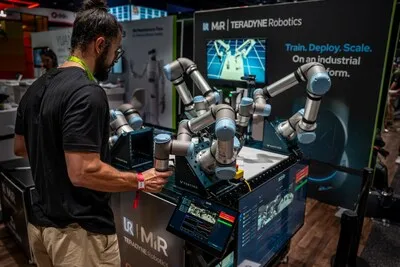
The Teradyne-JAKA dispute took a stranger turn than the original August 28 filing suggested. Teradyne Robotics sued JAKA’s German subsidiary at the Unified Patent Court’s Copenhagen division, alleging infringement across JAKA’s EU-marketed cobots. Rather than fight the patent claims directly, JAKA countered by seeking an injunction against Teradyne’s public statements, saying it had received no actual court filing as of September 2, despite Teradyne’s announcement a week earlier. Universal Robots CTO David Brandt, responding for Teradyne, said the case has been filed in Copenhagen and any delay is ordinary processing. JAKA leaned on 300-plus patents of its own and two clean freedom-to-operate reviews; Brandt’s rebuttal was pointed, patent count is irrelevant to whether JAKA’s mechanisms cross Teradyne’s specific claims. Nothing here resolves the infringement question. What’s new is the stakes: a UPC ruling, should Teradyne prevail, could restrict JAKA’s sales across roughly 19 European countries at once, the leverage now driving a public-messaging fight before any judge rules.
Humanoids get a paycheck, not a stage
CJ Logistics, South Korea’s largest logistics company, put two dual-arm humanoid robots on a live packaging line at an Olive Young fulfillment center starting September 3, inserting cushioning material into shipping boxes moving through real customer orders. The hardware comes from Robotis, the dexterous hands from Aidin Robotics, and the perception and task-planning model from RLWRLD, in which CJ Logistics is itself a reported investor. The task is deliberately narrow: cushioning insertion tolerates loose placement, and a misjudged fill doesn’t stop the line, exactly why it’s a sensible first foothold rather than a stunt. Set against Hyundai’s still-2028 Atlas timeline and LG and NVIDIA’s 2027 factory-humanoid pilot, CJ Logistics’ robots are already earning their keep on a real order today, on a task chosen so a mistake costs little. The company calls it Korea’s first live logistics humanoid deployment; that framing is CJ’s own and unverifiable from outside, but the underlying fact, a humanoid on actual customer orders rather than a demo floor, is real.
AI arrives in two very different sizes
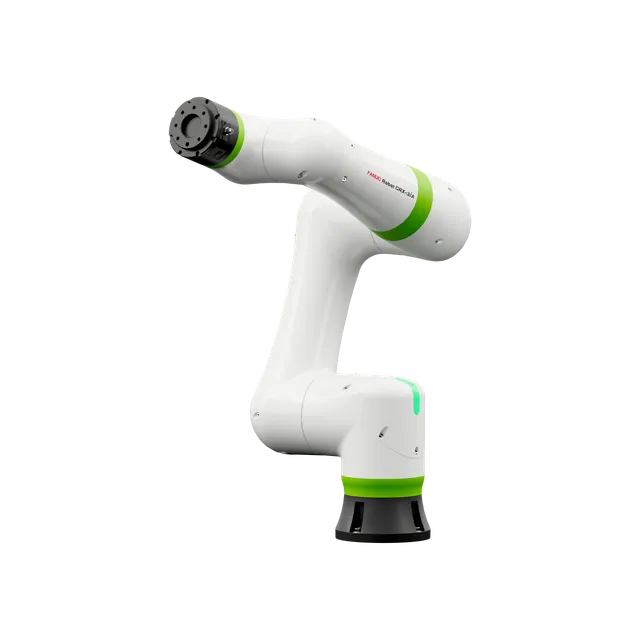
FANUC’s IMTS 2026 preview and Qualcomm’s Dragonwing IQ-2390 launch landed days apart and describe opposite ends of how AI is reaching factory floors. Qualcomm’s chip targets infrastructure that has never run a neural network on-device before, PLCs, gateways, machine-vision boxes, trading AI horsepower for toughness: a -30°C to +115°C rating and deterministic Ethernet, at just 1.1 TOPS against the 78 TOPS NVIDIA claims for its Jetson Orin Nano 2. No robot maker appears in Qualcomm’s materials. FANUC’s announcement is the inverse: no new silicon, but four partnerships, Google Cloud, NVIDIA’s Isaac Sim inside ROBOGUIDE, AWS predictive maintenance, and an Inbolt bolt-tightening demo, layered onto existing hardware plus a genuinely new R-50iA controller letting CRX cobots run off 24-48V battery power without a separate inverter, a real unlock for cobot-on-AMR builders. AI is arriving as minimal edge compute where there was none, and as cloud reasoning bolted onto robots already built, not yet one new class of hardware.
The quieter thread: paying for uptime
REWE’s new maintenance contract with Cimcorp is the smallest story of the week and arguably the most honest one. Nothing about the gantry-robot system moving produce through REWE’s Oranienburg hub, serving 950 retail locations, is new; it’s run for years. What’s new is REWE paying separately, through Cimcorp’s “Success Services,” for twice-yearly preventive maintenance, remote diagnostics, and six-day onsite support. It’s thinly sourced, mostly Cimcorp’s own pages, but it lands next to Corvus’s usage-priced round as a second signal: once a system is genuinely load-bearing, the harder sell isn’t the hardware, it’s guaranteed uptime.
Sources
- Hyundai Motor Company Charts Profit-Driven Growth Roadmap at 2026 CEO Investor Day — PR Newswire / Hyundai Motor Company, Aug 26, 2026
- Hyundai seeks to diversify revenue with its latest robotics acquisition — Manufacturing Dive, Aug 28, 2026
- NEURA Acquires ADLATUS Robotics, Bringing Physical AI to Professional Cleaning — NEURA Robotics (official), Aug 24, 2026
- Neura Robotics Acquires Adlatus to Build Out Physical AI — PitchBook News (via Yahoo Finance), Aug 24, 2026
- Corvus Robotics Names Co-Founder Mohammed Kabir Chief Executive Officer — Corvus Robotics, Aug 25, 2026
- JAKA hits Teradyne Robotics back over patent dispute — The Robot Report, Sep 3, 2026
- Collaborative robot leader Teradyne Robotics files patent infringement against Chinese robot competitor at European Court — Universal Robots, Aug 27, 2026
- CJ Logistics deploys humanoid robots at warehouse in Korean first — Seoul Economic Daily, Sep 3, 2026
- Qualcomm Introduces Dragonwing Q-2390 and IQ-2390 Processors, Expanding Access to Intelligent Connected Devices — WebWire (Qualcomm Technologies press release), Sep 1, 2026
- Qualcomm introduces Dragonwing Q-2390 and IQ-2390 for consumer and industrial AIoT applications — CNX Software, Sep 1, 2026
- FANUC America Brings Robotics, Automation, Physical AI and CNC Innovation to IMTS 2026 — PR Newswire / FANUC America Corporation, Sep 3, 2026
- REWE elevates supply chain reliability with Cimcorp's Success Services — Cimcorp Group, Aug 24, 2026
- REWE adds Cimcorp's Success Services to elevate supply chain reliability — Robotics 24/7, Aug 31, 2026
Robots mentioned
Tap a card to open the full spec sheet.

Frequently asked questions
What ties Hyundai's factory buildout, NEURA's acquisitions, and Corvus's funding round together this week? +
All three are robotics companies raising or deploying capital, but toward opposite theories of growth. Hyundai is spending on physical capacity (a 2028 US robot-production line, a tenfold RMAC expansion) funded by its automotive business. NEURA is buying finished companies (Adlatus is its fifth acquisition in 16 months) with a record €1.2 billion Series C. Corvus raised a comparatively small $20 million round, priced by investors on deployed usage, over 300 drones already scanning a million-plus warehouse locations a month, rather than on future capability.
Did a court actually rule on the Teradyne-JAKA patent dispute this week? +
No. Teradyne Robotics filed a patent-infringement case against JAKA's German subsidiary at the Unified Patent Court on August 28. This week, JAKA said it had received no formal court filing and countered by seeking an injunction against Teradyne's public statements about the case, not against the underlying patent claims. Universal Robots CTO David Brandt said the case has been filed in Copenhagen and any delay is normal processing time. The infringement question itself remains undecided.
Are CJ Logistics' humanoid robots doing general warehouse work? +
No. The two dual-arm robots at CJ Logistics' Olive Young fulfillment center handle one narrow task, inserting cushioning material into shipping boxes, chosen specifically because the tolerance for error is loose and a misstep doesn't stop the line. CJ Logistics has stated intentions to expand toward picking, sorting and inspection, but has not disclosed a timeline or performance figures for the current deployment.
Is Qualcomm's new Dragonwing chip meant to power robots? +
No. The IQ-2390 targets fixed factory infrastructure, PLCs, gateways, HMIs and machine-vision systems, not robot controllers or actuators. Its 1.1 TOPS of AI compute is roughly 70 times less than the 78 TOPS NVIDIA claims for its Jetson Orin Nano 2 edge module, a deliberate trade for a -30°C to +115°C rating and built-in deterministic networking that fixed infrastructure needs more than raw AI horsepower.
More news