Humidity Tolerance by Robot: Your IP Rating Does Not Cover It
An IP20 ABB SCARA with no ingress protection at all is rated to 95% relative humidity. An IP67 Estun arm, sealed against temporary immersion, is rated to 80%. Ingress protection and humidity tolerance are two separate specs, and only one of them appears in most people's shortlists.
If you are placing a robot near a washdown line, a chiller, a foundry door or anything else that moves the moisture in the air, you have probably already checked the IP rating. Check the humidity rating too, because it is a separate number and it does not follow the first one.
Of the 339 robots in our database, 105 publish an operating humidity ceiling. Ninety-three of those publish an IP rating as well. Across those 93, the two specs are close to independent: ABB’s IP20 IRB 910SC SCARA, which offers essentially no ingress protection, is rated to 95% relative humidity, while the IP67 ER7-910-MI from Estun and the IP67 HC10DTP from Yaskawa are both rated to 80%.
That is not a data error. It is what the two numbers actually mean.
The two specs answer different questions
An IP rating describes what happens when dust or liquid water arrives at the enclosure from outside. That is the subject of our IP rating guide and the wrist versus arm rating split, and it is the right spec for a hose-down or a coolant mist.
A humidity rating describes the water vapour the electronics are expected to live in continuously. Vapour does not need an opening to get in, and a seal that stops a jet of water does nothing about the dew point. The Semikron Danfoss application note on humidity and condensation in power electronics makes the underlying point plainly: relative humidity is a ratio between the partial pressure of water vapour and the saturation vapour pressure, and because the saturation pressure falls steeply as temperature drops, the relative humidity of a fixed volume of air rises when it cools even though the number of water molecules has not changed. Cool that air past its dew point and you get condensation on the coldest surface available, which inside a robot arm or a controller cabinet is usually a board.
So the failure mode behind the humidity ceiling is condensation and, over a longer horizon, corrosion of semiconductor passivation. Sealing the arm harder does not address it. That is why the two numbers move independently.
The crosstab, in full
Every robot in our database that publishes both an arm IP rating and a humidity ceiling, counted by tier.
| Arm IP rating | 75% RH | 80% RH | 85% RH | 90% RH | 95% RH | Models |
|---|---|---|---|---|---|---|
| IP20 | 4 | 5 | 9 | |||
| IP30 | 1 | 1 | ||||
| IP40 | 4 | 9 | 13 | |||
| IP54 | 2 | 7 | 2 | 17 | 7 | 35 |
| IP65 | 2 | 7 | 6 | 5 | 20 | |
| IP67 | 4 | 2 | 4 | 4 | 14 | |
| IP69K | 1 | 1 | ||||
| Total | 2 | 17 | 12 | 31 | 31 | 93 |
Read the IP54 row first. Thirty-five robots share that one ingress rating and they occupy every humidity tier in the table, from 75% to 95%. If IP rating carried humidity information, that row would cluster. It does not.
Then read the corners. The single IP69K machine in the dataset, ABB’s IRB 360 FlexPicker, is built for high-pressure high-temperature washdown and is rated to 95% RH. Five IP20 machines reach exactly the same 95% ceiling with none of the sealing. Meanwhile four IP67 arms sit at 80%, below IP20 machines. Sealing buys you washdown. It does not buy you vapour.
The five tiers
Across all 105 robots that publish a ceiling, regardless of whether they also publish an IP rating:
| Ceiling | Robots | Share | Who is there |
|---|---|---|---|
| 95% RH | 31 | 29.5% | All 13 rated ABB IRB arms, 9 Inovance IR-R articulated models, 6 Omron AMRs, all 3 Staubli |
| 90% RH | 31 | 29.5% | All 9 Universal Robots, all 9 AUBO, all 8 JAKA, 4 Omron SCARA and Viper arms, ABB IRB 365 |
| 85% RH | 16 | 15.2% | All 15 Kawasaki, ABB YuMi |
| 80% RH | 25 | 23.8% | All 10 Estun, 10 Inovance SCARA and IR-R10/R20, all 3 Siasun, KUKA LBR iiwa 14, Yaskawa HC10DTP |
| 75% RH | 2 | 1.9% | Both ABB GoFa CRB 15000 variants |
Sixty-two of 105, or 59%, are rated to 90% or above. For context, IEC 60204-1, the general standard for the electrical equipment of machines, sets its baseline expectation at relative humidity not exceeding 50% at a maximum temperature of 40 °C. The generic electronics climatic class 3K22 referenced in the Danfoss note allows 5% to 85% without condensation. Most robot arms are specified well above both, which tells you the manufacturers have deliberately engineered for humid plants rather than defaulting to the generic floor.
Humidity is a brand policy, not a model spec
This is the part that changes how you should shop for it. Ten brands in our data have at least three rated models. Seven of them publish exactly one ceiling across their entire rated lineup.
| Brand | Rated models | Published band | One policy? |
|---|---|---|---|
| Kawasaki | 15 | 35% to 85% | Yes, all 15 identical |
| Estun | 10 | 10-20% to 80% | Yes, one ceiling |
| Universal Robots | 9 | 0% to 90% | Yes, all 9 identical |
| AUBO | 9 | to 90% | Yes, one ceiling |
| JAKA | 8 | 0-10% to 90% | Yes, one ceiling |
| Staubli | 3 | 30% to 95% | Yes, all 3 identical |
| Siasun | 3 | 10% to 80% | Yes, all 3 identical |
| Inovance | 19 | 5-10% to 80 or 95% | No, two ceilings |
| Omron | 10 | 5% to 90 or 95% | No, two ceilings |
| ABB | 17 | 0-5% to 75, 85, 90 or 95% | No, four ceilings |
For seven of these ten brands, knowing the badge on the arm tells you the humidity number before you open the datasheet. Every Kawasaki in our data is 35% to 85%. Every Universal Robots arm is 0% to 90%, from the UR3e to the UR30. That is a corporate environmental-qualification decision applied lineup-wide, not a per-model engineering result, and it means switching models within a brand will almost never fix a humidity problem. Switching brands will.
ABB is the exception, and its cobots are the weak line
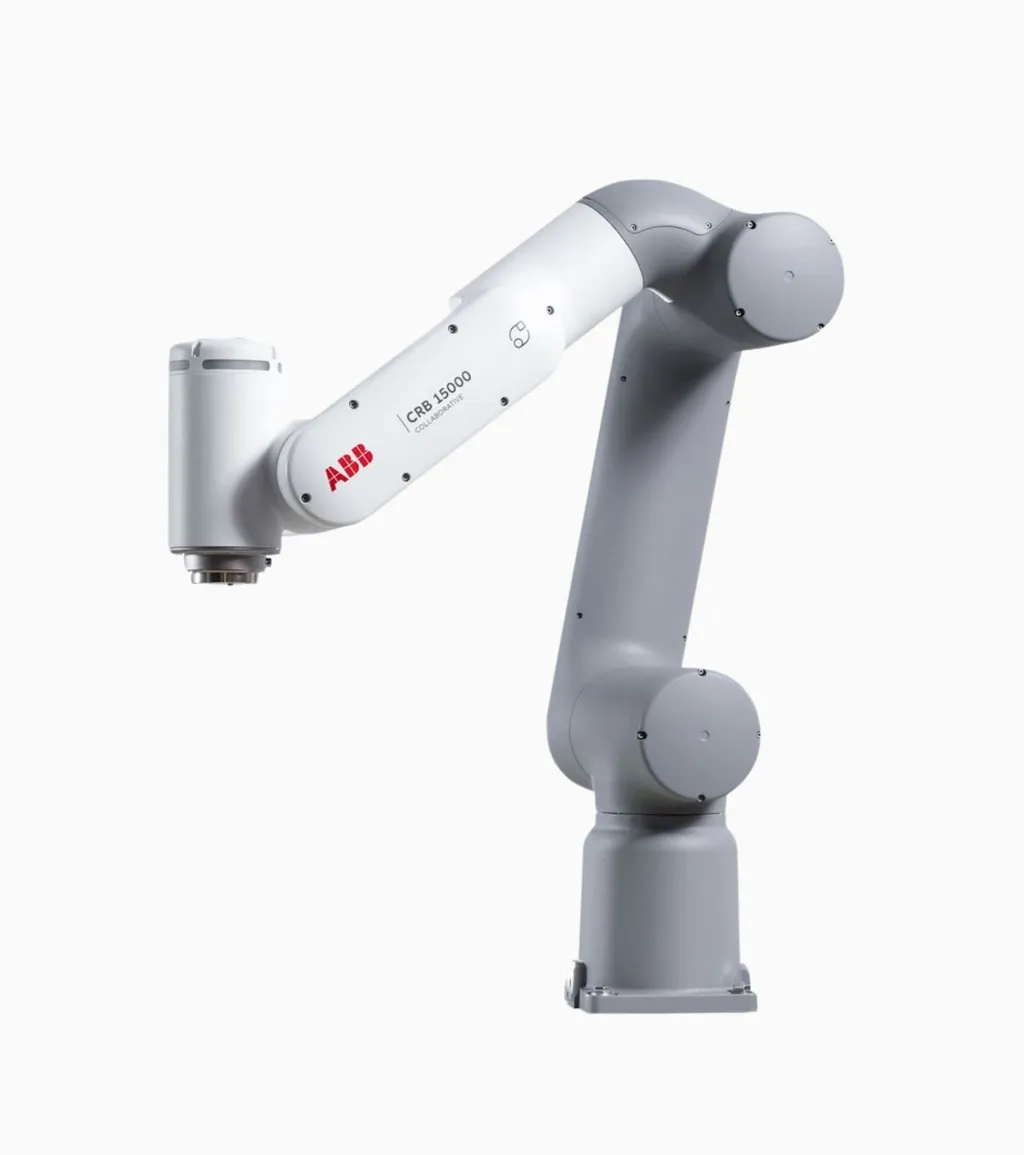
ABB publishes four different ceilings across 17 models, and the split runs opposite to intuition. Its traditional IRB industrial arms all sit at the 95% top tier, including the IRB 8700 and every IRB from the 1100 up to the 7600. Its collaborative robots sit at the bottom: YuMi at 85%, and both GoFa CRB 15000 variants at below 75%, the lowest continuous figure in the entire database.
If you assumed the cobot was the environmentally flexible choice because it is the one you can put anywhere, that is worth sitting with. It is the fenceless, easy-to-relocate arm that has the narrowest humidity envelope in ABB’s range.
ABB is also the only manufacturer here publishing a time-limited second tier rather than a single number. Its product specification 3HAC077390 for the CRB 15000 gives below 75% RH as the continuous operating ceiling, and separately allows below 95% RH “for limited period of time” of under one month. The same document notes that depending on climate and running conditions condensation may form on the inside of the plastic covers, and gives a remedy: the condensation clears on its own over time, or the user can open the covers and run a program for 12 hours to speed it up.
That is a better-specified robot than the ones publishing a bare 90%, not a worse one. A single ceiling with no time qualifier tells you nothing about what happens during a humid fortnight in August.
The lower bound almost nobody reads
Eighty-five of the 105 rated robots publish a minimum as well as a maximum. The floors are not decorative.
Kawasaki requires at least 35% RH and Staubli at least 30%, the two highest floors in the dataset. Kawasaki’s 35% to 85% band is the narrowest published envelope of any brand here at 50 percentage points, against 90 points for Universal Robots at 0% to 90% and for the Inovance IR-R articulated line at 5% to 95%. A Kawasaki RS007N and a UR20 look interchangeable on payload and reach. On rated humidity envelope they are not close.
Manufacturers rarely explain the floor, and it is worth being careful about the usual assumption. The ESD Association’s own humidity FAQ states that humidity control is not a requirement of ANSI/ESD S20.20, and that materials qualified to its test methods are tested at 12% ± 3% RH. So the tidy story that a 30% floor exists purely to suppress static does not survive contact with the standards body most likely to assert it. What the floor unambiguously is, is the edge of the envelope the manufacturer will stand behind. A heated plant in a cold-winter climate can sit below 30% RH indoors for weeks, and if you are running a Staubli or a Kawasaki there, you are outside spec whatever the underlying reason.
A percentage without a temperature is half a spec
One last thing the tables cannot show. Because relative humidity is a ratio that moves with temperature, a ceiling only means something alongside the temperature range it was measured against. The GoFa’s 75% is quoted against an operating range of 5 °C to 45 °C. Staubli’s 95% is quoted against 5 °C to 40 °C. The same absolute water content can read as 60% RH at the warm end of a shift and past saturation overnight when the plant heating drops, which is exactly the dew-point crossing that puts water on a board.
This is the same reason our operating temperature analysis matters more than it looks, and it is why the useful question to an integrator is never just “what humidity is it rated for”.
What to ask for
- Ask for both numbers and the temperature they were rated at. A ceiling without a range is not actionable.
- Ask whether the ceiling is continuous or time-limited. ABB is the only brand here that volunteers the distinction. Others may still have an answer.
- Ask about your minimum, not just your maximum, if you are in a dry-winter climate and looking at Kawasaki or Staubli.
- Do not let the IP rating stand in for this. As the crosstab shows, IP67 arms sit below IP20 arms in this dataset. If your problem is vapour and condensation rather than spray, ingress protection is answering a question you did not ask. The same logic applies one step further out to ATEX and IECEx certification, which is a third, separate environmental axis again.
- Measure your actual cell, inside and outside the cabinet, across days rather than at one moment. The Danfoss note recommends exactly this, because cabinet interior humidity tracks outside weather with a lag you cannot guess at.
A note on coverage
This analysis covers the 105 of 339 robots in our database that publish a humidity figure, which is 31%. That is thinner than most of the specs we tabulate here, and it is thin unevenly. ABB, Inovance, Kawasaki, Estun and the cobot brands are well represented, while FANUC, Epson, Techman, Doosan, Dobot, Hans and Rokae publish almost nothing on humidity in the sources we have, and KUKA and Yaskawa contribute a single model each. Twelve brands appear in this data and eight do not.
So read the brand table as a description of the brands that publish, not a ranking of all 20. The absence of a FANUC row means we do not have the number, not that FANUC arms lack a rating. Where a robot page shows ”—” for humidity, that is a gap in the published record, and asking the vendor to fill it is a perfectly reasonable line item in an RFQ.
Sources: ABB, Product specification CRB 15000, document 3HAC077390 (PDF); IEC 60204-1 general requirements, clause 4 summary; Semikron Danfoss, Effect of Humidity and Condensation on Power Electronics, application note AN 16-001 (PDF); EOS/ESD Association, humidity FAQ. All robot figures are from the Industrial Robotics Hub database as of 26 July 2026.
Frequently asked questions
Does a high IP rating mean a robot can handle high humidity? +
No. In our database the two specs do not track each other at all. Of the 93 robots that publish both, the IP54 group alone spans the entire humidity range from 75% to 95% relative humidity. ABB's IP20 IRB 910SC SCARA, which has no meaningful ingress protection, is rated to 95% RH, while Estun's IP67 ER7-910-MI and Yaskawa's IP67 HC10DTP are both rated to 80%. IP rating describes resistance to dust and liquid water arriving from outside the enclosure. The humidity rating describes the water vapour the electronics inside are expected to live in. They are different failure modes and different numbers.
What humidity are most industrial robots rated for? +
Of the 105 robots in our database that publish a ceiling, 62 (59%) are rated to 90% or 95% relative humidity. The full distribution is 95% for 31 robots, 90% for 31, 85% for 16, 80% for 25, and 75% for two. Ratings are almost always stated as non-condensing, which is the more important qualifier than the percentage itself.
Which robot has the lowest humidity rating? +
Both ABB GoFa CRB 15000 variants, at below 75% relative humidity for continuous operation. That is the lowest continuous figure of the 105 robots that publish one. ABB is also the only manufacturer in this dataset publishing a second, time-limited tier: its own product specification 3HAC077390 allows below 95% RH for a limited period of under one month, and documents what to do if condensation forms inside the plastic covers.
Why do some robots have a minimum humidity requirement? +
Eighty-five of the 105 rated robots publish a lower bound as well as an upper one. Kawasaki requires at least 35% RH across its entire rated lineup and Staubli at least 30%, the two highest floors in the data. Manufacturers do not generally publish the reasoning, and it is worth noting that the ESD Association states humidity control is not itself a requirement of ANSI/ESD S20.20. Treat the floor as a warranty and support boundary rather than a physics claim: if your cell runs dry in winter, you are outside the rated envelope regardless of why the number is there.
Compare these robots