Robot Wrist Inertia: SCARA Gives You the Least Margin
Only 115 of 339 robots publish wrist inertia. A 2 kg gripper offset margin: SCARA allows 41% of reach vs 61-63% for cobots and articulated arms.
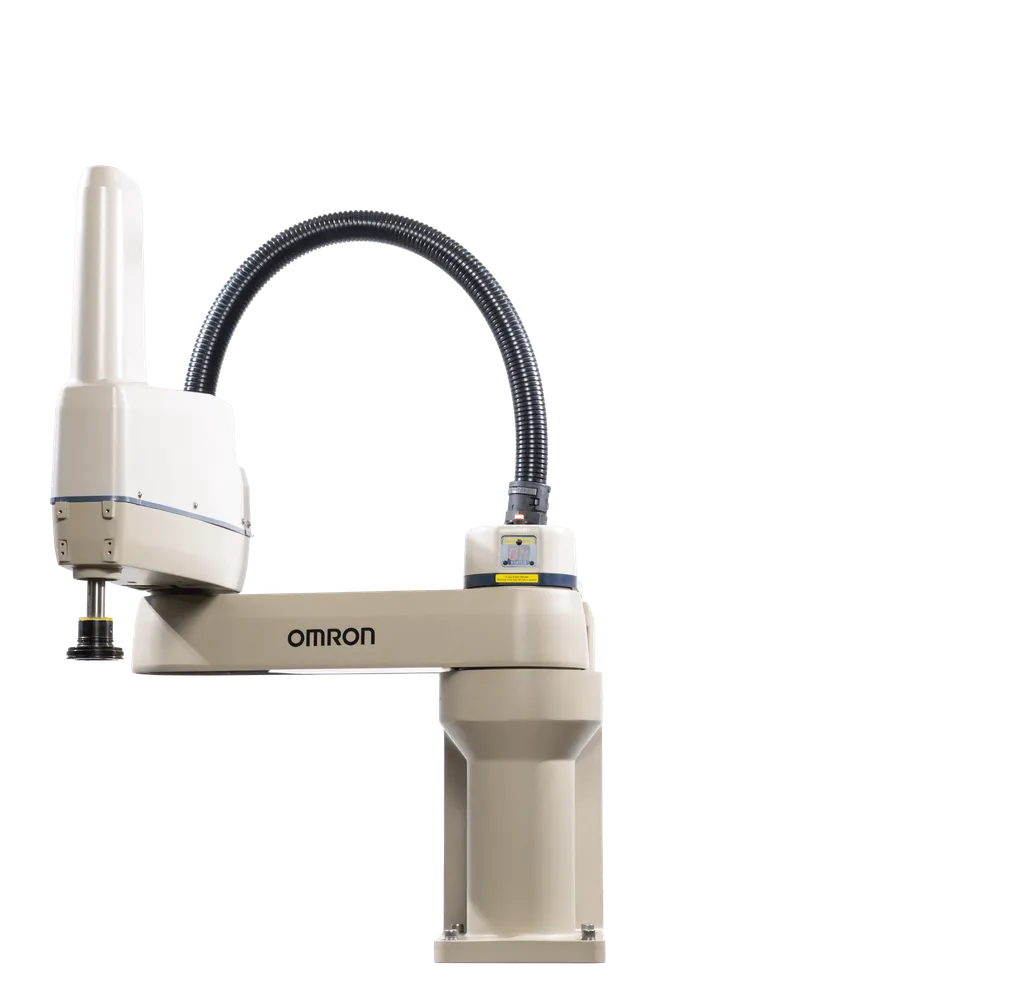
Mount the same 2 kg gripper off-center on two different robots and one of them runs out of margin twice as fast. Of the 339 robots in our database, 115 (33.9%) publish a wrist inertia rating, the spec that caps how far a tool’s center of mass can sit from the flange’s rotation axis before the last joint’s motor and brake can no longer control it. Run the math on all 115 and SCARA robots come out with the tightest margin of any well-populated class: a 2 kg gripper can only swing its center of gravity 41% of the arm’s own reach off-axis before hitting the limit, versus 61% for articulated arms and 63% for cobots. SCARA payloads are not smaller. The wrist just has less rotational room to spend.
What is wrist inertia, and why doesn’t payload cover it?
Rated payload is a straight-line number: how much mass the flange can carry through a trajectory. Wrist inertia (performance.wristInertiaKgm2 in our database) measures something else, the maximum moment of inertia the final rotating axis can spin without exceeding its motor torque or brake-holding limit. A gripper mounted dead-center on the flange contributes almost none of it, because a point mass on the rotation axis has zero moment arm. Push that same gripper’s center of gravity off to one side, on a long finger, an angled bracket, or an asymmetric vacuum cup array, and the moment of inertia grows with the square of the offset distance. Our companion piece on what payload rating doesn’t tell you walks through the underlying J = m x r² relationship and notes a typical light assembly gripper runs 2-3 kg once you count the tooling stack. That is where the 2 kg figure in this analysis comes from: a realistic, fixed baseline gripper mass, applied identically to every robot in the database so the comparison is apples-to-apples regardless of a robot’s own payload class.
Solve that equation for the offset distance instead of the inertia, r = sqrt(J / m), and a published wrist inertia rating turns into a concrete number: how far off-axis a 2 kg tool’s center of gravity can sit before the spec is exceeded. That is the number this piece ranks, across every robot class and every brand that publishes it.
How far can a 2 kg gripper sit off-axis?
Coverage is thin and uneven. Only 115 of 339 robots (33.9%) publish wristInertiaKgm2 at all, and it clusters in three classes: articulated arms (70 robots), cobots (16), and SCARA (14). Palletizer (6), welding (6), painting (2), and delta (1) have too few entries to trust as a class rate, flagged rather than charted as a stable finding.
Expressed as a percentage of each robot’s own reach, so a compact arm and a long-reach arm are compared fairly, here is the median offset margin for a 2 kg tool by type:
performance.wristInertiaKgm2, assuming a fixed 2 kg tool mounted with its center of mass at radius r from the wrist axis, solved from J = m x r². Welding (n=6) and palletizer (n=6) are small samples, flagged rather than treated as stable class rates; painting (n=2) and delta (n=1) are excluded as too thin to chart. Palletizer’s bar is capped visually at 100% (actual median 248.8%) since its wrist is built for a fixed, centered case load, not an off-axis tool.The two classes with enough robots to trust as a real comparison, SCARA at 14 and articulated arms at 70 (with cobots at 16 as a third check), tell a clean story: SCARA’s median margin is 41.3% of its own reach, roughly a third tighter than articulated (60.8%) and cobot (63.2%) arms. Welding robots look tighter still (35.8%), but with only 6 robots in the sample that reads as a niche coincidence, not a class-wide rule, the same caveat we’ve applied to small welding/painting samples in prior posts.
Why does SCARA come out tightest?
The physics explains it. A SCARA arm has exactly one rotational joint at the wrist, the Z-axis twist at the end of an otherwise planar mechanism, and that single joint’s motor has to absorb the entire rotational load on its own. A 6-axis articulated arm or cobot spreads the equivalent job across three wrist joints (J4, J5, J6), each sized for a share of the moment, and the published wrist inertia figure on those arms reflects that distributed capacity. SCARA’s speed and 0.01 mm-class precision, the reason the type dominates high-throughput assembly and pick-and-place, comes from a lighter, simpler wrist stage. That same simplicity is what caps how far a tool’s center of gravity can wander from the rotation axis.
The tightest individual margins in the database, restricted to robots rated at 2 kg payload or more so a 2 kg tool is physically plausible on that arm, back this up directly. Five of the six tightest robots in the whole 339-robot database are SCARA or a SCARA-adjacent form factor:
| Robot | Brand | Type | Payload | Reach | Offset margin (2 kg tool) | % of reach |
|---|---|---|---|---|---|---|
| Omron eCobra 600 | Omron | SCARA | 5.5 kg | 600 mm | 150 mm | 25.0% |
| Omron eCobra 800 | Omron | SCARA | 5.5 kg | 800 mm | 150 mm | 18.8% |
| Inovance IR-S4-40Z15S3 | Inovance | SCARA | 4 kg | 400 mm | 158 mm | 39.5% |
| Siasun SA4A | Siasun | SCARA | 4 kg | 400 mm | 158 mm | 39.5% |
| FANUC SR-3iA | FANUC | SCARA | 3 kg | 400 mm | 173 mm | 43.3% |
| Kawasaki duAro2 | Kawasaki | Cobot | 3 kg | 785 mm | 207 mm | 26.4% |
Source: our analysis of the Industrial Robotics Hub database, robots publishing wrist inertia with a payload rating of 2 kg or more, ranked by offset margin in millimeters.
Notice the two Omron eCobra models: identical wrist inertia rating (0.045 kg·m²), because they share the same wrist hardware, but a different percentage of reach (25.0% vs 18.8%) because the 800 mm variant has more arm to spread that same fixed 150 mm margin over. Absolute margin is a hardware property of the wrist; margin as a percentage of reach is what tells you whether that hardware feels tight or generous on a given arm.
At the other end, the loosest margins in the database belong almost entirely to heavy articulated arms and palletizers built to move large, centered loads rather than fine off-axis tooling:
| Robot | Brand | Type | Payload | Reach | Offset margin (2 kg tool) | % of reach |
|---|---|---|---|---|---|---|
| FANUC M-2000iA/1700L | FANUC | Articulated | 1,700 kg | 3,734 mm | 61.2 m | 1,640% |
| Yaskawa GP600 | Yaskawa | Articulated | 600 kg | 2,942 mm | 16.1 m | 548% |
| Siasun SR500A | Siasun | Articulated | 500 kg | 2,525 mm | 16.0 m | 632% |
| FANUC M-410iB/700 | FANUC | Palletizer | 700 kg | 3,143 mm | 15.7 m | 498% |
| Kawasaki MX350L | Kawasaki | Articulated | 350 kg | 3,018 mm | 14.1 m | 469% |
Source: same dataset, sorted descending by offset margin. These margins are theoretical distances far beyond any real tool geometry, the point is not that you could actually mount a gripper 61 meters off-axis, it is that a 2 kg tool represents such a trivial fraction of what these wrists are built to spin that the inertia limit stops being a practical constraint at all.
Does a heavier tool change the ranking?
We re-ran the same calculation scaling the assumed tool mass to 20% of each robot’s own rated payload instead of a fixed 2 kg, a check against the possibility that 2 kg happens to flatter or penalize one class unfairly. The ranking holds: SCARA’s median margin comes out to 48.7% of reach, still the tightest among the two large-sample classes, against 63.9% for articulated arms and 57.6% for cobots. The gap narrows slightly under this alternate assumption but does not close or reverse, which is a reasonable robustness check that the finding is a real property of SCARA’s single-joint wrist design, not an artifact of picking 2 kg as the example tool mass.
What should you check before mounting an off-center tool?
If your end effector is centered and compact, none of this matters much, most tooling stacks never get close to a wrist inertia limit. But the moment a gripper carries an asymmetric part, a long lead-through nozzle, an angled bracket, or a multi-cup vacuum array with its mass spread away from the flange, the rated payload number stops being the constraint that matters. Ask for the wrist inertia (or “allowable moment of inertia”) spec directly, especially on a SCARA arm, where the single-axis wrist design leaves the least room of any class we can measure. Cross-check it against your own tool’s mass and center-of-gravity offset using the J = m x r² relationship in our payload rating explainer, the same way you would check payload at full reach instead of trusting the headline spec. And treat the 224 of 339 robots that publish nothing on this field as an open question, not a clean bill of health: absence of a wrist inertia rating means you cannot verify the margin at all, not that the margin is generous.
Compare these robots