AVIC's Fengxing-001 Humanoid Debuts for Aviation Manufacturing
AVIC unveiled its 1.8-meter, 80kg Fengxing-001 humanoid at WRC 2026, claiming 2-3 units replace 4-6 workers on a task two state outlets describe differently.
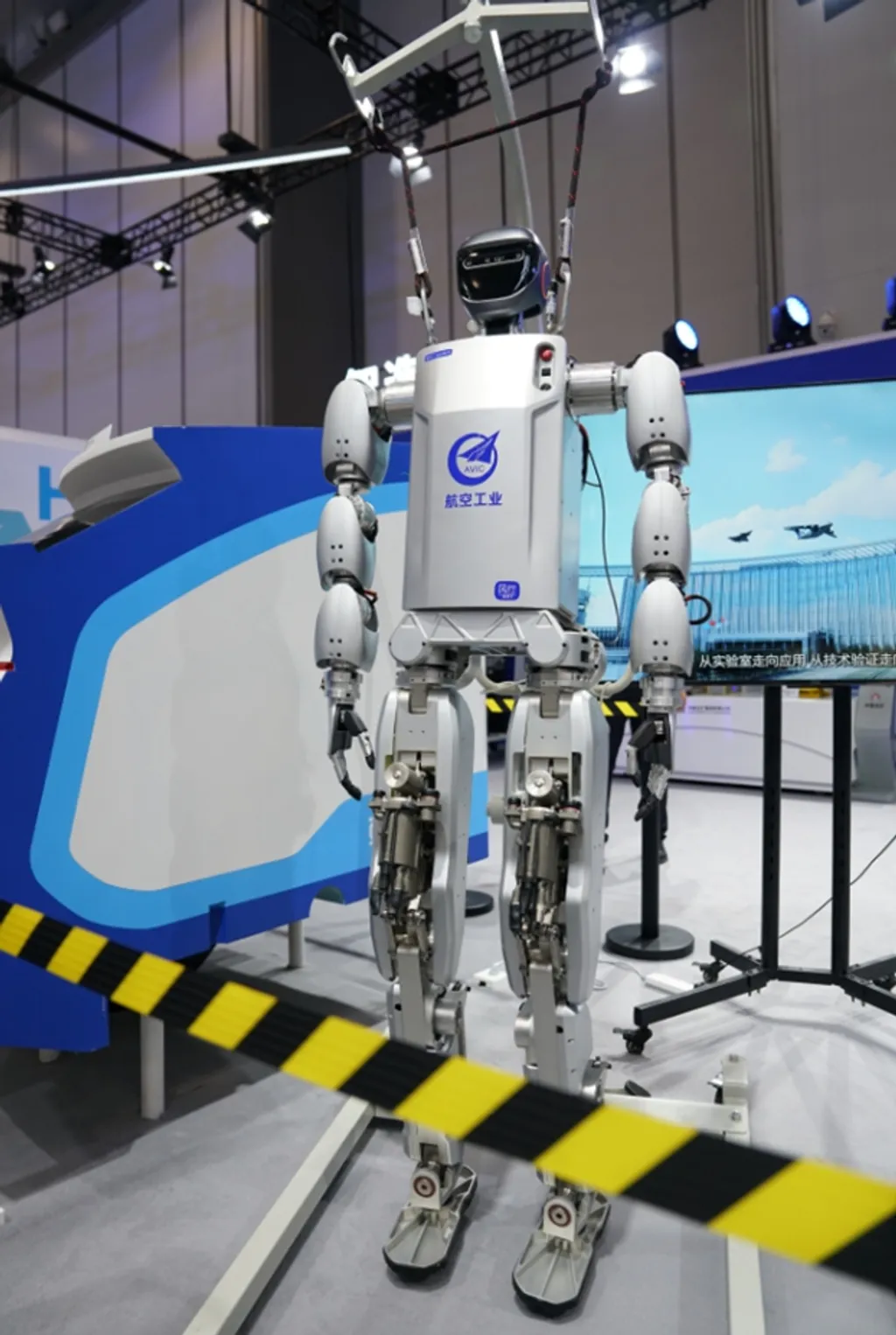
AVIC, the state-owned Aviation Industry Corporation of China, unveiled its Fengxing-001 humanoid robot at WRC 2026 in Beijing this week: 1.8 meters tall, 80 kilograms, able to jump 30 centimeters, jog at three kilometers per hour, walk while carrying 20 kilograms, and handle loads up to 15 kilograms, running on what AVIC describes as an electro-hydraulic hybrid-drive actuation system derived from aviation power-by-wire technology [1][2]. AVIC also claims two or three of the robots could complete a task that would otherwise need four to six workers, though the two state-media outlets that reported the claim describe the underlying task differently, and neither claim has been independently audited.
What Fengxing-001 is built to do
The specs above are confirmed verbatim, in matching language, in both People’s Daily Online and Global Times, the two primary sources for this story [1][2]. AVIC frames the actuation system as an aerospace-derived design choice: electro-hydraulic hybrid drive, rather than the pure electric actuators common on most humanoid robots being shown at WRC 2026, is pitched as delivering more force in a compact package, the same tradeoff aviation engineers make when designing flight-control actuators. Fengxing-001 has reportedly been in development since 2024, meaning this WRC 2026 unveiling caps roughly two years of work rather than representing a from-scratch reveal [1][2].
One number that circulated ahead of this story’s verification, “42 active degrees of freedom,” does not appear in either of the two directly fetched primary sources used here and is omitted rather than guessed at or rounded from another figure.
A missile, or a store?
AVIC’s own labor-replacement claim is where the two primary sources diverge, in a way worth reporting rather than silently resolving. People’s Daily Online’s English translation states that “two or three such robots could complete a missile-loading task that would normally require four to six workers” [1]. Global Times’ English translation of what reads as the same underlying claim and event instead states that “two or three such robots could complete a store-loading task that would normally require four to six workers” [2].
Those are not the same word, and the difference is not trivial: “store,” in aviation and military engineering, is an established term of art for externally carried ordnance or equipment on an aircraft, as in a “stores management system,” which would make “store-loading” a more literal, if narrower-sounding, translation of a Chinese original than the more dramatic “missile-loading.” This desk cannot independently confirm which English rendering is more accurate to AVIC’s original statement, and is not aware of any video, transcript, or third English-language source that resolves the discrepancy. Both readings are reported here, attributed to their respective outlets, rather than one being silently chosen as correct.
Whose claim, and how much weight it should carry
The 2-to-3-robots-for-4-to-6-workers figure is AVIC’s own company claim, relayed through state-media reporting rather than published as the finding of an independent time-and-motion study. No methodology accompanies it in either source: not the baseline task duration, not whether the four-to-six-worker figure reflects a specific real production line or a general estimate, and not whether “loading” here means the full cycle (positioning, securing, verification) or a narrower slice of it. That does not make the claim false, but it means readers should treat it the way trade press treats any single-source vendor productivity figure: a company’s own reported result, not an audited benchmark.
No stated safety certification
Neither source states that Fengxing-001 carries any independent safety certification. That is a meaningful gap to name explicitly rather than let pass by omission, especially set against IRH’s own August 16 coverage of Agility Robotics’ Digit v5, which is the first confirmed integrator of NVIDIA’s Halos for Robotics, built around an NVIDIA IGX Thor compute module with a Functional Safety Island certified to IEC 61508 SIL 3. Fengxing-001 is not reported to carry that certification, or any equivalent under ISO 10218, in either of the two sources reviewed for this story. Given that Fengxing-001 is explicitly pitched for tasks involving heavy loads and aviation hardware, that absence is worth flagging plainly rather than assuming parity with a robot that does carry a named third-party safety certification.
For a look at how a comparable humanoid maker has approached third-party safety certification, see IRH’s coverage of Agility Robotics’ Digit v5 and its NVIDIA Halos for Robotics safety chip.
Sources
- China's homegrown humanoid robot makes debut in aviation manufacturing — People's Daily Online, Aug 21, 2026
- China's first homegrown humanoid robot for aviation manufacturing revealed at WRC 2026 — Global Times, Aug 21, 2026
Frequently asked questions
What is Fengxing-001 and who makes it? +
Fengxing-001 is a humanoid robot built by AVIC, the Aviation Industry Corporation of China, unveiled at the 2026 World Robot Conference in Beijing. It uses an electro-hydraulic hybrid-drive actuation architecture that AVIC has described as derived from aviation power-by-wire systems, and has reportedly been in development since 2024.
What can Fengxing-001 actually do? +
Per specs confirmed verbatim in both People's Daily Online and Global Times, it stands about 1.8 meters tall and weighs 80 kilograms, can jump 30 centimeters, jog at three kilometers per hour, walk while carrying 20 kilograms, and handle loads weighing up to 15 kilograms.
What's the claimed labor-replacement figure, and is it independently verified? +
AVIC's own claim, relayed through both outlets, is that two or three Fengxing-001 units could complete a task that would normally require four to six workers. This is a company claim carried by state media, not an independently audited time-and-motion study, and no methodology for the comparison is disclosed.
Does Fengxing-001 have a safety certification comparable to Agility Digit v5's? +
Not disclosed. Neither People's Daily Online nor Global Times states that Fengxing-001 carries any independent safety certification, such as IEC 61508 SIL 3 (the standard behind NVIDIA's Halos for Robotics, which Agility Robotics' Digit v5 carries) or ISO 10218. Its absence from the reporting should not be read as equivalent to having one.
More news