KUKA's AMP Orchestration Platform Goes Live at Ohio Jeep Plant
KUKA's new AMP software platform is live at KTPO, the Ohio plant building every Jeep Wrangler body since 2006, starting with AMR fleet orchestration.
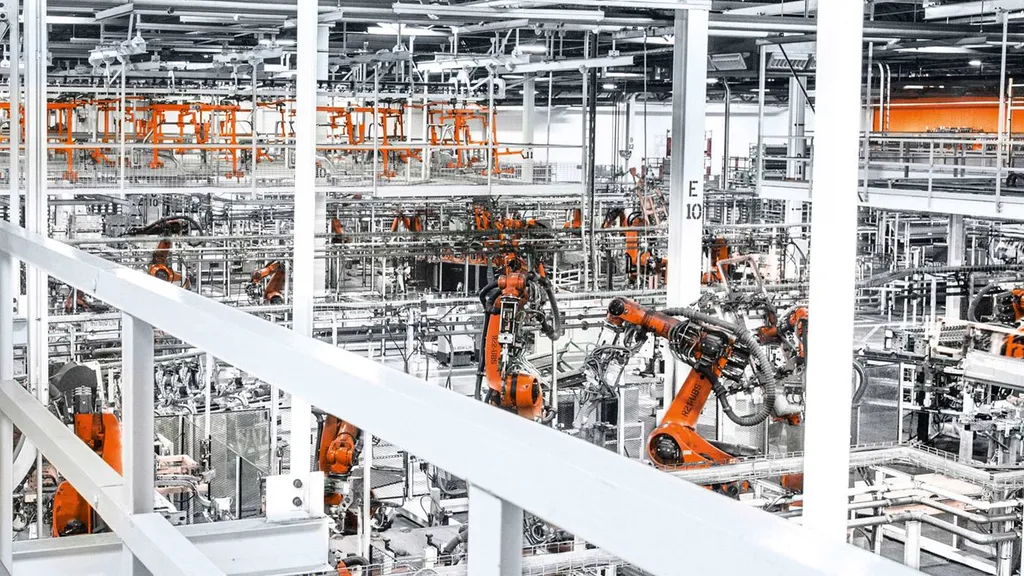
KUKA has switched on its Automation Management Platform (AMP) — an orchestration software layer the company describes as an “open, modular API platform” combining traditional industrial automation with AI — at KUKA Toledo Production Operations (KTPO), the 335,000-square-foot Ohio plant that has built the body-in-white for every Jeep Wrangler sold worldwide since 2006. KUKA’s own press release announcing the deployment is dated July 20, 2026; the initial focus, per KUKA, is coordinating autonomous mobile robots (AMRs) rather than the plant’s 285 fixed robot arms. This is not a same-day event: it is KUKA’s own disclosure, now roughly two weeks old and picked up since by trade press, that AMP is live in a real production environment rather than a pilot or lab demo.
What AMP actually is
AMP is not a robot, a controller, or a new arm — it is a software layer meant to sit above a plant’s existing automation and connected devices, giving customers a way to plug AI-driven applications into production without re-architecting the automation underneath. KUKA frames it as a “shared context layer”: a common data and orchestration plane that lets a manufacturer bring its own AI models to bear on plant operations rather than being locked into whatever intelligence ships baked into each machine. That is a different kind of product than iiQKA.OS2, the KUKA robot-controller operating system this desk covered on July 26 when it became the first robot OS certified to IEC 62443-4-2 Security Level 2 — iiQKA.OS2 runs on individual KR C5-family controllers to operate a robot; AMP sits a level above, orchestrating a fleet and the data flowing between machines. The two are complementary layers of the same software push, not the same product, and KUKA’s KTPO release does not claim AMP depends on or supersedes iiQKA.OS2.
Marc Fleischmann, KUKA’s Chief Software and AI Officer, put the pitch this way in the company’s release: “Traditional automation is expanding and transforming, and the future lies in the combination of precision and reliability of proven industrial automation with the capabilities of AI-powered systems. KUKA AMP provides the foundation for that next step.” He added a framing line KUKA has clearly built the whole announcement around: “Physical AI should not be viewed as a disruption, but as the next evolution of industrial automation.”
Why KTPO, and why AMRs first
KTPO is a working automotive body-shop, not a showcase built for a press release. It has operated since 2006, employs KUKA equipment across 285 robots and more than 60,000 connected devices, and turns out more than 300 vehicle bodies a day — roughly one every two minutes — with over 2 million bodies produced in total. It makes body-in-white for every Jeep Wrangler sold globally since the plant opened, and for the Jeep Gladiator pickup since that model launched in 2019. RoboticsTomorrow’s coverage adds a detail worth taking at face value as KUKA’s own stated rationale rather than independently verified strategy: KUKA reportedly chose KTPO for AMP’s alpha testing specifically because it is “a familiar environment,” letting the platform be evaluated “under realistic conditions” rather than a green-field or synthetic test line.
Starting with AMR coordination, rather than the plant’s much larger population of fixed arms, is a sensible sequencing choice on its face. Automotive body shops have run fixed robot arms on welding and material-handling lines for decades under mature, well-understood safety and controls architectures; AMRs are the newer variable in that environment, moving materials and parts around a floor shared with people, fixed equipment, and other mobile units. Coordinating a growing AMR fleet — routing, traffic management, task allocation, avoiding gridlock at pinch points — is exactly the kind of problem a fleet-orchestration layer is built to solve, and it is a lower-risk place to prove out a new software platform than rewriting how 285 welding and handling arms are already scheduled.
What’s actually new here, and what isn’t
It is worth being precise about which parts of this story are new and which have been true for years. KTPO’s Jeep production history, the plant opening in 2006, the Wrangler body-in-white work running the whole time, the Gladiator starting in 2019, is not news; it is decades of established manufacturing history that KUKA is using as the backdrop for a software announcement. What is new is narrower: KUKA says an orchestration platform it has been building is now running in a live production plant rather than existing only as a roadmap item or pilot, and that its first job is managing AMR traffic rather than the plant’s core welding operations. Neither KUKA’s release nor the trade coverage discloses a specific robot or AMR model running under AMP, a unit count for the AMR fleet, or any before/after performance metric — no throughput change, no downtime reduction, no cycle-time figure. That is a genuine reporting gap, not an omission on this desk’s part: this is a platform-availability announcement, not yet a results announcement.
Sources
- KUKA AMP begins operations at KUKA Toledo Production Operations — KUKA AG, Jul 20, 2026
- KUKA deploys Automation Management Platform for North American automakers — The Robot Report, Jul 31, 2026
- KUKA AMP goes live in North America automotive production — RoboticsTomorrow, Jul 29, 2026
Frequently asked questions
What is KUKA AMP? +
AMP stands for Automation Management Platform. KUKA describes it as an open, modular API platform that orchestrates production infrastructure and combines industrial automation with AI-driven software, rather than a single new robot or controller. KUKA's own materials say the initial deployment focuses on coordinating autonomous mobile robots (AMRs), with a broader goal of becoming a shared software layer across a plant's automation.
Where and when did KUKA AMP actually go live? +
KUKA Toledo Production Operations (KTPO) in Toledo, Ohio. KUKA's press release announcing the deployment is dated July 20, 2026; trade press including The Robot Report and RoboticsTomorrow covered it over the following days (July 29-31). As of this story's publication, that makes it roughly two weeks old, not a same-day event — the news is KUKA's own disclosure that AMP is now running in production, not a fresh announcement made today.
Does this mean KTPO uses a specific new KUKA robot model? +
No specific robot model is named in KUKA's release or in the trade-press coverage reviewed for this story. AMP is a software/orchestration layer, not a robot product, and none of the sources state which arm or AMR hardware it is coordinating. We are not naming a model because none was disclosed.
What are the headline KTPO production numbers, and are they independently audited? +
KUKA states KTPO is a 335,000-square-foot facility running 285 robots and more than 60,000 connected devices, producing over 300 vehicle bodies a day (about one every two minutes) and more than 2 million vehicle bodies total since the plant opened in 2006. These are KUKA's own reported figures from its press materials, not numbers independently audited by a third party or by this desk beyond confirming they appear consistently across KUKA's release and the trade-press coverage that cites it.
More news