Eclipse Automation Gets $6M Federal Grant for Digital Mfg Hub
Ottawa is putting $6 million CAD into Eclipse Automation's new Neuron Centre, part of a $40.5M regional package backing the Cambridge, Ontario integrator's push into digital twins and Apple Vision Pro-based factory simulation.
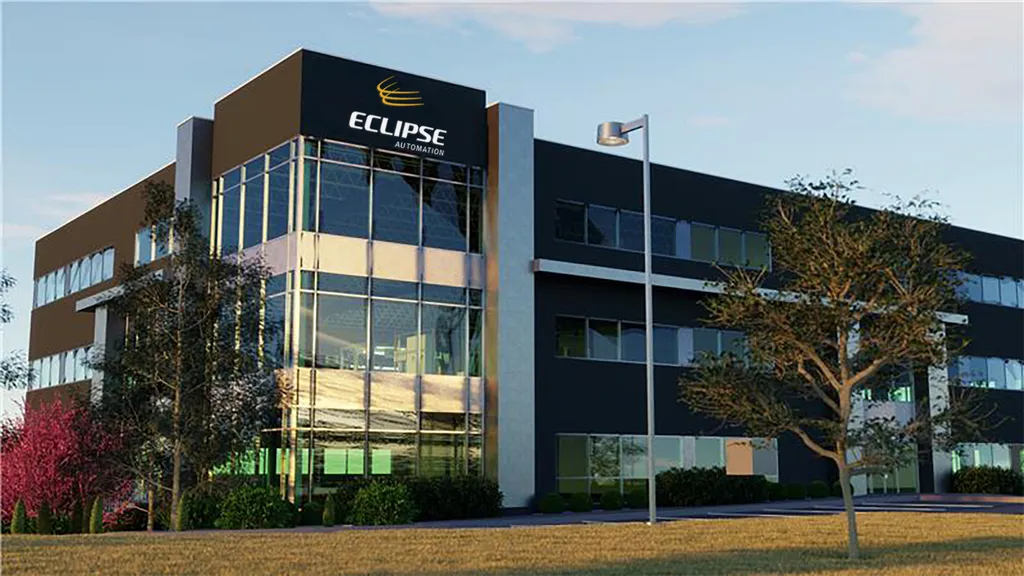
Eclipse Automation, a Cambridge, Ontario systems integrator, is getting $6 million CAD from the federal government to build out a digital-manufacturing innovation hub on its home campus. The money comes from FedDev Ontario, the federal economic-development agency for Southern Ontario, through two programs, the Regional Tariff Response Initiative and the Regional Defence Investment Initiative, and it is not a standalone gift: it is Eclipse’s slice of a nearly $40.5 million package the government announced the same day for businesses and organizations across the Waterloo and Brant region.
What the money is for
Eclipse is not a robot maker. It is an automation systems integrator, the kind of company that designs, builds, and installs custom production lines, tooling, and factory automation for manufacturers rather than selling catalog robot arms, which is why it does not have an entry in Industrial Robotics Hub’s robot database. Founded 25 years ago, the company says it has spent the past three years building out digital-manufacturing capabilities, and the federal funding is meant to accelerate that work rather than start it from scratch.
Concretely, the investment funds two connected things. The first is Project Neuron, described in Eclipse’s announcement as “a company-wide initiative to better connect Eclipse’s information, systems, and expertise,” aimed at improving how the company designs, plans, builds, and delivers automation projects for its own customers. The second is the Neuron Centre, a new headquarters and “Centre of Innovation” going up on Eclipse’s existing Cambridge campus. Per the release, the Neuron Centre will bring Eclipse’s corporate functions together with a Digital Manufacturing Incubator, already home to a startup called Mirsee Robotics, and a new immersive-technology lab.
CEO Steve Mai’s quote in the release frames this narrowly: “This investment will help us use technology to work more efficiently as we continue to solve complex manufacturing challenges.” That is a statement about internal tooling and incubator space, not about a new product launch.
The technology behind the “digital innovation” framing
The headline technology tying this announcement together is Eclipse RealitySync, a product Eclipse launched a month earlier, on June 16, 2026, and demonstrated at Automate 2026 in Chicago. RealitySync combines Gaussian splatting, a computer-vision method for reconstructing a photorealistic, walkable 3D scene from a set of ordinary photos or video, far faster than manual CAD modeling or laser-scan-based digital-twin creation, with Apple Vision Pro headsets. The pitch, per Eclipse’s own June release, is that manufacturers can “step into their future factory before it’s built,” walking proposed production lines and evaluating workflow changes in an immersive environment instead of reviewing static drawings and layouts. CEO Mai’s quote from that launch is more pointed than the funding-announcement quote: “The way manufacturers evaluate automation hasn’t kept pace with the real-world complexity of modern production.”
Eclipse has also shown a related piece of this work publicly before: in October 2025, the company demonstrated cyber-physical systems built on NVIDIA’s Omniverse platform to the Manufacturing Leadership Council, illustrating digital-twin and immersive-simulation environments for production planning. RealitySync appears to be the productized, Vision-Pro-specific extension of that same direction.
Why a $6M grant to an integrator, not a robot maker, is worth tracking
Most industrial-robotics funding news is about robot or component makers raising capital to build hardware. This is different: it is a government betting on a systems integrator’s software and simulation layer, the part of the industry that actually plans and installs automation for end customers, rather than on a new arm or AMR. That is a meaningful distinction for anyone tracking where “digital twin” and immersive-planning tools are headed in practice. Eclipse’s argument, echoed in both its releases, is that simulation and immersive walkthroughs cut the time and risk of committing capital to a factory line before it is built. If Gaussian-splatting-based digital twins genuinely reduce automation project failure rates or planning cycles, other integrators are likely to follow with similar tooling; if RealitySync stays a marketing showcase, it will not be the first Vision-Pro-branded industrial pitch to quietly fade.
It is also a data point on how Ottawa is spending tariff-response and regional-defence money in 2026: not purely on defence-adjacent manufacturing capacity, but on the software and simulation layer that automation integrators say they need to compete globally while keeping engineering work in Canada.
Sources
- Eclipse Automation Receives $6 Million Investment to Bring Digital Innovation to Factory Automation — GlobeNewswire (Eclipse Automation Inc.), Jul 24, 2026
- Eclipse Automation Inc. Receives $6M Investment From FedDev Ontario — Canadian Manufacturing, Jul 24, 2026
- Government of Canada invests nearly $40.5 million in Waterloo and Brant Region businesses and organizations to expand capacity and compete for a more resilient future — Government of Canada / FedDev Ontario, Jul 24, 2026
- Eclipse Automation Unveils Immersive Factory Automation Experience — GlobeNewswire (Eclipse Automation Inc.), Jun 16, 2026
Frequently asked questions
What is Eclipse Automation? +
Eclipse Automation is a 25-year-old factory-automation systems integrator based in Cambridge, Ontario, Canada. It designs and builds custom automation, tooling, and production lines for manufacturers rather than manufacturing its own catalog robots, so it does not appear in Industrial Robotics Hub's robot database.
What will the $6 million actually pay for? +
Per Eclipse's own announcement, the funding accelerates Project Neuron, a company-wide initiative to connect Eclipse's information systems and engineering expertise, and helps build the Neuron Centre, a new headquarters and Centre of Innovation on Eclipse's Cambridge campus that will house a Digital Manufacturing Incubator and an immersive-technology lab.
Is this a one-off grant to a single company? +
No. The $6 million to Eclipse is one piece of a nearly $40.5 million package the federal government announced for Waterloo- and Brant-region businesses and organizations, delivered through FedDev Ontario's Regional Tariff Response Initiative and Regional Defence Investment Initiative, and unveiled by Minister of Artificial Intelligence and Digital Innovation Evan Solomon.
What is Gaussian splatting and why does it matter here? +
Gaussian splatting is a computer-vision technique for reconstructing a photorealistic, navigable 3D scene from ordinary photos or video, faster than traditional CAD modeling or laser scanning. Eclipse uses it inside Eclipse RealitySync, a product it launched in June 2026 that pairs the technique with Apple Vision Pro headsets so manufacturers can walk through a proposed factory layout before it is built, rather than reviewing static drawings.
More news